Saving for retirement is only half the job. The real challenge begins when you need to turn your savings into income—without running out of money or paying unnecessary taxes.
That’s where a smart withdrawal strategy comes in.
The order, timing, and amount you withdraw can significantly impact:
- How long your money lasts
- How much tax you pay
- Your overall financial stability
Let’s break down the best withdrawal strategies in a clear, practical way.
Why Withdrawal Strategy Matters
Without a plan, you could:
- Pay higher taxes than necessary
- Deplete your savings too quickly
- Miss opportunities to optimize income
A good strategy helps you:
Maximize income while minimizing taxes and risk
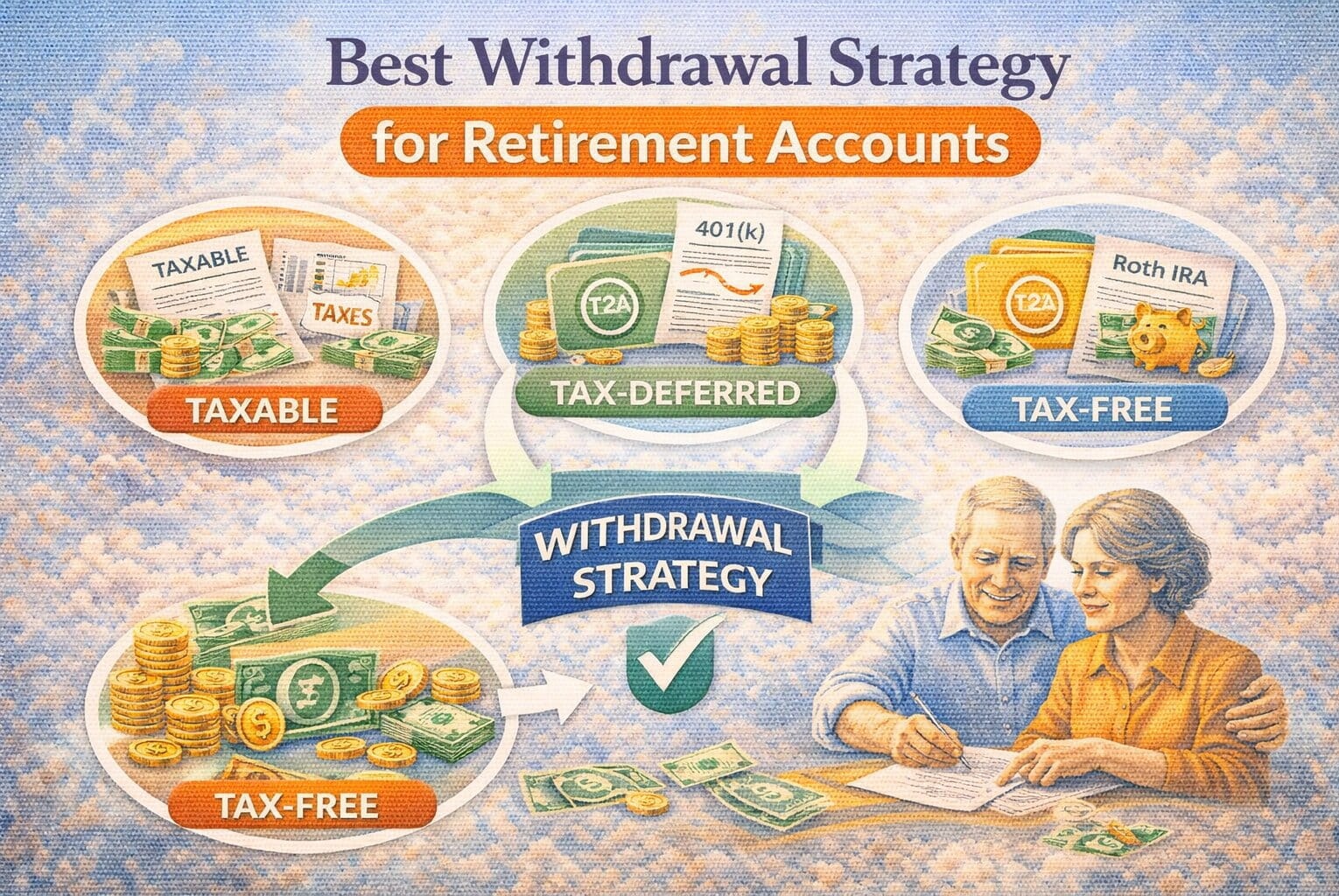
Types of Retirement Accounts (Quick Overview)
Before choosing a strategy, understand how different accounts are taxed:
| Account Type | Tax Treatment |
|---|---|
| Traditional IRA / 401(k) | Taxed as income |
| Roth IRA | Tax-free withdrawals |
| Taxable Accounts | Capital gains tax |
Each account plays a different role in your withdrawal plan.
The Standard Withdrawal Order
A commonly recommended strategy is:
1. Taxable Accounts First
2. Tax-Deferred Accounts (IRA, 401k)
3. Roth Accounts Last
Why this works:
- Taxable accounts → lower tax rates (capital gains)
- Tax-deferred → taxed as income
- Roth → grows tax-free, best used later
Example of Withdrawal Order
Case Study:
- Total retirement income needed: $60,000
Strategy:
- $20,000 from taxable investments
- $25,000 from Traditional IRA
- $15,000 from Roth IRA
Result:
- Balanced tax impact
- Lower overall tax burden
Strategy 1: Follow the 4% Rule
The 4% rule provides a baseline for how much to withdraw.
- Withdraw 4% annually
- Adjust for inflation
Example:
- $1 million portfolio → $40,000/year
To understand this rule:
https://statush.com/retirement-planning/safe-withdrawal-rate-explained
Strategy 2: Use a Flexible Withdrawal Approach
Instead of fixed withdrawals, adjust based on market conditions.
Example:
- Strong market → withdraw slightly more
- Weak market → withdraw less
This helps preserve your portfolio during downturns.
Strategy 3: Tax Bracket Management
Your goal is to stay within a lower tax bracket.
Example:
- Withdraw just enough from IRA to stay in the 12% or 22% bracket
- Use Roth funds to avoid pushing into higher brackets
To reduce taxes:
https://statush.com/retirement-planning/how-to-reduce-taxes-in-retirement
Strategy 4: Plan Around Required Minimum Distributions (RMDs)
Traditional retirement accounts require withdrawals starting in your 70s.
These can:
- Increase taxable income
- Push you into higher tax brackets
Solution:
- Withdraw gradually before RMD age
- Consider Roth conversions
To understand RMDs:
https://statush.com/retirement-planning/traditional-ira-withdrawal-rules-explained
Strategy 5: Coordinate with Social Security
The timing of Social Security affects your withdrawal strategy.
Example:
- Delay Social Security
- Use savings early
This can:
- Increase future benefits
- Reduce early taxable income
To plan timing:
https://statush.com/retirement-planning/when-should-you-start-social-security
Strategy 6: Combine Income Sources
A strong withdrawal plan includes multiple income streams:
- Social Security
- Investment withdrawals
- Passive income
Example:
- Social Security → $25,000
- Withdrawals → $30,000
- Dividends → $10,000
Total: $65,000
To explore income strategies:
https://statush.com/retirement-planning/retirement-income-planning-strategies
Strategy 7: Use Roth Accounts Strategically
Roth accounts provide tax-free income.
Best use:
- During high-tax years
- To avoid moving into higher tax brackets
To understand Roth strategies:
https://statush.com/retirement-planning/roth-conversion-strategy-explained
Real-World Example
Case Study:
- Portfolio: $1.2 million
- Income need: $70,000
Strategy:
- $25,000 Social Security
- $30,000 IRA withdrawals
- $15,000 Roth withdrawals
Result:
- Balanced taxes
- Stable income
Common Mistakes to Avoid
- Withdrawing too much early
- Ignoring tax implications
- Not diversifying income sources
- Taking large lump sums unnecessarily
For more pitfalls:
https://statush.com/retirement-planning/retirement-mistakes-to-avoid
How It Fits Into Your Retirement Plan
Your withdrawal strategy connects:
- Savings
- Investments
- Taxes
- Income
Without a plan, even large savings can be inefficiently used.
To align with your savings goals:
https://statush.com/retirement-planning/how-much-should-you-save-for-retirement-by-age
Practical Tips
- Plan withdrawals annually
- Use a mix of account types
- Adjust based on market performance
- Keep flexibility in your strategy
- Review regularly
Final Thoughts
The best withdrawal strategy isn’t just about how much you take—it’s about when, where, and how you take it.
A well-planned approach helps:
- Reduce taxes
- Extend your savings
- Maintain a stable income
Retirement isn’t just about having money—it’s about using it wisely.
And with the right withdrawal strategy, you can turn your savings into a reliable income that lasts for decades.