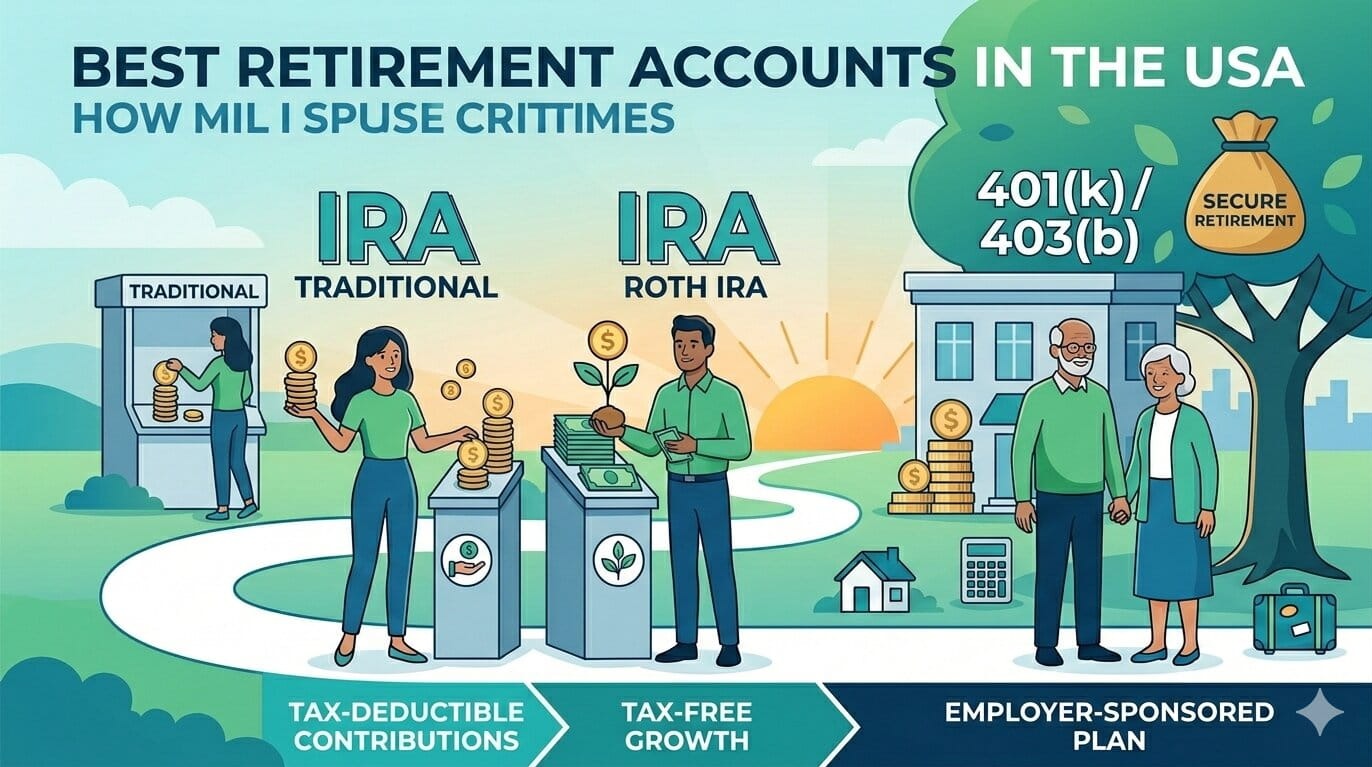
Choosing the right retirement account in the U.S. can feel confusing at first. You’ll hear terms like 401(k), IRA, Roth, traditional—it’s a lot. But once you break it down, each account has a clear purpose.
The real goal isn’t just picking one account—it’s using the right combination to reduce taxes, grow your money, and create reliable income later.
Let’s walk through the best retirement accounts in the USA, how they work, and how to use them effectively.
Why Retirement Accounts Matter
Retirement accounts are powerful because they offer tax advantages. That means you either:
- Pay less tax now (Traditional accounts), or
- Pay less tax later (Roth accounts)
Over decades, these tax benefits can add hundreds of thousands of dollars to your savings.
Overview of the Best Retirement Accounts
Here’s a simple comparison to understand your options:
| Account Type | Tax Benefit Now | Tax Benefit Later | Best For |
|---|---|---|---|
| 401(k) | Yes | No | Employees with employer plans |
| Roth 401(k) | No | Yes | Higher earners expecting future growth |
| Traditional IRA | Yes | No | Tax deduction seekers |
| Roth IRA | No | Yes | Long-term tax-free growth |
| SEP IRA | Yes | No | Self-employed individuals |
| Solo 401(k) | Yes | Yes option | High-income freelancers |
Each account plays a different role depending on your income, job type, and tax strategy.
401(k): The Foundation for Most Americans
A 401(k) is often the first and most important retirement account for employees.
It’s offered by employers, and many companies provide a matching contribution—essentially free money.
Example:
If you earn $70,000 and contribute 6%, and your employer matches 6%, you’re effectively saving 12% of your salary.
That’s a huge boost early on.
Why it’s powerful:
- Contributions reduce your taxable income
- Automatic payroll deductions make saving easy
- High contribution limits compared to IRAs
Practical tips:
- Always contribute enough to get the full employer match
- Increase contributions with every salary raise
- Avoid early withdrawals unless absolutely necessary
Roth 401(k): Tax-Free Growth Later
A Roth 401(k) works similarly to a traditional 401(k), but with a key difference:
You pay taxes now, but withdrawals in retirement are tax-free.
This is especially useful if you expect to be in a higher tax bracket later.
Example:
David contributes $10,000 annually to a Roth 401(k). Over 30 years, it grows to $800,000. When he withdraws it in retirement, he pays zero tax on that amount.
That’s a major advantage.
Traditional IRA: Flexible Tax Deduction
A Traditional IRA allows you to contribute independently of your employer.
Your contributions may be tax-deductible, which lowers your taxable income today.
Example:
If you earn $60,000 and contribute $6,500 to a Traditional IRA, you might only be taxed on $53,500.
However, withdrawals in retirement are taxed as income.
To understand withdrawal rules in detail, check this guide:
https://statush.com/retirement-planning/traditional-ira-withdrawal-rules-explained
Best for:
- People wanting immediate tax savings
- Those without employer retirement plans
Roth IRA: One of the Best Long-Term Tools
The Roth IRA is often considered one of the most powerful retirement accounts.
You contribute after-tax money, but your investments grow tax-free—and withdrawals in retirement are completely tax-free.
Example:
Emily invests $500/month into a Roth IRA starting at 25. By 65, she could have over $1 million—and none of it is taxed when withdrawn.
That’s hard to beat.
To understand how contributions work, read:
https://statush.com/retirement-planning/how-roth-ira-contributions-work
Why it stands out:
- Tax-free growth
- No required minimum distributions (RMDs)
- Great for younger investors
SEP IRA: For Self-Employed Professionals
If you’re self-employed or run a small business, a SEP IRA is a strong option.
It allows significantly higher contributions than a traditional IRA.
Example:
A freelancer earning $100,000 could contribute up to $25,000 (approx.), depending on IRS limits.
Advantages:
- Easy to set up
- High contribution limits
- Tax-deductible contributions
Solo 401(k): Maximum Flexibility for Entrepreneurs
The Solo 401(k) is ideal for self-employed individuals with no employees.
It combines the benefits of both employee and employer contributions.
Example:
You can contribute as:
- Employee (salary deferral)
- Employer (profit-sharing)
This allows very high total contributions annually.
Why it’s powerful:
- Higher limits than SEP IRA in many cases
- Option for Roth contributions
- Greater control over investments
How to Choose the Right Account
The best retirement strategy usually involves layering accounts, not choosing just one.
Here’s a simple approach:
- Start with a 401(k) (get employer match)
- Add a Roth IRA for tax-free growth
- Increase 401(k) contributions
- Use additional accounts if self-employed
This combination balances tax savings today and tax-free income later.
Real-World Strategy Example
Let’s look at a practical scenario:
Mark, age 35, earns $90,000:
- Contributes 10% to 401(k) → $9,000/year
- Employer adds 5% → $4,500
- Invests $6,500 in Roth IRA
Total annual investment: $19,500
Over time, this diversified approach gives him:
- Tax savings now (401k)
- Tax-free income later (Roth IRA)
That balance is what strong retirement planning looks like.
Common Mistakes to Avoid
Even with the right accounts, mistakes can slow your progress:
- Not taking employer match
- Delaying investing
- Withdrawing early and paying penalties
- Ignoring tax diversification
For a deeper look, check:
https://statush.com/retirement-planning/retirement-mistakes-to-avoid
How These Accounts Fit Into Your Bigger Plan
Retirement accounts are just one part of the equation.
You also need:
- A withdrawal strategy
- A plan for Social Security
- Protection against inflation
To understand income planning, read:
https://statush.com/retirement-planning/retirement-income-planning-strategies
And for inflation impact:
https://statush.com/retirement-planning/how-inflation-impacts-retirement-planning
Final Thoughts
The best retirement account isn’t about popularity—it’s about fit.
- 401(k) builds your foundation
- Roth IRA creates tax-free income
- IRAs add flexibility
- Self-employed plans maximize contributions
Used together, these accounts can create a powerful, tax-efficient retirement strategy.
If you’re just getting started, don’t overcomplicate it. Begin with one account, stay consistent, and expand as your income grows.
And if you want a deeper breakdown of how much you should actually be saving at each stage, start here:
https://statush.com/retirement-planning/how-much-should-you-save-for-retirement-by-age