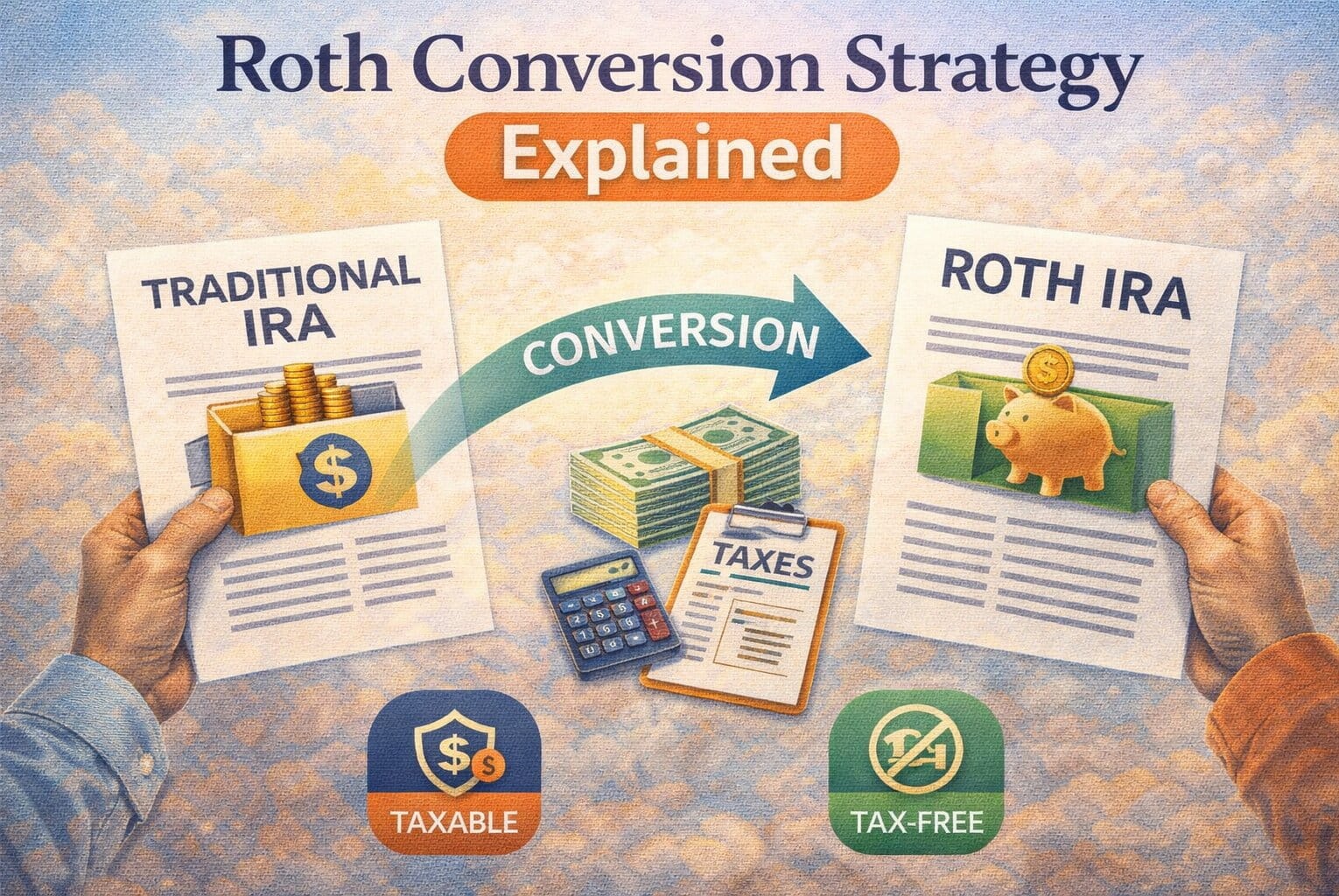
A Roth conversion is one of the most powerful—and often misunderstood—strategies in retirement planning.
At its core, it’s simple:
You move money from a tax-deferred account (like a Traditional IRA) into a Roth IRA—and pay taxes now instead of later.
But the real value comes from when and how you do it. Done correctly, a Roth conversion can reduce lifetime taxes, increase flexibility, and create tax-free income in retirement.
Let’s break it down step by step.
What Is a Roth Conversion?
A Roth conversion is the process of transferring funds from:
- Traditional IRA → Roth IRA
- 401(k) → Roth IRA (via rollover)
When you convert:
- You pay income tax on the amount converted
- Future growth becomes tax-free
Why Consider a Roth Conversion?
The main goal is to pay taxes at a lower rate now to avoid higher taxes later.
Benefits include:
- Tax-free withdrawals in retirement
- No Required Minimum Distributions (RMDs)
- Greater flexibility in income planning
Simple Example
Case Study:
- You convert $50,000 from a Traditional IRA
- You’re in the 22% tax bracket
Taxes owed:
- ~$11,000
But later:
- That $50,000 grows to $150,000
- You withdraw it tax-free
That’s the long-term advantage.
When Does a Roth Conversion Make Sense?
Timing is everything.
A Roth conversion works best when:
1. You’re in a Lower Tax Bracket Today
Example:
- Early retirement years before Social Security starts
- Temporary drop in income
2. You Expect Higher Taxes Later
This could happen if:
- Tax rates increase
- Your retirement income is high
3. You Want Tax-Free Income in Retirement
Having a Roth account gives you flexibility:
- Withdraw without increasing taxable income
- Control your tax bracket
Roth Conversion vs Regular Contributions
| Feature | Roth Contribution | Roth Conversion |
|---|---|---|
| Source of Funds | New income | Existing retirement funds |
| Taxes Paid | Already paid | Paid at conversion |
| Income Limits | Yes | No |
| Purpose | Ongoing saving | Tax strategy |
Both are useful—but conversions are more strategic.
To understand contributions:
https://statush.com/retirement-planning/how-roth-ira-contributions-work
Step-by-Step Roth Conversion Process
- Choose how much to convert
- Transfer funds to a Roth IRA
- Pay taxes on the converted amount
- Invest the funds for growth
That’s it—but the strategy lies in how much and when.
Real-World Strategy Example
Case Study:
- Age: 60
- Retired but not yet claiming Social Security
- Low taxable income
Strategy:
- Convert $40,000/year from Traditional IRA
- Stay within a lower tax bracket
Over 5–7 years:
- Significant portion moved to Roth
- Future taxes reduced
Partial Conversions: The Smart Approach
Instead of converting everything at once, many people use partial conversions.
Why?
- Avoid jumping into a higher tax bracket
- Spread tax impact over multiple years
Example:
- Convert $30,000/year instead of $150,000 at once
This keeps taxes manageable.
Tax Impact of Roth Conversions
The biggest downside is immediate taxation.
Important considerations:
- Conversion amount is added to your income
- Can push you into a higher tax bracket
- May affect Medicare premiums
To manage taxes effectively:
https://statush.com/retirement-planning/how-to-reduce-taxes-in-retirement
Roth Conversion and RMDs
Traditional IRAs require Required Minimum Distributions (RMDs).
Roth IRAs:
- Do NOT require RMDs
This makes Roth conversions useful for:
- Reducing future mandatory withdrawals
- Controlling taxable income
To understand withdrawal rules:
https://statush.com/retirement-planning/traditional-ira-withdrawal-rules-explained
How Roth Conversion Fits Into Your Retirement Plan
A Roth conversion is not a standalone strategy—it works best when combined with:
- Withdrawal planning
- Tax strategy
- Income planning
Example:
- Use Traditional IRA for early withdrawals
- Use Roth IRA later for tax-free income
To build a full strategy:
https://statush.com/retirement-planning/retirement-income-planning-strategies
Common Mistakes to Avoid
- Converting too much at once
- Ignoring tax brackets
- Not planning for tax payments
- Converting without a long-term strategy
For more pitfalls:
https://statush.com/retirement-planning/retirement-mistakes-to-avoid
When Roth Conversion May Not Be Ideal
It may not make sense if:
- You’re already in a high tax bracket
- You need the money soon
- You can’t afford the tax bill
Timing and planning are critical.
How It Helps Long-Term
A well-executed Roth conversion can:
- Reduce lifetime taxes
- Provide tax-free income
- Increase financial flexibility
- Simplify estate planning
Final Thoughts
A Roth conversion is a powerful tool—but only when used strategically.
It’s not about avoiding taxes—it’s about choosing when to pay them.
Paying taxes at the right time can save you significantly over the long run and give you more control over your retirement income.
If used correctly, a Roth conversion can turn a tax-deferred future into a tax-free one—and that’s a major advantage in retirement planning.
To align this strategy with your overall savings goals, start here:
https://statush.com/retirement-planning/how-much-should-you-save-for-retirement-by-age