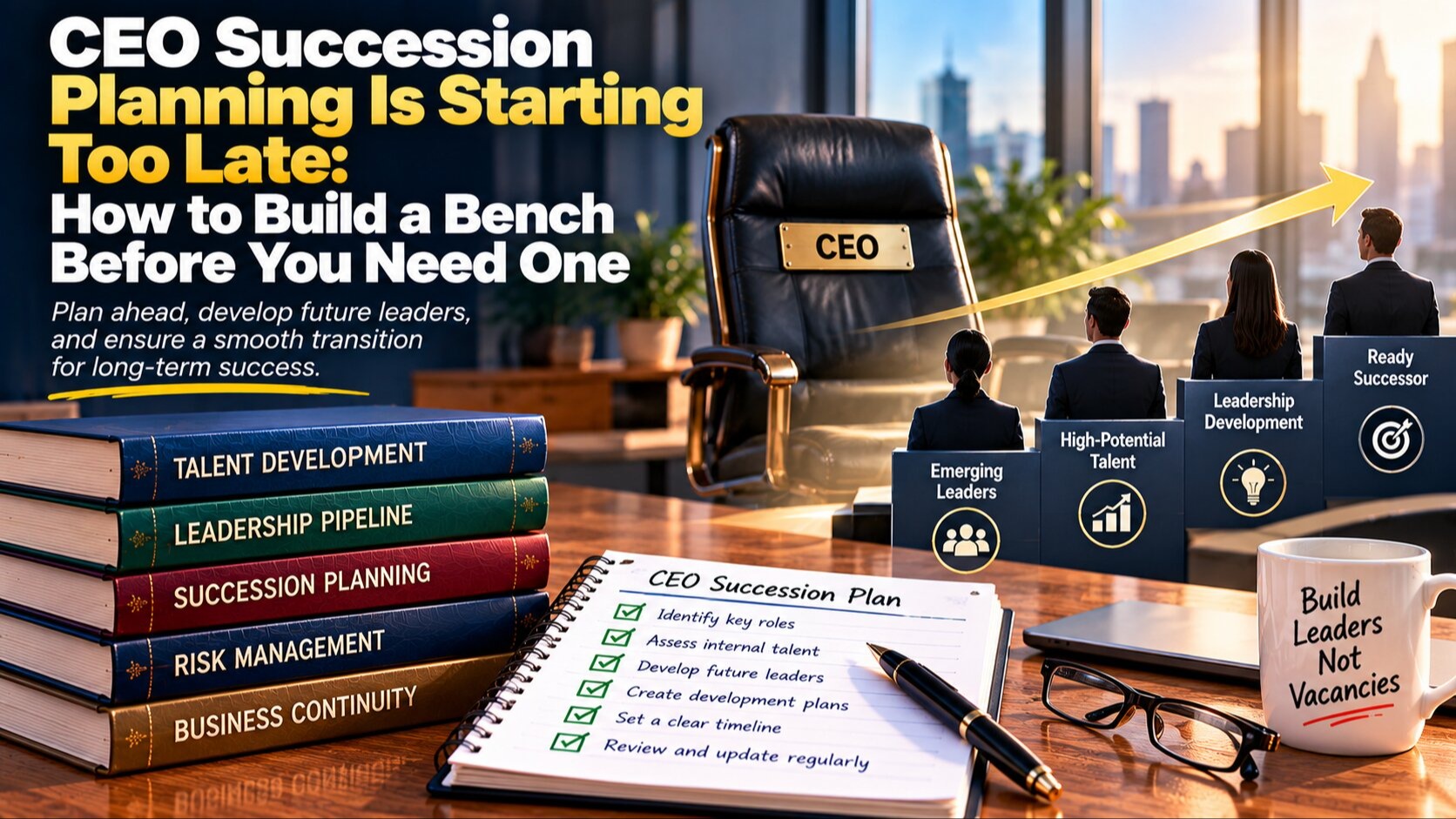
Korn Ferry's 2026 CEO & Board Survey, released July 21 and based on interviews with 250 board directors and chief executives across the US, UK, and wider Europe conducted that April, found that half of boards — 50% — say succession planning for their most recent CEO transition started too late. Only 15% of board members said their organization did a "very strong" job preparing its first-time CEO for the role, and just 10% said the new chief executive was already fully connected to and trusted by the board. Confidence in handling AI and emerging technology risk was thin on both sides of the table: 49% of first-time CEOs said they felt confident managing it, and only 30% of board members agreed.
Those numbers describe a governance problem, but the underlying issue touches far more people than the handful who sit in boardrooms. Every organization, from a public company to a 40-person family business, eventually replaces its top leader, and the gap between "we should really think about that" and "we have a plan" is exactly where costly, chaotic transitions come from. This guide walks through how to build a real succession plan — whether you're a board member, an HR leader, a CEO planning your own exit, or a manager who wants to be ready when the seat opens up.
What the Korn Ferry Survey Actually Found
The survey drew respondents from seven industries and organizations ranging from 1,000 to more than 20,000 employees, with 60% based in the US, 20% in the UK, and 20% across the rest of Europe — a genuinely cross-market sample rather than a US-only snapshot. The headline finding is a timing problem: half of boards admit they started too late. But the data underneath that number is more useful, because it shows where the process typically breaks down.
| What Korn Ferry Found | The Number | What It Means for You |
|---|---|---|
| Succession planning started too late | 50% of boards | Waiting for a resignation letter before you start is now the norm, not the exception — and it shows in transition quality |
| Board did a "very strong" job preparing the first-time CEO | Only 15% | Even organizations that plan ahead often under-invest in onboarding once the successor is named |
| New CEO fully connected to and trusted by the board | Just 10% | Trust isn't automatic with the title — it has to be built deliberately in the first months |
| First-time CEOs confident managing AI/tech risk | 49% (vs. 30% of board members) | Successors need structured exposure to emerging-tech governance before they're in the chair, not after |
Read together, these numbers point to the same root cause: succession is treated as an event instead of a process. A plan that only starts once a CEO announces their departure is, by definition, reactive. The organizations that avoid the chaos are the ones that treat succession as ongoing talent development that happens to produce a ready successor when the time comes.
Why Succession Planning Starts Too Late
Boards and founders rarely skip succession planning on purpose. It slips for a handful of predictable reasons: a sitting CEO who is reluctant to name a potential replacement because it can look like a countdown clock on their own tenure; a board that assumes there's more runway than there actually is, especially when the CEO is performing well; and a genuine shortage of ready internal candidates once anyone actually looks. Identifying and developing an internal successor is a multi-year undertaking, not a quarter's worth of work, which is exactly why starting "when we need it" is already too late. The Korn Ferry data suggests a fourth reason worth naming directly: AI and technology risk has moved the goalposts. Boards are now evaluating candidates against a skill set — governing AI adoption, data risk, and emerging technology — that didn't fully exist as a board-level competency a few years ago, and neither side feels fully ready to evaluate or occupy it.
How to Build a Succession Plan, Step by Step
A working succession plan has the same basic architecture whether it's for a 15,000-person multinational or a founder-led business with a dozen employees. The scale changes; the sequence doesn't.
- Form a small succession committee. This should include the board chair or a lead independent director (or, in a private company, an owner plus one or two trusted advisors), the current CEO, and the head of HR. Give it explicit authority to own the process, not just discuss it.
- Write down what the role actually requires next. Don't just recycle the current CEO's job description. Define the strategic priorities for the next five years — AI adoption, market expansion, a turnaround, whatever applies — and translate those into the leadership traits and experience a successor will need.
- Map internal candidates against that criteria honestly. For each plausible internal successor, note their current readiness (ready now, ready in 2 years, ready in 5), the specific gaps holding them back, and a development plan to close those gaps — a stretch assignment, a P&L role they haven't held, board exposure they're missing.
- Keep an external option live, even if you expect to promote from within. A benchmark slate of two or three outside candidates, refreshed annually, keeps the internal process honest and gives the board a real comparison rather than a rubber stamp.
- Build the transition and communication plan before you need it. Decide in advance how the change will be announced to employees, investors, and customers, and who briefs whom in what order. A plan built under pressure, in the days after a sudden departure, is where the worst missteps happen.
- Revisit the plan every year, not just when a departure looks imminent. Treat it as a standing board agenda item, the same way you'd treat financial audits or risk reviews.
How to Identify and Develop Internal Candidates
The organizations Korn Ferry's data implicitly praises — the ones getting ahead of the 50% who start too late — tend to run a formal high-potential review at least once a year, separate from routine performance reviews. That review should ask a different question than "is this person doing their current job well?" It should ask "could this person do a job two or three levels up, and what's missing if not?" Rotational assignments matter more here than almost anything else: a finance leader being groomed for the top job benefits enormously from time running an operating business unit, just as an operations leader benefits from exposure to investor relations and the board itself. Board exposure specifically is worth calling out, since Korn Ferry's own trust numbers suggest it's underused: inviting a rising leader to present to the board, or to sit in on select sessions, does more to build the relationship a future CEO will need than almost any training program.
The First 100 Days: Setting a New Leader Up to Succeed
Naming a successor is not the finish line; it's the start of the highest-risk period in the entire process. The instinct for a new CEO or senior leader is to move fast and make a visible mark early. The better-documented pattern is closer to the opposite: spend the first phase genuinely learning the organization, its people, and its constraints before making irreversible calls. A useful way to sequence it is in phases rather than a single 100-day sprint: an initial preparation and listening phase, a phase for framing strategy once the picture is clear, a phase for a small number of high-conviction decisions, and only then a phase focused on institutionalizing the new leader as a trusted, installed presence rather than "the new person." Pairing a first-time CEO or senior leader with an executive coach through this stretch, and giving them a defined structure for early check-ins with the board, directly addresses the trust and connection gaps the Korn Ferry survey found — problems that mostly stem from ambiguity about what "doing well" looks like in the early months.
Common Mistakes to Avoid
- Treating the successor's name as the whole plan. Naming someone without a development timeline, a transition sequence, and a communication plan just moves the risk later instead of removing it.
- Letting the sitting leader control the process alone. A CEO evaluating their own potential successors, with no independent board or committee oversight, tends to favor candidates who won't challenge their legacy rather than the ones best suited for what's next.
- Skipping the external benchmark. Without outside comparison, internal candidates get graded against each other rather than against the market, which quietly lowers the bar.
- Under-investing in the first year after the transition. Only 15% of boards in the survey called their onboarding "very strong" — a sign that most organizations spend heavily to select a successor and then leave them to sink or swim.
- Ignoring emerging-technology governance in the criteria. With confidence on AI and tech risk sitting at 49% among new CEOs and 30% among board members, this can no longer be treated as a specialist concern handled by someone else.
Who Should Be Driving This
In public and larger private companies, succession is formally the board's responsibility, typically delegated to a nominating and governance committee working closely with the CEO and chief human resources officer. In smaller and founder-led businesses across the US, UK, Canada, Australia, and Western Europe, there's often no formal board with that mandate, which is precisely why the plan tends not to exist at all. If you're a founder or owner without a governance structure, the fix is simple even if the conversation is uncomfortable: appoint one or two trusted advisors, an accountant, a non-executive director, or a peer founder, and give them explicit permission to push you on the question every year. The mechanism matters less than the discipline of revisiting it on a fixed schedule rather than waiting for a crisis to force the issue.
Practical Tips If You're the One Being Groomed
If you're a manager or executive who suspects — or hopes — you're on a succession track, you don't have to wait passively for the organization to formalize a plan around you.
- Ask directly, in a performance or development conversation, whether you're viewed as a potential successor for a specific role, and if so, what capability gaps stand between you and "ready now."
- Volunteer for the kind of rotational or cross-functional assignment that broadens your profile, particularly anything involving P&L ownership, investor or board exposure, or technology governance.
- Build relationships with board members or senior stakeholders before you need their trust, not after you're announced in the role.
- If your organization has no formal process at all, treat that as useful information: it tells you the timeline is uncertain and that you should keep building an external network and options in parallel.
The gap Korn Ferry measured isn't really about boards being careless. It's about succession competing for attention against every other urgent item on a board or founder's agenda — and consistently losing, right up until it's the only thing that matters.
Related Articles
- CEO Turnover Just Hit a Nine-Year Low. Boards Are Making a Riskier Bet Than Ever
- CFO Turnover Just Hit a Post-Pandemic High. Here's What It Signals About Leadership Teams
- Only 42% of Managers Feel Ready to Lead: How to Close Your Own Leadership Readiness Gap
- How to Close the Leadership Readiness Gap: A Manager's Guide to AI Anxiety, Layoffs, and Hard Conversations