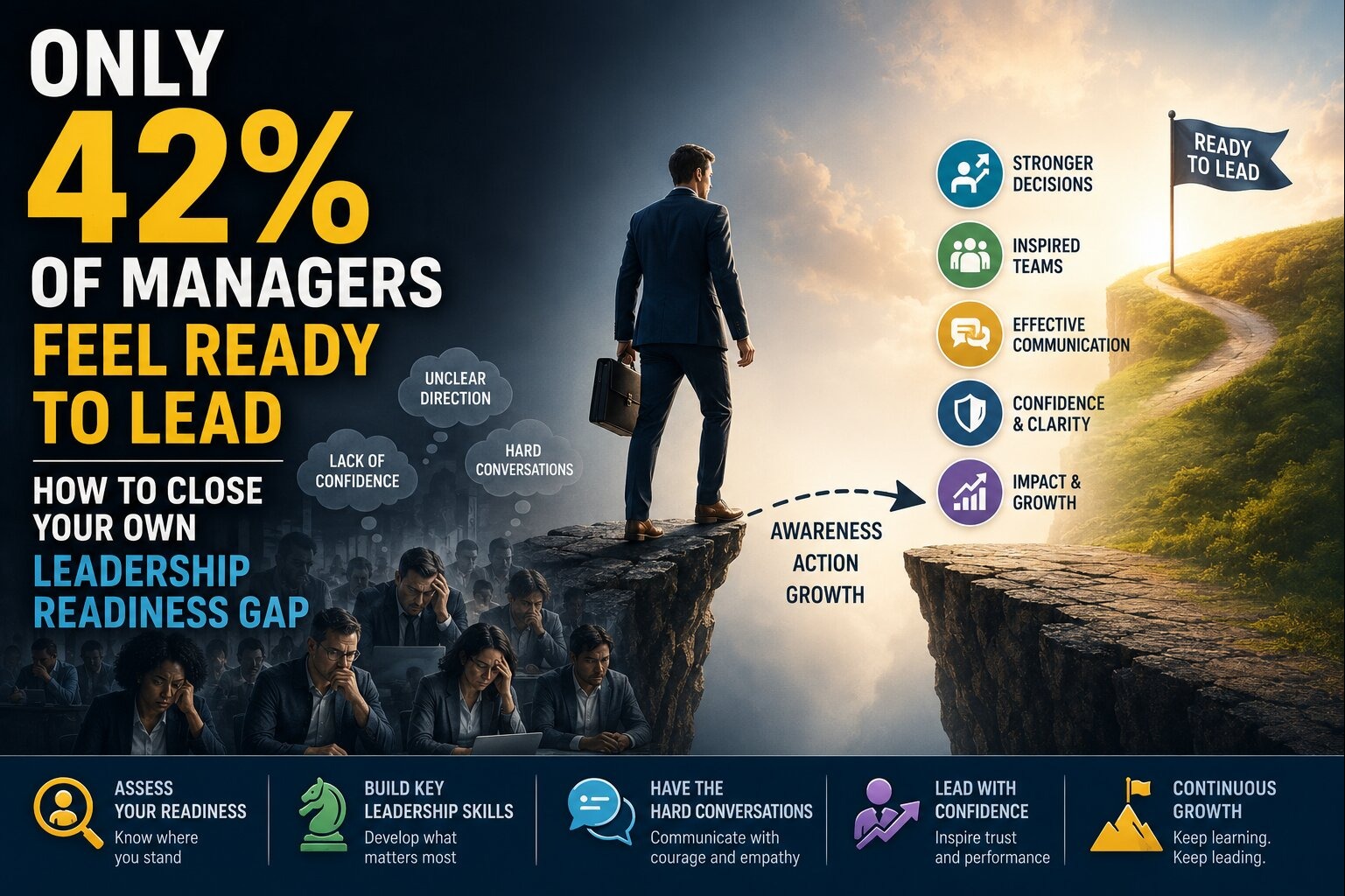
A new Careerminds report released August 4, 2026, surveyed 595 US HR professionals and 547 US people managers and found something worth sitting with: 98% of managers and 97% of HR professionals say managers are ready to lead through the next wave of workplace change. But when the same researchers asked about specific skills — leading through AI adoption, handling layoffs, managing organizational change, having hard conversations — readiness collapses. Only 42% of senior and middle managers describe themselves as "very ready," compared to 66% of C-suite managers. Just 41% of managers say they've received sufficient preparation for difficult workplace conversations, even though 97% of HR professionals believe that training is being provided.
That gap between what managers believe about leadership in the abstract and what they can actually do when a specific, hard situation lands on their desk is called the leadership readiness gap, and if you manage people, it almost certainly applies to you whether you've noticed it yet or not. The good news is that a readiness gap is fixable with deliberate, unglamorous work, not a personality overhaul. Here's how to find yours and close it.
What the Readiness Gap Looks Like in Numbers
The Careerminds data is useful because it doesn't just say "managers need more training," it shows exactly where confidence and preparation diverge. The further down the org chart you go, the wider the gap gets, and the areas where managers feel least prepared are the areas where they're most likely to be tested this year.
| Measure | What the Report Found | Why It Matters to You |
|---|---|---|
| Overall confidence | 98% of managers, 97% of HR say managers are "ready" in general terms | Broad confidence hides specific gaps — don't assume you're covered because you feel fine day-to-day |
| Readiness by level | 66% of C-suite managers feel "very ready" vs. 42% of senior/middle managers | If you're a frontline or mid-level manager, the data says you're statistically less prepared, not less capable — the gap is structural, not personal |
| AI impact | Only about 35% of managers say AI has made their role significantly easier | Most managers are absorbing new AI-oversight work without a corresponding drop in their existing workload |
| Difficult conversations | 41% of managers feel sufficiently prepared, vs. 97% of HR who think training is adequate | Don't wait for HR to notice this gap — from your seat, it's invisible to them until it fails |
Why This Gap Exists Right Now
Three things are converging at once. First, AI adoption inside companies has moved faster than manager training budgets, so managers are being asked to validate AI-generated work, decide when to override it, and coach their teams through new tools with little formal guidance. Second, restructuring and layoffs haven't slowed down in 2026, which means more managers are delivering news they were never taught how to deliver. Third, HR departments genuinely believe they're providing adequate support — the Careerminds data shows 97% of HR professionals think managers get sufficient training for hard conversations — but the managers living through those conversations disagree by a wide margin. That disconnect means you likely can't wait for a training rollout to fix this. You have to build the readiness yourself, and target it precisely instead of hoping general leadership development covers it.
How to Diagnose Your Own Readiness Gap
Before you fix anything, find out where your gap actually sits, because it's rarely where you'd guess. Pull out a blank page and rate yourself, honestly, on a 1-to-10 scale across four areas: leading your team through AI-driven workflow changes, having a genuinely difficult conversation (a layoff, a performance issue, a conflict between two employees), leading through organizational change you didn't choose, and supporting a direct report's career growth when you don't control promotions. Most managers score highest on the areas they practice most often and lowest on the ones they've been quietly avoiding. If you rated "difficult conversations" below a 6, that's not a character flaw — it's the exact gap the national data says 59% of managers share with you.
A Faster Way to Check Yourself
If a full self-assessment feels like too much, ask one blunt question: which of these four situations would you delay if it landed on your desk tomorrow? Whatever you'd put off is your real gap, regardless of what you'd say in a performance review.
A Step-by-Step Plan to Close the Gap
- Pick one skill, not four. Trying to fix AI oversight, difficult conversations, change management, and career coaching simultaneously guarantees you improve at none of them. Choose the one costing you the most right now.
- Script the conversation you're avoiding. If it's a difficult conversation, write out the actual opening line you'd use and say it out loud once before you need it for real. Managers who rehearse the first 30 seconds report far less anxiety walking in.
- Set a rule for AI-assisted work before you need one. Decide in advance which tasks require a human check before AI output goes out the door, and put it in writing for your team so you're not improvising the standard mid-crisis.
- Borrow a template instead of building from scratch. Search for a change-management communication template, a layoff-conversation framework, or a 1:1 coaching script from a credible HR source rather than reinventing the structure yourself.
- Get feedback from someone below you, not just above you. Your manager can tell you if you're hitting targets; your direct reports can tell you if you're actually closing the readiness gap where it's felt.
- Re-rate yourself in 60 days. Readiness gaps close slowly and unevenly. A small, measured improvement on your weakest area beats a vague sense that you're "working on leadership" generally.
How to Prepare for the Conversations Managers Say They're Not Ready For
The Careerminds report singled out AI anxiety, layoffs, and workplace conflict as the three conversation types managers feel least equipped to handle. Each needs a slightly different approach. For AI anxiety, don't oversell or underplay the technology — tell your team plainly what's changing, what isn't, and what happens to their role either way, because vague reassurance reads as evasion. For layoff or reduction conversations, keep the message short, factual, and delivered early in the day rather than at 4:45pm on a Friday; rehearse it so you're not searching for words while someone is absorbing life-changing news. For conflict between employees, resist the instinct to mediate a compromise on the spot; separate fact-finding from resolution, and give both people a chance to be heard before you propose anything. In all three cases, the preparation that actually helps isn't a script memorized word for word — it's knowing your first two sentences cold so you don't freeze, and being clear beforehand on the one or two facts you will not deviate from.
Building Your Own Training Plan When Your Company Hasn't Given You One
If your organization is one of the many where HR believes training exists but managers don't feel it landed, don't wait for a course to appear on your calendar. Ask your HR business partner directly what leadership development budget exists for your level — many companies have unused stipends nobody requests. If nothing formal is available, build a 90-day self-directed plan: one book or structured course on your weakest skill area, one peer manager you check in with biweekly to compare notes on hard situations, and one real conversation per month where you deliberately apply what you're learning instead of defaulting to your old habits. This is slower than a company-run program, but it's also entirely within your control, which matters given that the data shows you can't count on the gap being closed for you.
Common Mistakes to Avoid
- Assuming general confidence means specific readiness. Feeling fine about your leadership overall, as 98% of managers do, doesn't mean you're prepared for the one hard conversation you haven't had yet.
- Treating AI oversight as someone else's job. If your team uses AI tools, you already own the responsibility of checking their output, whether or not anyone assigned it to you formally.
- Waiting for HR to flag the gap. The data shows HR often believes support is adequate when managers experience it as insufficient — the mismatch means you have to self-report and self-advocate.
- Practicing only the skills you're already good at. It's natural to lean on your strengths, but readiness gaps close only when you deliberately work on the area you'd rather avoid.
- Rehearsing content but not delivery. Knowing what to say in a layoff or conflict conversation isn't the same as being able to say it calmly under pressure — that takes practice, not just preparation.