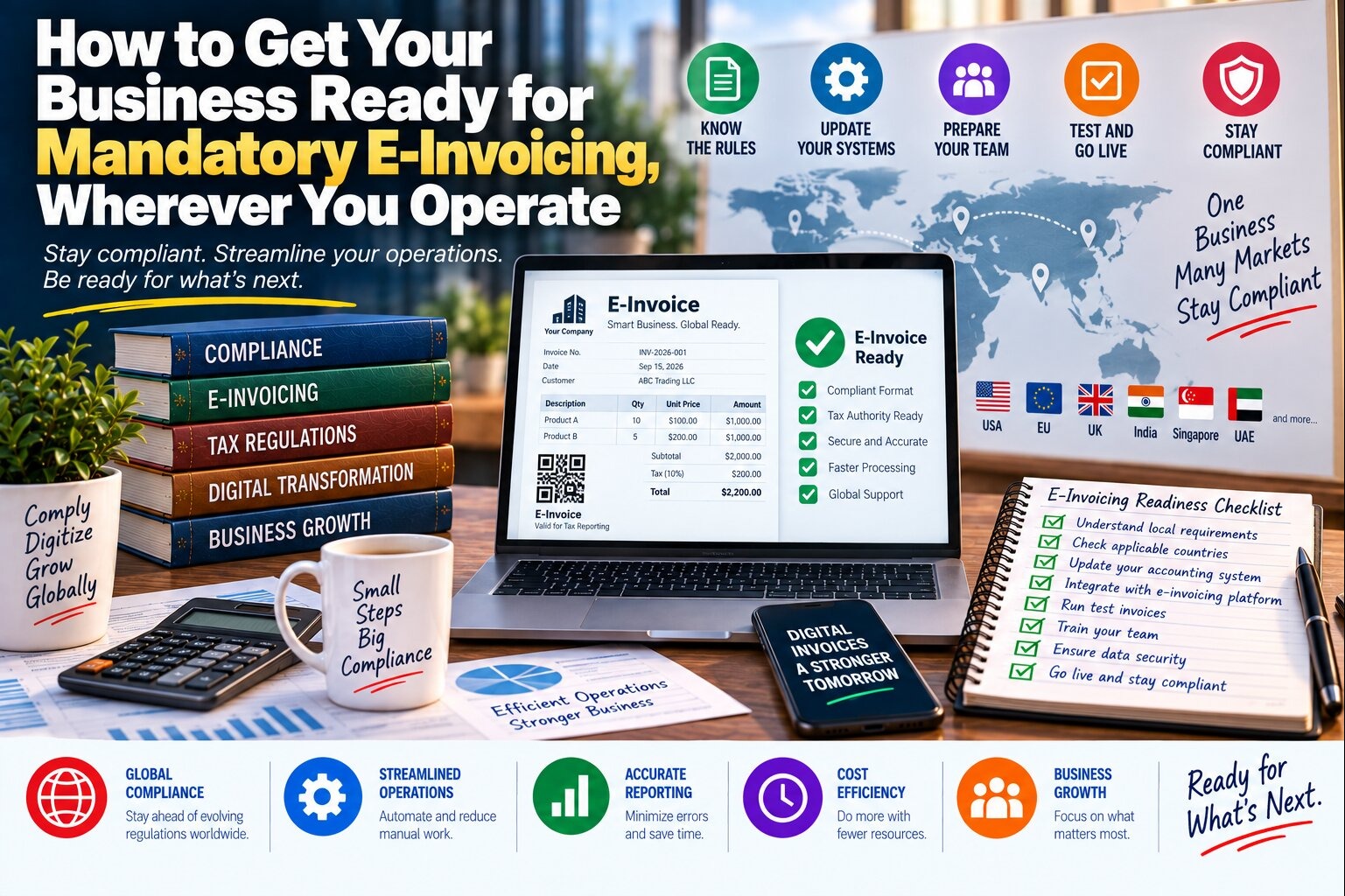
France's e-invoicing mandate went live on September 1, 2026. Every large and intermediate-sized company registered for VAT there now has to issue structured, machine-readable invoices for domestic B2B sales — a PDF attached to an email no longer satisfies the law. Belgium got there first, requiring the same shift from every VAT-registered business on January 1, 2026, backed by fines that start at €1,500 for a first offense and climb to €5,000 for a third within three months. Poland's national KSeF platform brought its largest taxpayers (those over PLN 200 million in turnover) into scope on February 1, 2026, then pulled in most other VAT-registered businesses on April 1.
None of this is a purely European story. If you invoice a customer in any of these countries, sell software or services across borders, or simply run a business in the UK, US, Canada, Australia, or New Zealand, the compliance wave reaching your suppliers and buyers will eventually reach you, too — the UK government confirmed its own Peppol e-invoicing mandate for April 1, 2029, back in November 2025. This guide walks through exactly what's changed, whether it applies to you today, and the concrete steps to get compliant or get ahead of it without disrupting how you get paid.
Where E-Invoicing Mandates Stand Right Now
The rollout is staggered by country and by company size, which is exactly why so many business owners assume none of this touches them yet. It's worth seeing the full timeline in one place before deciding whether to act now or later.
| Country / Region | Requirement | Who It Applies To | Effective Date |
|---|---|---|---|
| Belgium | Structured B2B e-invoicing via the Peppol network | All VAT-registered businesses | Jan 1, 2026 (tolerance through Mar 31, 2026) |
| Poland (KSeF) | Invoicing through the government KSeF platform | Large taxpayers (over PLN 200M revenue) | Feb 1, 2026 |
| Poland (KSeF) | Same requirement extended | Most other VAT-registered businesses | Apr 1, 2026 |
| Poland (KSeF) | Same requirement extended | Micro-entrepreneurs | Jan 1, 2027 |
| France | Structured e-invoicing via approved PDP platforms | Large and intermediate-sized enterprises | Sept 1, 2026 |
| France | Same requirement extended | SMEs and micro-enterprises | Sept 2027 |
| Germany | Mandatory ability to receive e-invoices | All businesses | Since Jan 2025 |
| Germany | Mandatory to issue e-invoices | Phased by company size | 2027 (large) / 2028 (all) |
| United Kingdom | Peppol e-invoicing mandate | All VAT-registered businesses | Confirmed for Apr 1, 2029 |
| EU-wide (ViDA) | Mandatory e-invoicing for cross-border transactions | All intra-EU B2B trade | Jul 1, 2030 |
| US / Canada / Australia / NZ | No domestic B2B mandate yet | Federal procurement contracts only, in most cases | Not yet scheduled |
Two things stand out in that timeline. First, "structured e-invoicing" doesn't mean the same platform everywhere: Belgium and France both route through the Peppol network but via different national access points, while Poland runs its own government-hosted KSeF system entirely outside Peppol. Second, being outside a mandated country doesn't mean you're unaffected. If your customer in Brussels or Lyon now has to receive a structured invoice from every domestic supplier, and you sell into their local subsidiary, they may ask you to switch formats voluntarily long before any law requires it of you directly.
What "Structured E-Invoicing" Actually Means
This is the part that trips up business owners who think they already send electronic invoices because they email a PDF. Under these mandates, an e-invoice is a data file, not a picture of one. It has to be built in a machine-readable format — typically UBL 2.1 or CII (Cross Industry Invoice), both of which comply with the European standard EN 16931 — so that a buyer's accounting system can read the amounts, tax codes, and line items automatically without a human retyping anything.
Most of these mandates run on the Peppol network's "four-corner model": your business (corner one) sends its invoice to your own access point provider (corner two), which routes it through the network to your customer's access point provider (corner three), which delivers it into your customer's system (corner four). You never touch your customer's software directly, and neither do they touch yours — the access points handle translation and delivery. Poland's KSeF works differently: invoices go through a single centralized government platform rather than a distributed network, which is closer to how Italy's long-running SDI system operates.
How to Tell If a Mandate Applies to You Right Now
Before you spend a cent on new software, work out whether you're actually in scope today, in scope soon, or not directly in scope at all. Check each of the following:
- Where you're VAT-registered. Mandates generally apply based on VAT registration in the country, not where your headquarters sits — a US company with a Belgian VAT number for local sales is in scope in Belgium.
- Whether the sale is domestic B2B. Most 2026 mandates cover domestic business-to-business transactions first; B2C sales and cross-border sales are typically phased in later or covered by separate EU-wide rules arriving in 2030.
- Your revenue tier. France and Poland both use company size to stagger deadlines, so a mid-sized exporter and a five-person consultancy in the same country can face compliance dates a year or more apart.
- What your biggest customers are doing. Even without a legal deadline, a major customer switching to structured invoicing can effectively force your hand if they stop accepting PDFs from suppliers.
- Whether you sell through marketplaces or platforms. Some platforms are starting to require structured invoice data from sellers regardless of local law, to simplify their own tax reporting.
Step-by-Step: Getting Your Invoicing Compliant
Once you know a deadline applies to you — or that one is close enough to plan for — the path is the same regardless of country. Here's the order that causes the fewest headaches:
- Audit your current invoicing volume and software. Pull a year of invoice data and note which customers are domestic, which are cross-border, and whether your accounting software (QuickBooks, Xero, SAP, Sage, or similar) already has an e-invoicing or Peppol module built in.
- Choose an access point or PDP provider. In Belgium and most Peppol countries you need a certified access point provider; in France you need an accredited Plateforme de Dematerialisation Partenaire (PDP); in Poland you connect directly or through an intermediary to KSeF. Many accounting platforms now bundle this as an add-on rather than requiring a separate vendor.
- Clean up your customer and product data. Structured invoices require accurate VAT numbers, Peppol IDs, and standardized product or service codes for every customer — data that's often missing or outdated in older accounting records.
- Run a parallel test period. Send structured invoices alongside your normal process for two to four weeks with a handful of cooperative customers before switching over fully, so you catch formatting errors while they're still cheap to fix.
- Train accounts payable and receivable staff. The people issuing and approving invoices need to understand that rejected structured invoices behave differently from a bounced email — they need a defined process for resubmission.
- Build in the tolerance period as a buffer, not a deadline. Belgium's three-month grace period, for example, requires businesses to show "tangible progress" toward compliance — it isn't automatic breathing room to do nothing until March.
Common Mistakes to Avoid
- Assuming a PDF invoice counts as electronic. Tax authorities have been explicit that a scanned or exported PDF, however professional it looks, does not meet the structured-data requirement.
- Waiting until the deadline month to start. Access point onboarding, data cleanup, and staff training routinely take six to ten weeks longer than businesses expect, especially during a national rollout when providers are swamped with new signups.
- Only preparing to send invoices, not receive them. Germany's mandate has required businesses to be able to receive e-invoices since January 2025 — long before the sending requirement kicks in — and many companies overlook that half of the obligation.
- Not verifying customers' Peppol IDs before going live. A structured invoice sent to the wrong access point or an outdated ID simply fails to deliver, and you may not find out until a payment is late.
- Treating this as a one-time IT project. Formats, thresholds, and country coverage are still being finalized in several jurisdictions, so whoever owns compliance needs to keep checking for updates through 2027 and beyond.
If You're Not Yet Mandated: What to Do Now
If your business operates solely in the US, UK, Canada, Australia, or New Zealand and you have no European VAT registrations, none of these 2026 deadlines apply to you directly today. But treating that as a reason to ignore the topic would be a mistake. The UK's own mandate is already confirmed for April 1, 2029, which sounds distant until you remember that Belgium's businesses had barely more runway once their government finalized the rules. If you sell into the EU at all, even occasionally, ask your largest EU customers now whether they expect structured invoices going forward — getting ahead of a request beats scrambling to meet one.
It's also worth asking your accounting software provider directly whether e-invoicing capability is on their roadmap and on what timeline, since retrofitting compliance into a platform that wasn't built for it tends to be slower and more expensive than choosing a provider that already supports Peppol or your relevant local platform. Businesses that export goods or services to Belgium, France, Poland, or Germany today should treat 2026 and 2027 as the window to modernize invoicing infrastructure at a comfortable pace, rather than under deadline pressure.