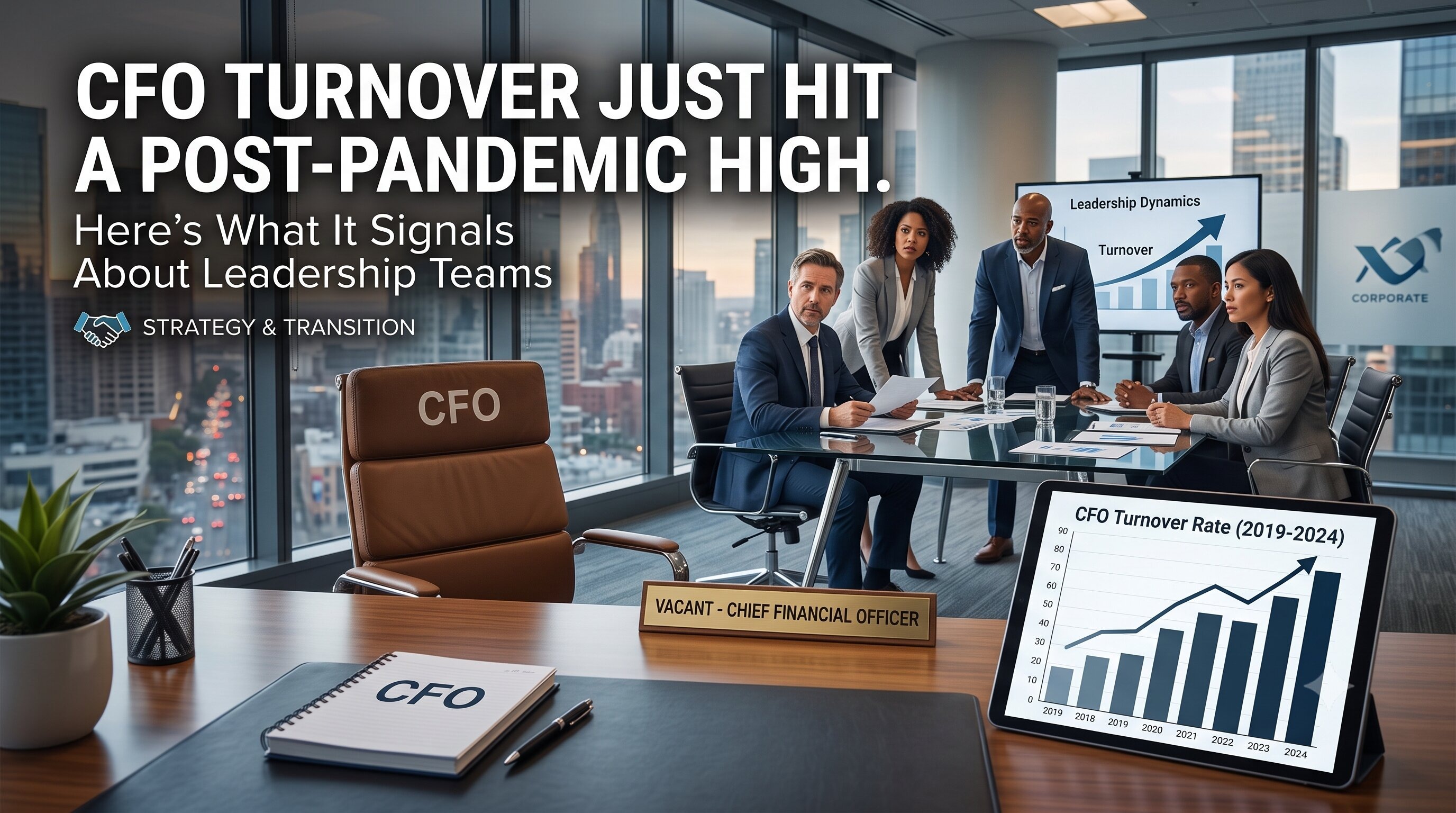
CFO turnover at America's largest public companies is on pace to hit 18.3% in 2026, the highest annual rate since 2020, according to the mid-year Volatility Report from executive search firm Crist|Kolder Associates. The firm tracks the Fortune 500 and S&P 500 — a combined universe of 665 companies once overlap is removed — and its finding lands at an odd moment: corporate profits are healthy, and most of the boardrooms losing a CFO aren't in crisis. The churn is happening anyway, and it's happening at the top of the finance function, which makes it a leadership story as much as an accounting one.
For readers who run teams, sit on boards, or simply want to understand what's shaking loose in the executive suite, the CFO number is a useful proxy for something bigger: how quickly the demands on senior leadership are changing, and how unprepared many companies still are to replace the people who leave.
The Numbers Behind the Churn
Crist|Kolder's data shows this year's rate is not an isolated spike. It sits close to the elevated turnover seen during the pandemic reshuffle, well above the ten-year historical average, and it comes with a second, less-discussed shift: the people stepping into the CFO chair are noticeably younger than the people leaving it.
| Metric | Figure |
|---|---|
| 2026 projected CFO turnover (Fortune 500 + S&P 500) | 18.3% |
| 2020 CFO turnover (pandemic-era peak) | 18.2% |
| 2019 CFO turnover | 19.3% |
| 10-year historical average CFO turnover | 16% |
| Average CFO age, 2026 | 48 |
| Average CFO age, 2025 | 52 |
| Share of 2025 Fortune 500/S&P 500 CEO hires who were sitting CFOs | 10.3% |
| Same figure for 2024 | 7.1% |
Put those rows together and a pattern emerges. Companies aren't just losing CFOs faster than the historical norm; they're replacing them with a younger bench, and a growing share of those departing CFOs are landing the corner office themselves rather than leaving the company altogether.
Why CFOs Are Leaving Now
Scott W. Simmons, co-managing partner at Crist|Kolder, put it bluntly in the firm's report: “The demands of the job keep expanding, so it's no surprise the churn continues.” That expansion is the throughline across nearly every reason cited for the 2026 spike. Some CFOs are retiring after multi-year runs managing pandemic-era volatility, rate hikes, and now an AI capital cycle. Others aren't leaving the workforce at all — they're being pulled into new roles, either running turnarounds at other companies or taking direct ownership of AI transformation initiatives that used to sit with a chief technology officer or chief digital officer.
That last category matters for anyone watching how leadership roles are being redrawn. The CFO job used to be defined by controls, reporting, and capital allocation. Boards are now asking finance chiefs to also own technology ROI, workforce planning around automation, and investor messaging about AI spending — on top of the job they were already doing. When the scope of a role keeps growing without a corresponding growth in support, burnout and opportunistic exits both go up.
The CFO-to-CEO Pipeline Is Widening
The jump from 7.1% to 10.3% in CFO-to-CEO promotions is the more optimistic half of this story. Boards facing economic uncertainty are increasingly comfortable handing the top job to the person who already understands the balance sheet, the covenants, and the capital markets relationships, rather than importing an outside operator. It's a vote of confidence in financial fluency as a leadership credential, and it gives ambitious CFOs a reason to stay engaged with a single company's trajectory instead of shopping their skills to a competitor.
A Parallel Story at the Top of the Org Chart
The CFO data doesn't sit in isolation. Russell Reynolds Associates' Global CEO Turnover Index, covering the same mid-2026 window, shows the opposite direction of travel at the very top: CEO departures are actually cooling. Globally, 101 CEOs left their roles in the first half of 2026, down from 118 in the first half of 2025 and the lowest first-half total in the firm's nine-year tracking history. Average outgoing CEO tenure has stretched to roughly nine years, up sharply from 6.6 years a year earlier, and boards are leaning harder toward experience: 23% of incoming CEOs globally in the first half of 2026 had already run a public company before, the highest first-half share on record, with the S&P 500 figure running even higher.
Read side by side, the two data sets describe a leadership market that's stabilizing at the very top while churning hard one level down. Boards are keeping proven CEOs in place longer, but the finance seat directly beneath them is turning over faster than it has since the pandemic. That's a structural shift worth paying attention to if you're building a leadership bench: the pressure isn't landing evenly across the C-suite.
What This Means for Leadership Teams Right Now
If you manage a team, sit on a compensation or nominating committee, or are simply trying to figure out where the next round of executive-level opportunity will come from, a few practical implications follow from this data.
- Succession planning can no longer treat the CFO seat as stable. A role with 18%-plus annual turnover needs an internal successor identified and being developed at all times, not a plan dusted off after a resignation letter arrives.
- Scope creep in senior roles needs an explicit conversation. If a CFO, COO, or other executive is quietly absorbing AI strategy, workforce automation, and investor relations on top of their original mandate, that expansion should come with added resources, a redefined title, or a defined sunset — not just added hours.
- Younger executives are getting bigger jobs faster. An average CFO age of 48, down from 52 a year ago, means companies are betting on leaders with less runway in the role but more comfort with the technology shifts reshaping finance. Mentorship and structured onboarding for these younger hires matters more than it did five years ago.
- Financial fluency is becoming a leadership differentiator, not just a technical skill. With CFO-to-CEO promotions climbing, leaders who understand capital allocation and can speak credibly to a board about AI ROI are building a faster path to the top job.
Building a Succession-Ready Bench Before You Need One
Companies that weather this kind of churn well tend to share a few habits. They run structured “what if this person left tomorrow” exercises for every C-suite seat, not just the CEO's. They give high-potential directors and VPs real exposure to board meetings and investor conversations years before they're formally in line for a promotion, so the jump to the executive table isn't their first time in the room. And they separate retention conversations from annual review cycles — waiting twelve months to ask a stretched executive what they need is often twelve months too late, given how quickly recruiters are calling once a name starts circulating as a flight risk.
Common Mistakes Boards Make During an Executive Transition
Even well-run companies stumble in the months after a CFO or other senior finance leader announces they're leaving. The mistakes tend to repeat across industries, and most of them are avoidable with a plan drafted before the resignation letter shows up.
- Treating the search as purely external. Boards that skip a real internal bench review often overlook a controller or divisional finance head who's already doing 80% of the job informally, and end up paying a premium for an outside hire who needs a year to learn the company.
- Underestimating the interim period. A CFO transition frequently drags on for four to six months once notice, search, and onboarding are added together. Companies that don't name a credible interim leader early risk stalling budget cycles, audit committee work, and investor calls in the meantime.
- Ignoring the AI and technology mandate creeping into the role. A search built around a 2019 job description will miss candidates who can actually own the AI reporting and forecasting tools the board now expects the finance chief to run.
- Failing to communicate proactively with investors and lenders. A CFO departure that leaks before the company controls the narrative tends to move the stock and rattle credit relationships more than the underlying change in personnel usually warrants.