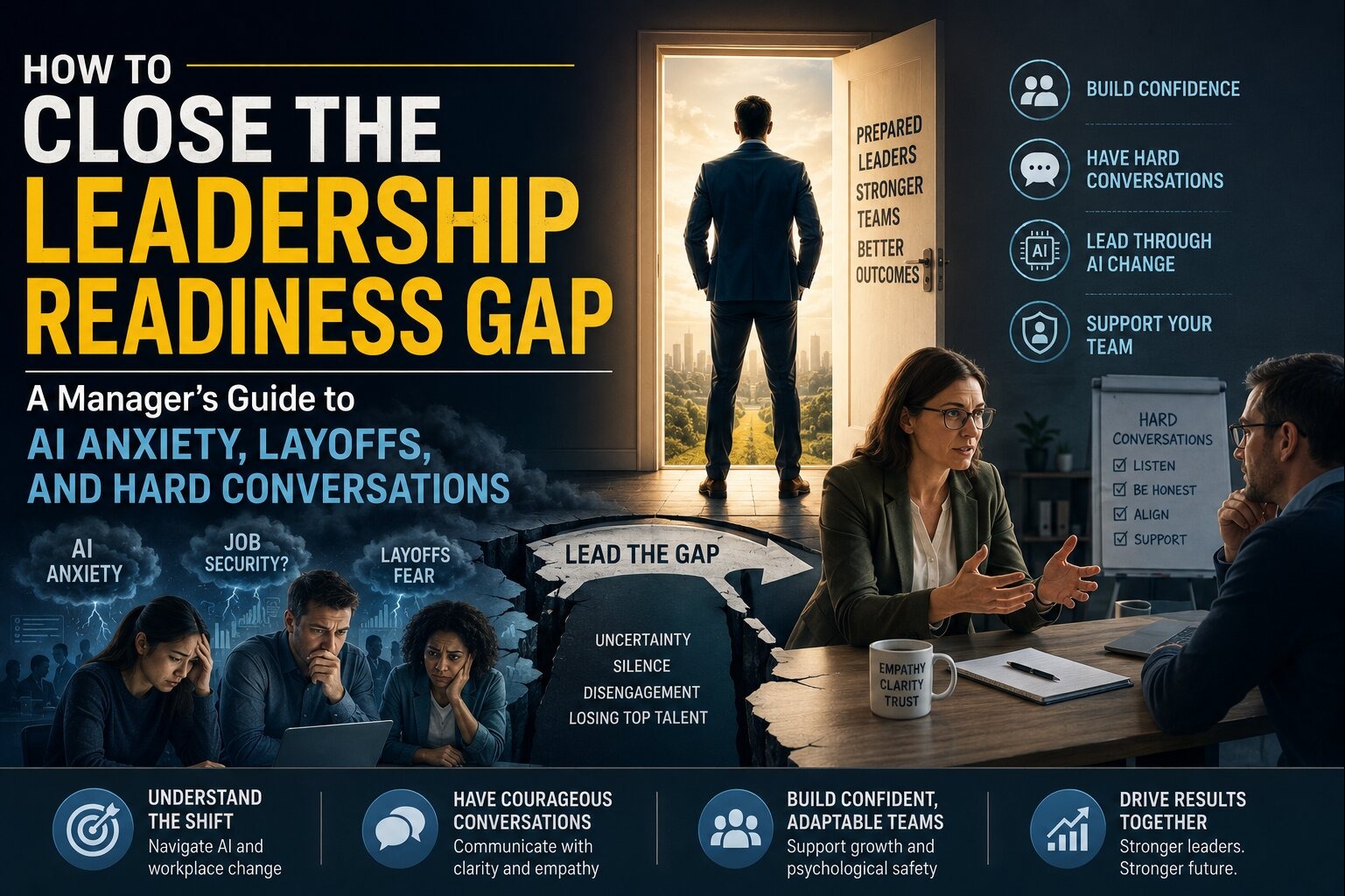
A study released by Careerminds in early August 2026 found something that should worry anyone managing people right now: 98% of people managers and 97% of HR professionals say managers are ready to lead through whatever comes next. But when researchers asked about specific skills — leading through AI adoption, handling organizational change, having tough career conversations — fewer than half of respondents rated managers as highly prepared on any single one of them. The confidence is nearly universal. The actual readiness is not.
The gap gets sharper on the topics that matter most day to day. While 97% of HR professionals believe their organization gives managers adequate training for difficult conversations around AI anxiety, layoffs, and workplace conflict, only 41% of the managers actually having those conversations say the preparation was sufficient. Separately, 88% of HR professionals and 72% of managers report that managers regularly feel caught between what executives expect and what their teams need, and fewer than half say they get real organizational support for that tension. If you manage people, that data describes your week, whether or not your company has named it yet.
What the Gap Actually Means for You
A confidence score of 98% next to a preparedness score under 50% is not a rounding error, it's a warning sign. It means most managers believe in their own general leadership ability while privately being unsure how to run an actual layoff conversation, respond to a direct report who's anxious about AI replacing their job, or push back on an executive directive that will hurt their team's morale. That mismatch is dangerous because it doesn't show up until the moment it matters most — mid-conversation, with someone's job or trust on the line.
The Careerminds research also found a hierarchy problem: C-suite leaders consistently rate their own and their organization's readiness higher than the managers doing the actual day-to-day work rate theirs. That means the people deciding how much training and support to fund are the least likely to see the gap firsthand. If you're a frontline or mid-level manager, waiting for leadership to notice the problem and fix it for you is not a plan. You need your own approach.
The Readiness Gap by the Numbers
| Area | What HR/Leadership Believes | What Managers Report | Gap |
|---|---|---|---|
| General leadership readiness | 97% of HR say managers are ready | 98% of managers say they're ready | Confidence is high on both sides |
| Specific skills (AI adoption, change, career talks) | Fewer than half rate managers as highly prepared | Fewer than half rate themselves as highly prepared | Confidence collapses once questions get specific |
| Training for hard conversations | 97% believe training is adequate | Only 41% say preparation was sufficient | 56-point gap between belief and experience |
| AI making the job easier | — | Only about 35% say AI has significantly helped | AI adoption is adding work for most managers, not removing it |
| Tension between execs and teams | 88% of HR acknowledge it exists | 72% of managers report feeling it | Fewer than half feel supported through it |
How to Diagnose Your Own Readiness Gap
Start with a blunt self-audit rather than trusting your general confidence level, since that's exactly the metric the Careerminds data shows is unreliable. Think back over the last quarter and write down every difficult conversation you had to have or avoided having: a performance issue you delayed addressing, a team member who came to you anxious about AI tools changing their role, a moment you had to relay an unpopular decision from above. For each one, rate honestly whether you walked in with an actual plan or improvised in the moment.
Then ask two or three peers, not your boss, a direct question: "If I had to lay someone off or deliver hard news to the team tomorrow, would you trust how I'd handle it?" Peers tend to give a more honest read than a direct report (who may not feel safe being critical) or your manager (who may be grading you on results, not process). The pattern that emerges from these two exercises — not your gut feeling — is your actual readiness gap.
Step-by-Step: Preparing for the Conversations You're Most Likely to Face
- Build a simple script before you need it. For layoffs or role changes: state the decision clearly and early, explain the reason in one or two sentences without over-justifying, and leave space for the person to react before you move to logistics. Rehearsing this once, even alone, changes how steady you sound when it's real.
- Separate the message from the mechanics. Know the severance, timeline, and next-step details cold before the conversation starts, so you're not fumbling for HR answers while someone is processing an emotional shock.
- For AI-anxiety conversations, lead with specifics, not reassurance. "I don't know" delivered honestly, followed by "here's what I do know about our team's plans," builds more trust than a vague "don't worry, your job is safe" that you can't actually guarantee.
- Practice naming the tension out loud. When you're caught between an executive directive and what your team needs, say so plainly to your team: "Leadership has asked for X, and I know that's going to be hard given Y." Managers who pretend there's no tension lose credibility faster than those who acknowledge it.
- Debrief every hard conversation within 24 hours. Write down what went well and what you'd change. This is how the 41% who feel prepared got there — not from a single training session, but from treating every real conversation as practice for the next one.
How to Ask Your Organization for the Support You're Actually Missing
Since HR consistently overestimates how prepared managers feel, don't assume your company already knows you need more support — the data says they probably think you're fine. Bring specifics instead of a general complaint. Rather than "I need more leadership training," say "I've had three conversations this quarter about AI-related job anxiety and I don't have a consistent way to answer questions about our team's plans — can we get alignment on what I'm allowed to say?" Specific asks tied to real incidents are far more likely to get funded than abstract requests for "more training."
If your organization has an HR business partner, request a role-play session ahead of any conversation you know is coming, like a reorg announcement or a performance-based exit. Rehearsing with a neutral third party surfaces the moments where your plan breaks down, before it breaks down in front of your team. And if formal support isn't available, build an informal version: identify one or two peer managers you trust and agree to debrief each other's hard conversations, since the readiness gap closes fastest through repetition and honest feedback, not lecture-style training.
Who Should Treat This as Urgent
Newer managers, promoted within the last year or two, face the widest version of this gap since they're building management skills at the same moment AI adoption and restructuring are reshaping what their teams' jobs look like. Managers on teams that have recently rolled out AI tools for drafting, coding, analysis, or customer service should also prioritize this now, given that only about 35% of managers say AI has actually made their role easier so far — meaning most are absorbing new oversight work without a script for the conversations it creates. And any manager who has had to relay a decision from above that they personally disagreed with, without a plan for how to do that credibly, should treat this guide as immediately relevant rather than a someday project.
Common Mistakes to Avoid
- Mistaking general confidence for specific readiness. Feeling capable as a leader overall doesn't mean you have a plan for the one conversation that's actually coming next week.
- Waiting for the company to offer training. The data shows HR believes training is already adequate, so it's unlikely to be prioritized without a specific, incident-based request from you.
- Over-explaining bad news. Long justifications during layoff or role-change conversations tend to increase confusion and distress rather than soften the blow.
- Promising things you can't guarantee. Telling an anxious employee their job is "definitely safe" from AI-driven change, when you don't actually control that outcome, damages trust when circumstances change.
- Skipping the debrief. Moving straight from one hard conversation to the next without reviewing what worked means you keep making the same avoidable mistakes.
What to Do Next
Pick one conversation type from this guide — a layoff or role-change script, an AI-anxiety response, or naming the exec-versus-team tension out loud — and prepare for it this week, even if nothing is imminent. The Careerminds data makes the underlying lesson clear: readiness isn't something you either have or don't, it's built through specific preparation for specific moments. Managers who close their own readiness gap now, rather than waiting for their organization to notice the 56-point difference between what HR believes and what managers experience, will be the ones their teams trust when the next hard conversation actually arrives.