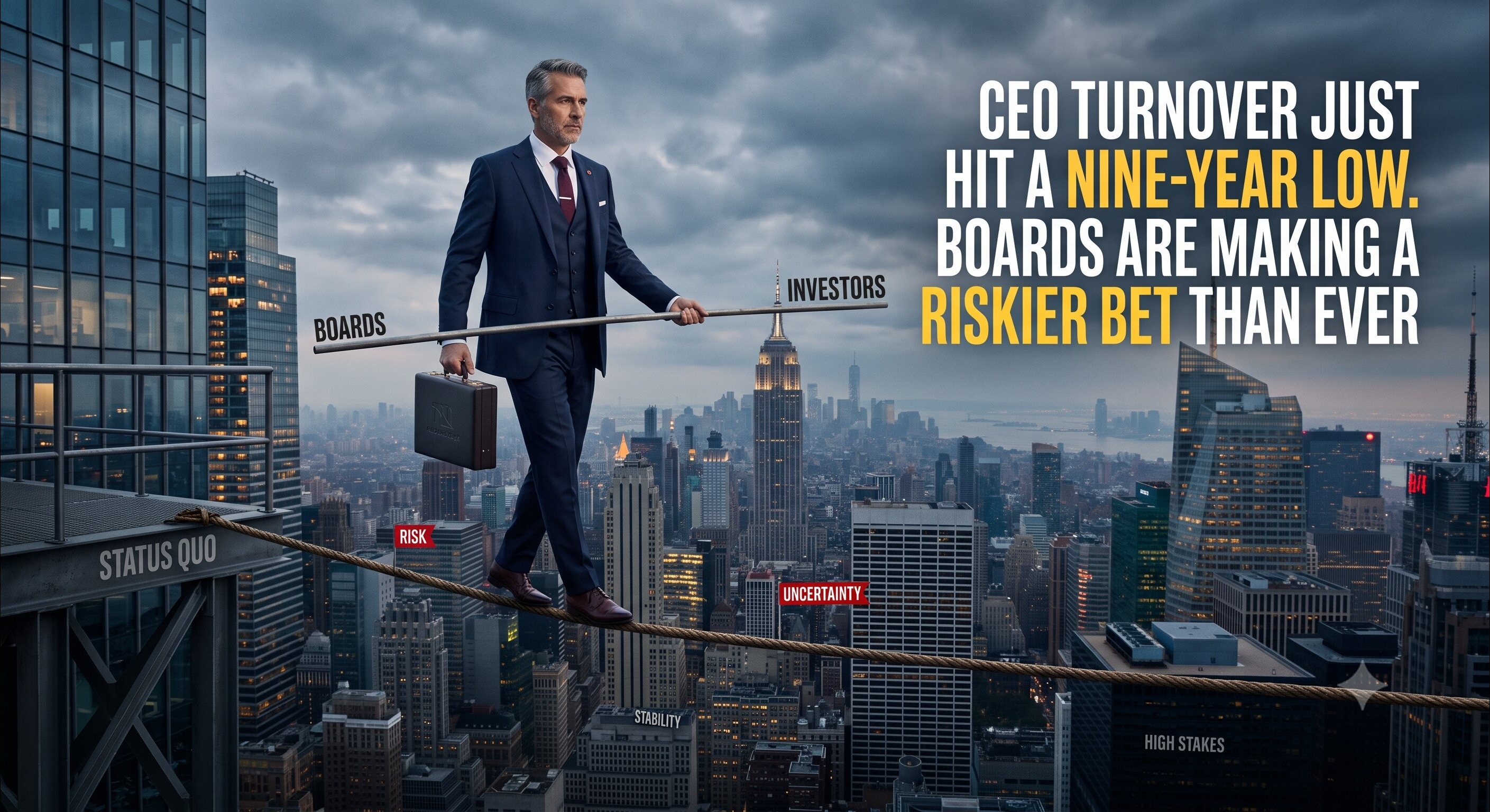
Only 101 CEOs left their jobs at the world's largest public companies in the first half of 2026, down from 118 a year earlier and the lowest H1 departure count in the nine years Russell Reynolds Associates has tracked the data, according to the firm's Global CEO Turnover Index published August 13. On its face, that reads as good news: after 234 global CEOs departed in 2025 — a 16% jump over 2024 and 21% above the eight-year average — the churn at the top has finally slowed. But the report's more interesting number isn't the departure count. It's who is filling the empty chairs, and it suggests boards have quietly swapped one kind of risk for another.
Companies made 131 CEO appointments globally in the first half of the year, roughly in line with the nine-year average of 129. Of the incoming class at S&P 500 companies, 88% were internal promotions — the highest share of insider hires in the index's history. Just 23% of the 131 new CEOs worldwide had already run a public company before, also a record for a first half. Put simply: boards aren't looking outside anymore. They're reaching for the person already in the building, and increasingly, for someone who has never sat in the top chair at all.
The Nine-Year Low, By the Numbers
Turnover data is easy to skim past as an HR statistic, but for anyone managing a team, running a business, or investing in one, CEO succession patterns are a leading indicator of how much risk a board is willing to tolerate. A falling departure count paired with a rising insider-hire rate tells a specific story: directors are prioritizing continuity and known quantities over fresh outside perspective, even as the operating environment — AI capital spending, tariff volatility, tighter credit — keeps getting more complicated, not less.
| Metric | H1 2026 | Prior Period |
|---|---|---|
| Global CEO departures | 101 | 118 (H1 2025) |
| Full-year 2025 global CEO departures | 234 | 16% YoY increase |
| Global CEO appointments | 131 | 129 (9-year H1 average) |
| S&P 500 internal CEO appointments | 88% | Highest H1 share on record |
| New CEOs who previously ran a public company | 23% (30 of 131) | Highest H1 share on record |
| Retired CEOs satisfied with transition after 1 year (BCG) | 40% | Published early August 2026 |
Russell Reynolds CEO Constantine Alexandrakis has framed the broader trend behind these numbers as a structural shift, not a blip: tenures are shortening even as the job's demands expand, which raises the stakes on every succession decision a board makes. A slower departure rate doesn't mean the pressure on sitting CEOs has eased — it may just mean boards have gotten more cautious about who they're willing to let go.
Why Boards Are Suddenly Playing It Safe
The jump to 88% internal hires is the headline here, and it cuts against a decade of conventional wisdom that said outside CEOs bring the disruption a struggling company needs. That calculus has flipped. In an environment where AI transformation, tariff-driven cost pressure, and activist investor scrutiny can each upend a company's plan within a single quarter, boards appear to be betting that continuity of institutional knowledge beats the shock value of an outsider who needs a year just to learn where the bodies are buried.
There's a second, less flattering explanation worth naming directly: succession benches have thinned. When a board can't point to two or three credible internal candidates who could step in tomorrow, promoting whoever is closest to the door becomes the default, not the deliberate choice. SHRM's executive network has been blunt about this dynamic, arguing that stable-looking turnover numbers can mask a deeper problem — boards mistaking the absence of a crisis for the presence of a plan. As the group put it in its recent analysis of the trend, strong internal successors are not built at the moment a vacancy appears; they're built years earlier, through stretch assignments, P&L ownership, and deliberate exposure to the board.
The First-Time-CEO Problem
A record 77% of new CEOs globally are stepping into the role for the first time. First-time CEOs aren't inherently worse leaders than repeat CEOs, but the data on their tenure and performance volatility is not comforting: first-timers take longer to find their footing, are more likely to be replaced within three years, and lean harder on their leadership team during the transition because they haven't done the job before. Boards betting on a deep internal bench are also, whether they say so explicitly or not, betting on a steeper learning curve.
The Retirement Problem Nobody Is Planning For
The turnover data explains who is getting the job. A separate study from Boston Consulting Group, published in early August, explains why the people leaving it aren't making the exit easy for their successors. BCG found that only 40% of CEOs who retired felt satisfied with their transition out of the role during their first year away from it. The rest described a version of the same experience: the sudden loss of a schedule, an identity, and a support structure built entirely around the job, arriving all at once on the day the badge stops working.
The adjustment isn't just a personal matter for the departing executive. How smoothly a CEO handles their own exit shapes how much runway the incoming leader actually gets — and in a crisis, a board that watched its last CEO struggle to let go is more likely to reach for a proven veteran than to keep grooming an internal candidate.
That feedback loop matters more than it looks. A board nervous about a messy handoff has every incentive to keep the outgoing CEO involved longer, whether as chair, adviser, or informal shadow leader — which can quietly undercut the authority of the internal successor the company just spent years developing. The two data points, taken together, describe a system under more strain than the headline "turnover is cooling off" suggests.
What Boards and Rising Executives Should Take From This
For directors, the practical takeaway is that a quiet year at the top isn't a reason to deprioritize succession planning — it's the best window to fix it before the next wave of departures arrives. For managers who see themselves as future C-suite material, the calculus has shifted too: internal track record, board visibility, and cross-functional P&L experience now matter more than ever, because boards are demonstrably rewarding the people already inside the building.
- Build the bench before you need it. Boards that wait until a CEO resigns to start identifying successors are choosing from whoever happens to be available, not who is actually best.
- Give high-potential leaders real P&L exposure early. The gap between a strong functional leader and a credible CEO candidate is usually decision-making authority over revenue and cost, not talent.
- Plan the outgoing CEO's exit as carefully as the incoming CEO's onboarding. BCG's data suggests companies that help departing executives find purpose after the corner office reduce the pressure to keep them unofficially involved.
- Don't confuse an internal hire with a safe hire. A record share of first-time CEOs means boards need sharper onboarding support and faster feedback loops than they've historically provided.
- Track board exposure, not just performance reviews. Executives who present to the board regularly build the relationships and visibility that turn into succession consideration later.
What Happens Next
Russell Reynolds' own framing of the data — "shorter runways, higher stakes" — suggests this isn't a one-quarter story. Tenures have been compressing for years, even as the H1 2026 departure count ticked down, and the firms with the deepest succession benches will be the ones best positioned when turnover inevitably picks back up. The 40% retirement-satisfaction figure from BCG is a reminder that succession planning doesn't end when the new CEO's name hits the press release; it ends when the outgoing one has actually let go.
Related Articles
- CFO Turnover Just Hit a Post-Pandemic High. Here's What It Signals About Leadership Teams
- Companies Are Pouring $2.5 Trillion Into AI. Most Leadership Teams Still Can't Say Who's in Charge of It
- How to Lead a Team Effectively in 2026 | OBBBA & AI Leadership
- Leadership vs Management 2026 | Key Differences & OBBBA Impact