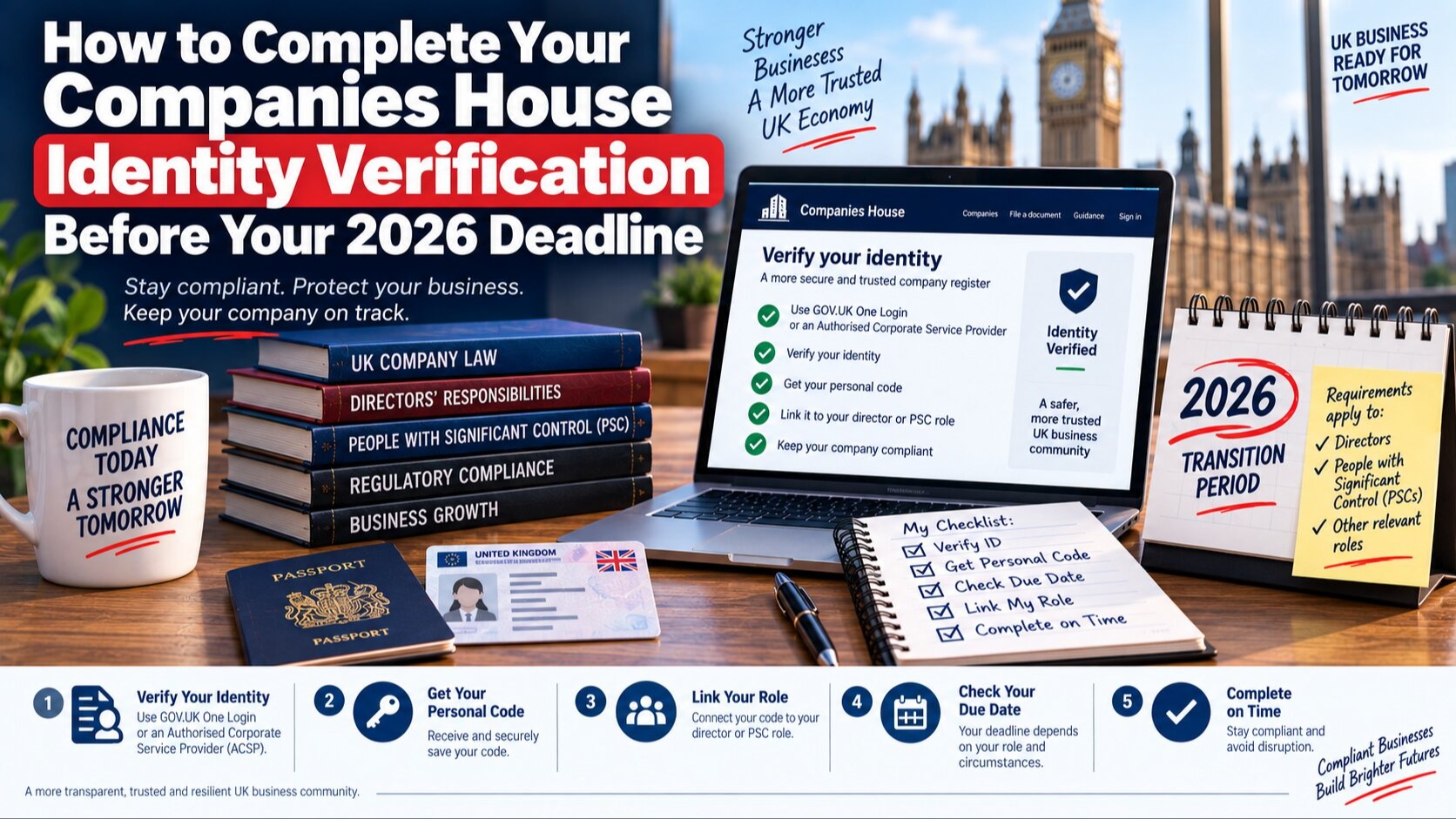
Since 18 November 2025, every new director appointed to a UK company has had to verify their identity with Companies House before that appointment takes effect, under the Economic Crime and Corporate Transparency Act 2023. Existing directors and people with significant control (PSCs) get a longer runway, but not an open-ended one: the requirement attaches to your company's next confirmation statement, and the absolute backstop for everyone still unverified is 18 November 2026. Companies House estimates that six to seven million directors and PSCs across roughly five million UK companies fall under this rule, and non-compliance is a criminal offence, not a paperwork slap on the wrist.
If you run, co-found, or sit on the board of a UK-registered company, this is now a task on your list, not background noise. If you're a founder in the US, Canada, Australia, or elsewhere who happens to have a UK subsidiary, a UK holding company, or a UK PSC designation because you own more than 25% of a British business, it applies to you too, wherever you live. And if you're not touching UK company law at all, the same weeks brought a genuinely opposite move in the United States, where FinCEN just eliminated beneficial ownership reporting for domestic companies. The two changes, read together, say something useful about where corporate transparency rules are heading depending on which country's registry you're dealing with. Below is exactly what to do about the UK requirement, plus how the equivalent rules stack up if you're building a company outside Britain.
Key Numbers to Know
Here's how identity and beneficial-ownership verification currently compares across four Tier 1 jurisdictions:
| Country | Requirement | Status as of September 2026 | Maximum penalty for non-compliance |
|---|---|---|---|
| United Kingdom | Companies House ID verification (directors & PSCs) | Mandatory since 18 Nov 2025; backstop 18 Nov 2026 | Criminal offence; civil penalty up to £10,000 |
| Australia | Director ID (ABRS) | Mandatory since Nov 2021; existing directors' deadline already passed (30 Nov 2022) | Civil penalty up to $1,375,000 AUD; criminal penalty up to $16,500 AUD |
| United States | FinCEN Corporate Transparency Act (BOI reporting) | Reversed 11 Aug 2026: domestic companies and US persons no longer have to report; only foreign entities' non-US owners remain in scope | N/A for domestic filers (exempted) |
| Canada | Federal beneficial ownership register (CBCA corporations) | In effect since Jan 2024 for federally incorporated companies | Fines and possible imprisonment for false or missing filings |
Who Actually Needs to Verify
Companies House isn't asking every shareholder or employee to do this. The requirement is narrower, but it catches more people than most founders assume:
- Every director of a UK limited company, including non-executive and non-UK-resident directors
- Every person with significant control (PSC) — generally anyone who owns more than 25% of shares or voting rights, or who otherwise controls the company
- Anyone filing documents at Companies House on behalf of a company, if they do so directly rather than through an agent
- New directors appointed on or after 18 November 2025, who must verify before Companies House will register the appointment
- Directors of multiple UK companies — you verify once, and your personal Companies House code then covers every directorship, but your deadline is set by whichever of your companies files its confirmation statement first
Step-by-Step: How to Verify Your Identity
The process itself is short once you know which route to take. Most directors can finish it in under thirty minutes.
- Find your trigger date. Check your company's confirmation statement due date on the Companies House register — that's the date your verification is actually due, not 18 November 2026, unless your confirmation statement happens to fall on that date.
- Choose your verification route. You can use GOV.UK One Login, which is free and run directly by government, or go through an Authorised Corporate Service Provider (ACSP) — typically your accountant, solicitor, or company formation agent — who will usually charge a fee, often around £35 plus VAT.
- Gather your ID documents. A passport is the most reliable document for the GOV.UK ID Check app; a UK driving licence also works. Have the physical document in hand, not a photo of it, since the app scans the chip.
- Complete the scan and facial match. The GOV.UK ID Check app walks you through scanning your document and taking a live selfie to match against it. Photo quality and lighting matter more than people expect — this is the step where most self-service attempts fail and have to be redone.
- Receive your personal verification code. Once verified, Companies House issues you a unique code tied to your identity, not to any single company.
- File it with your confirmation statement. Your company (or your accountant, if they file on your behalf) submits your code as part of the next confirmation statement. That filing is what actually closes out the requirement.
GOV.UK One Login or an ACSP: Which Should You Use
The free route sounds like the obvious choice, and for a lot of directors it is. But it has a real failure rate, driven mostly by strict photo-quality checks and address matching against other government records. If your passport photo is old, your name has changed, or your registered address doesn't quite match what's on file elsewhere, the self-service app can reject you more than once before it works.
An ACSP route costs money but comes with a person troubleshooting the process with you, which matters if you're a non-UK resident director verifying from abroad, or if you've already had a failed attempt through One Login. If your company already uses an accountant or company secretarial service, ask whether they're a registered ACSP before you pay a separate provider — many already offer it as part of an existing engagement.
What Happens If You Miss the Deadline
This isn't a late fee you can just pay later and move on. Once your verification deadline passes, Companies House can refuse to register other filings connected to that directorship, which effectively freezes routine company administration — you can't easily change your registered address, appoint a new director, or file certain other documents until it's resolved. Acting or purporting to act as a director without having verified your identity is a criminal offence under the 2023 Act, and Companies House can also levy a civil financial penalty of up to £10,000 as an alternative to prosecution. In practice, enforcement is expected to ramp up gradually rather than hit everyone on day one, but "gradually" is not the same as "never," and the backstop date removes any ambiguity by 18 November 2026.
If You're Not Based in the UK: What the Equivalent Looks Like
Founders reading this from outside Britain shouldn't tune out — the underlying trend, verified ownership tied to a real, checked identity, is spreading unevenly across Tier 1 countries, and it's worth knowing where you stand in your own jurisdiction.
Australia got here first. The director ID scheme, run by the Australian Business Registry Services, has been mandatory since November 2021, and the deadline for existing directors passed back in November 2022. ASIC has since begun prosecuting non-compliant directors, with penalties that dwarf the UK's — a civil penalty of up to $1,375,000 AUD is on the books, and ASIC has already secured convictions with real fines attached. If you're an Australian director, this ship has sailed; if you somehow never applied, do it now rather than wait for a compliance letter.
The United States just moved the opposite direction. On 11 August 2026, FinCEN finalised a rule that permanently exempts domestic US companies and US persons from beneficial ownership reporting under the Corporate Transparency Act — a sharp reversal from the reporting regime that had been phased in since 2024. Only foreign entities registered to do business in the US now have to report, and only on their non-US beneficial owners. If you formed an LLC or corporation in Delaware, Wyoming, or anywhere else in the US, you no longer need to file or maintain a BOI report with FinCEN, and previously filed US-person data is being deleted from the database. That doesn't mean identity checks vanish from your life as a founder — banks, payment processors, and state-level registries still run their own know-your-customer checks — but the federal registry-level requirement is gone for now.
Canada sits in between. Federally incorporated companies under the Canada Business Corporations Act have had to maintain and, since January 2024, in many cases report beneficial ownership information to Corporations Canada. Several provinces run parallel registries with their own rules, so a Canadian founder's obligations depend heavily on whether they incorporated federally or provincially.
New Zealand and the rest of Western Europe vary company by company and country by country — some EU states run public beneficial ownership registers under anti-money-laundering directives, others have scaled theirs back after court challenges. If you've incorporated outside these four countries, check your own companies register directly rather than assuming either the UK or US approach applies to you.
Common Mistakes to Avoid
- Assuming 18 November 2026 is your deadline when your confirmation statement actually falls earlier — check the real date on the register, not the backstop
- Waiting until the week before your confirmation statement to attempt GOV.UK One Login, leaving no time to fix a failed scan or switch to an ACSP
- Verifying once but forgetting that a newly appointed co-director or PSC on the same company still needs to verify separately
- Using an out-of-date passport photo or a registered address that doesn't match your bank or utility records, which is the most common cause of a failed automated check
- Assuming a US LLC owner is now completely exempt from every ownership disclosure just because FinCEN's domestic reporting rule was scrapped — state and bank-level checks still apply
Practical Tips for Founders Operating in More Than One Country
If you hold directorships or significant ownership stakes across two or more of these jurisdictions, treat this as one compliance calendar rather than four separate tasks. Pull every confirmation statement date, director ID renewal note, and registered-agent reminder into a single tracker, because the penalties in Australia and the UK are both criminal in nature and neither registry will accept "I was focused on the other country's deadline" as a defence. If you use a single accountant or company secretarial firm across jurisdictions, ask directly whether they're an ACSP in the UK and whether they handle director ID applications in Australia — consolidating the admin with one provider tends to be cheaper and far less error-prone than juggling separate portals yourself.