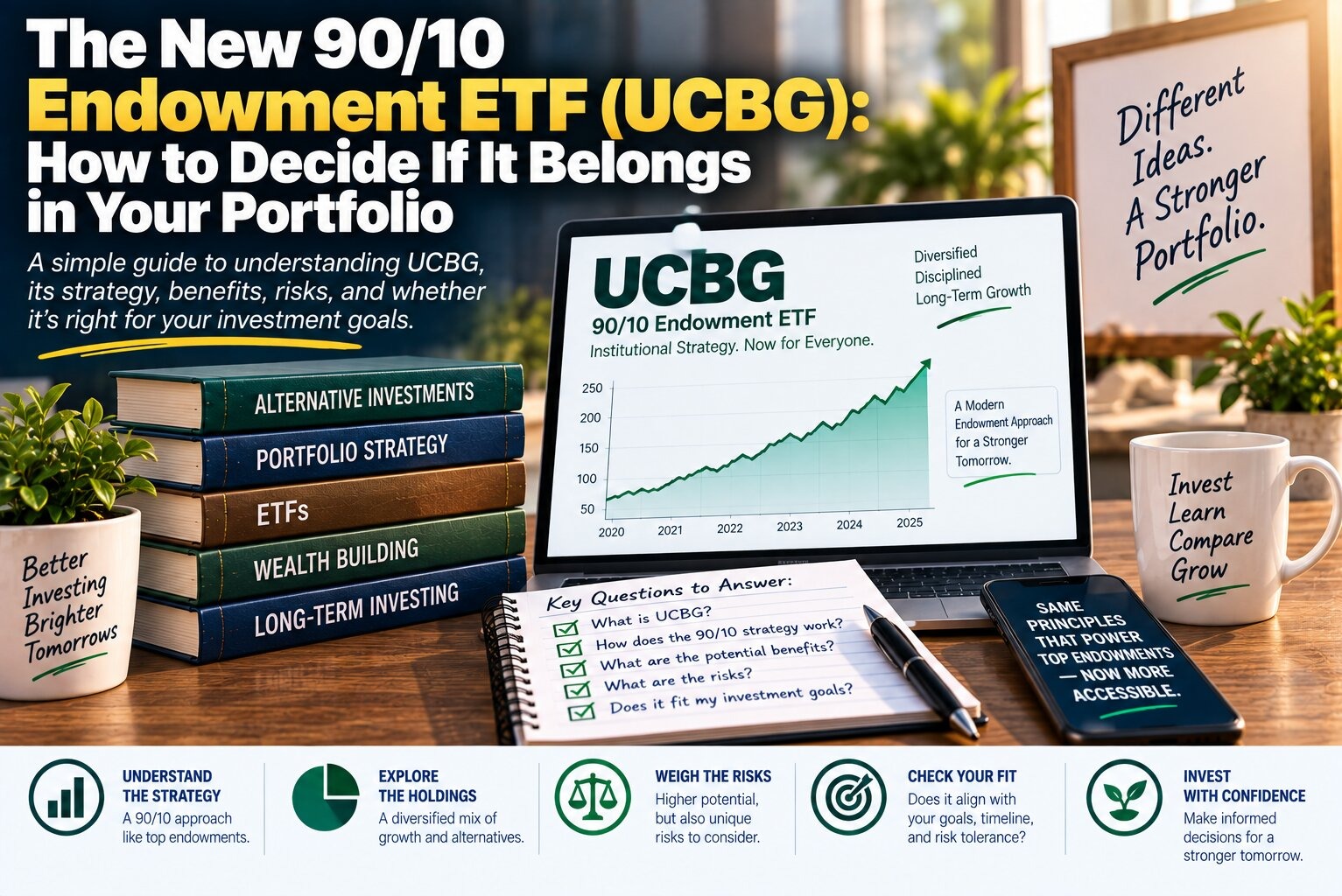
On September 2, 2026, State Street Investment Management launched the State Street SPDR UC Investments 90/10 Endowment Strategy Index ETF, trading under the ticker UCBG, with a $2.5 billion anchor investment from UC Investments — the office that manages money for the University of California system. That seed made UCBG the largest single ETF launch in U.S. history, and it did something more interesting than set a record: it repackaged a strategy UC Investments has used inside its own $7.9 billion Blue and Gold Endowment Pool, and inside the retirement plans of UC's 10 campuses and six medical centers, into a single fund anyone with a brokerage account can buy. The expense ratio is 0.06% — six basis points — for a portfolio that holds 90% large-cap U.S. equities and 10% short-duration, investment-grade corporate bonds.
If you've never had access to an institutional endowment strategy before, this is the first time one has shown up on a normal stock screener next to your index funds. That raises a practical question that matters far more than the launch itself: does a single 90/10 fund like this belong in your portfolio, how does it compare with the all-in-one funds you may already own, and — if you don't live in the U.S. — can you even buy it? This guide walks through all three.
What Is an Endowment-Style ETF, and How Is UCBG Different?
University endowments have historically invested very differently from a typical retail portfolio. Instead of the classic 60% stocks / 40% bonds split that dominates target-date funds and robo-advisor defaults, large endowments like UC's have leaned much more heavily into equities and alternative assets, betting that a multi-decade time horizon lets them ride out volatility in exchange for higher long-run returns. UCBG doesn't try to replicate the alternatives sleeve (private equity, venture capital, real assets) that a real endowment holds — that's not something you can package cheaply into a daily-traded ETF. What it does replicate is the aggressive stock-to-bond ratio: 90% S&P 500 exposure, 10% short-duration investment-grade bonds as a shock absorber rather than a return driver.
That's a meaningfully different design goal from a traditional 60/40 or even an 80/20 allocation fund. The 10% bond sleeve in UCBG isn't there to generate income or smooth out a retirement paycheck; it's there to give the fund a small amount of dry powder and a modest cushion against the sharpest equity drawdowns, while leaving almost all of the fund's return potential tied to U.S. large-cap stocks. In practice, that means UCBG will behave a lot more like a leveraged-light S&P 500 fund than like a balanced fund, and its risk profile is closer to 100% equities than most people expect from something marketed as a "90/10" allocation.
UCBG by the Numbers — and How It Compares
UCBG isn't the only single-ticket allocation fund on the market, and it isn't only Americans who have access to something like it. Here's how it stacks up against comparable funds available to investors in other Tier 1 markets:
| Fund (Market) | Approx. Allocation | Cost | Notes |
|---|---|---|---|
| UCBG – State Street SPDR UC Investments 90/10 (US) | 90% S&P 500 / 10% short-duration IG bonds | 0.06% | Launched Sept. 2, 2026 with record $2.5B anchor from UC Investments |
| AOA – iShares Core 80/20 Aggressive Allocation ETF (US) | ~80% global equity / 20% bonds | 0.15% | Broader global equity mix (US + international), not endowment-branded |
| Vanguard LifeStrategy 80% Equity Fund (UK) | 80% global equity / 20% bonds | 0.20% OCF | Fund (not ETF), widely used inside UK ISAs and pensions |
| VGRO – Vanguard Growth ETF Portfolio (Canada) | ~80% equity / 20% fixed income | 0.24% MER | All-in-one ETF popular in TFSAs and RRSPs |
| VDHG – Vanguard Diversified High Growth Index ETF (Australia) | 90% growth assets / 10% defensive | 0.27% MER | Closest non-US match to UCBG's 90/10 split |
Two things jump out. First, UCBG is dramatically cheaper than any of its closest peers — less than a third the cost of AOA and roughly a quarter the cost of VDHG, largely because it's a passively tracked index fund with no active management layer and a heavy weighting toward a single, cheap-to-track index (the S&P 500) rather than a blend of multiple underlying funds. Second, UCBG is the most equity-heavy of the group and the least internationally diversified: it's 90% U.S. large-cap, while AOA, LifeStrategy and VGRO all blend in meaningful non-U.S. equity exposure. That combination — cheap, concentrated, aggressive — is exactly what makes it worth evaluating carefully rather than buying reflexively because an institution's name is attached to it.
Who Should Consider This Kind of Fund?
An endowment-style, 90/10 single-ticket fund isn't a universal replacement for a diversified portfolio, and it isn't trying to be. It tends to make the most sense for a fairly specific investor profile.
- Long time horizon: At least 15-20 years until you'll need to draw on the money, since a fund that's effectively ~90% equity-like risk needs time to recover from downturns.
- High risk tolerance: You need to be comfortable watching the fund fall 25-35% in a bad year without panic-selling, because the 10% bond sleeve won't meaningfully cushion a broad equity selloff.
- Preference for simplicity: You'd rather hold one fund than rebalance a multi-fund portfolio yourself, and you're willing to accept US-only, large-cap-only exposure as the tradeoff for that simplicity.
- Already has other diversification: You hold international equity, small-cap, or bond exposure elsewhere (a 401(k), workplace pension, or other account), so UCBG is one piece of a bigger picture rather than your entire portfolio.
It's a poor fit if you're within a decade of retirement, if this would be the only fund in an account you can't add to elsewhere, or if a 30% drawdown would genuinely change your financial plans rather than just your mood.
Step-by-Step: How to Decide and Buy
If UCBG or a similar fund looks like a fit after reading the section above, work through these steps before placing an order rather than after.
- Step 1 — Check what you already own. Pull up your 401(k), IRA, or other brokerage holdings and calculate your current overall stock-to-bond mix and how much of your equity exposure is already U.S. large-cap. If you're already heavily concentrated in the S&P 500 through other funds, adding UCBG compounds that concentration rather than diversifying you.
- Step 2 — Decide what role it plays. Are you using it as a core holding, a satellite "growth" sleeve alongside international and bond funds, or a replacement for a target-date fund? Write the answer down; it will keep you from second-guessing the allocation during the next market drop.
- Step 3 — Confirm it's available in your account. UCBG trades on U.S. exchanges, so it's accessible through any standard U.S. brokerage account, and through most 401(k) self-directed brokerage windows, but check that your specific plan or platform lists it before assuming it does.
- Step 4 — Size the position. Because the fund behaves close to 100% equity risk, treat it as equity allocation in your overall plan, not as a "balanced" holding, when you calculate how much of your total portfolio it represents.
- Step 5 — Automate and hold. Endowment strategies work over decades, not quarters. If you buy, consider dollar-cost averaging in rather than investing a lump sum right after a record-breaking launch, and set a rebalancing schedule (annually is typical) rather than reacting to headlines.
If You're Outside the US: How to Access a Similar Strategy
UCBG is a U.S.-listed ETF, and that creates a real obstacle for investors in the UK and European Union specifically. Under UK and EU retail-investor protection rules (the PRIIPs regulation and its UK successor), brokers generally cannot offer U.S.-domiciled ETFs to retail clients unless the fund publishes a Key Information Document (KID) in the required format — and most U.S. ETF issuers, including State Street, don't produce one for products like UCBG. In practice, that means most UK and EU discount brokers will block a retail order for UCBG entirely, even though the ticker is easy to find on U.S. market data sites.
That's not the case everywhere. Canadian and Australian brokers generally do allow retail clients to buy U.S.-listed ETFs like UCBG directly (subject to currency conversion and any foreign-holding tax paperwork), so investors there have a genuine choice between UCBG and a domestic equivalent. If you're in the UK or EU, or you'd simply rather hold a fund denominated in your home currency, the funds in the comparison table above — Vanguard LifeStrategy 80% Equity for UK/EU investors, VGRO for Canadians, VDHG for Australians and New Zealanders — are the closest available substitutes, even though none of them matches UCBG's ultra-low 0.06% fee or its near-total US-only concentration.
Common Mistakes to Avoid
- Assuming "endowment" means diversified. UC Investments' actual endowment pool holds private equity, real assets, and international exposure that UCBG doesn't replicate. The ETF borrows the risk ratio, not the full strategy.
- Treating the 10% bond sleeve as real downside protection. Short-duration investment-grade bonds cushion interest-rate risk, not a broad stock market decline. Don't expect UCBG to hold up meaningfully better than the S&P 500 itself in a downturn.
- Buying it as your only fund without checking overlap. If your 401(k) already holds S&P 500 or total-market funds, stacking UCBG on top can leave you far more concentrated in U.S. large-cap stocks than you intended.
- Chasing the launch headline. A record-breaking anchor investment says something about institutional confidence in the structure, not about near-term price direction. Don't buy simply because the launch made news.
- Ignoring tax location. In the US, a fund this equity-heavy is often more efficient held in a tax-advantaged account (IRA, 401(k)) than in a taxable brokerage account, depending on your turnover and dividend tax situation.
Practical Tips Before You Buy
Read the fund's actual prospectus and index methodology before buying, not just news coverage of the launch — State Street publishes both on its website, and the index rules explain exactly how and when the 90/10 split rebalances. Compare UCBG's one-year and since-inception performance against a plain S&P 500 index fund once there's a track record beyond the first few weeks; because the fund is 90% S&P 500 by design, the two will move almost identically, and the real question is whether the small bond sleeve and six-basis-point fee justify choosing UCBG over a fund you may already hold. Finally, set a calendar reminder to revisit your allocation to any 90/10-style fund once a year, since a fund this equity-heavy can quietly become a much larger share of your net worth than you planned for after a strong run in the market.