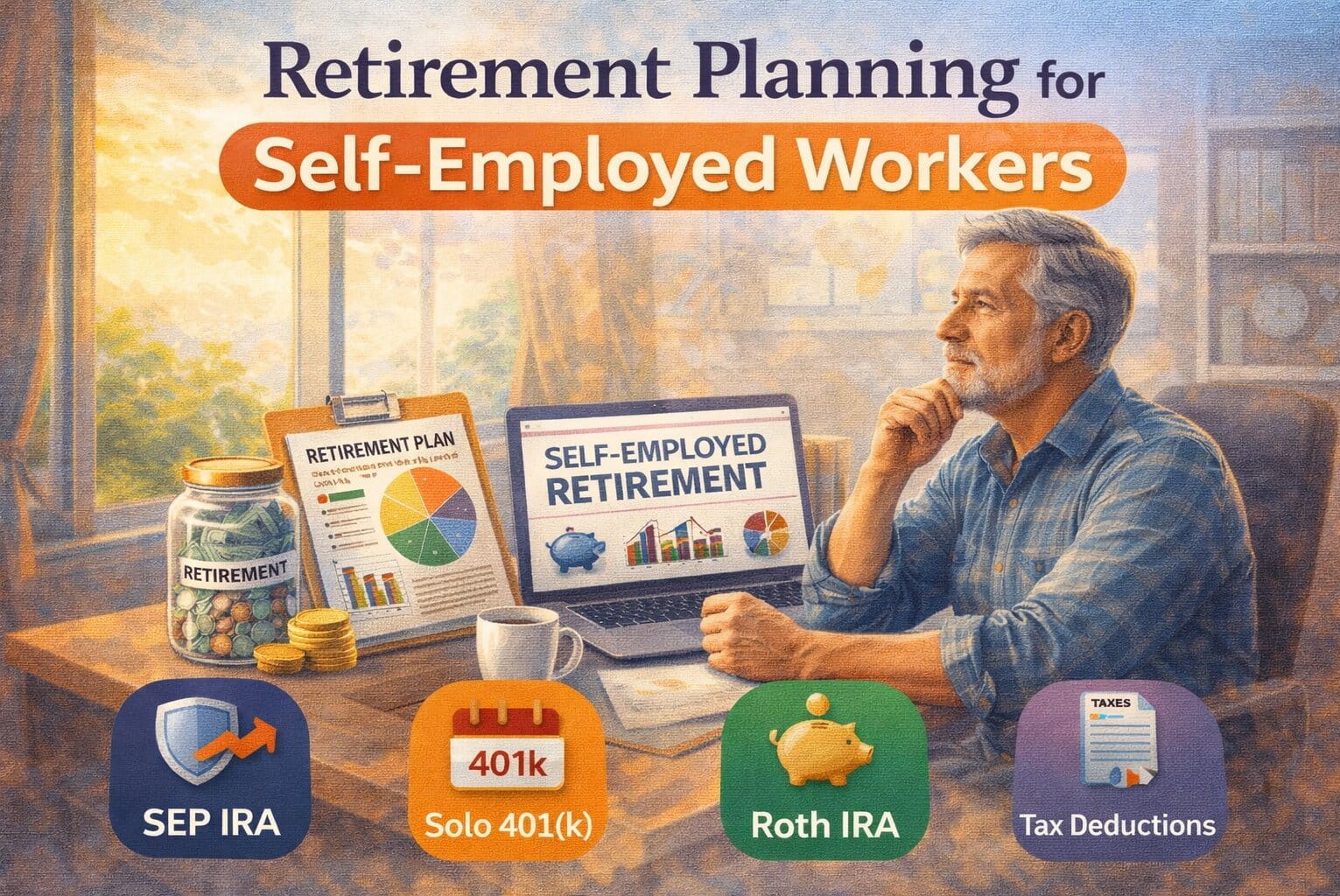
Retirement planning is already challenging—but if you’re self-employed, it becomes even more important.
There’s no employer-sponsored 401(k), no automatic contributions, and no company match. Everything depends on you.
The good news? Self-employed individuals actually have more flexibility and higher contribution opportunities—if they plan correctly.
Let’s break down how to build a strong retirement plan when you’re your own boss.
Why Retirement Planning Is Different for Self-Employed Workers
When you’re self-employed:
- You don’t have a built-in retirement plan
- Your income may fluctuate
- You’re responsible for saving and investing
But you also get:
- More control over contributions
- Access to powerful retirement accounts
- Flexibility in investment strategies
Key Challenge: No Employer Match
One of the biggest disadvantages is missing out on employer contributions.
Example:
An employee with a 5% employer match is effectively getting “free money.”
As a self-employed worker, you need to:
Replace that benefit by saving more yourself
Best Retirement Accounts for Self-Employed Workers
Here are the top options:
| Account Type | Contribution Potential | Best For |
|---|---|---|
| SEP IRA | High | Freelancers, small businesses |
| Solo 401(k) | Very High | High-income self-employed |
| Traditional IRA | Moderate | Tax deduction |
| Roth IRA | Moderate | Tax-free growth |
To explore all options:
https://statush.com/retirement-planning/best-retirement-accounts-usa
SEP IRA: Simple and Powerful
A SEP IRA allows you to contribute a percentage of your income—often much higher than traditional IRAs.
Example:
- Income: $100,000
- Contribution: Up to ~$25,000
Advantages:
- Easy setup
- High contribution limits
- Tax-deductible contributions
Solo 401(k): Maximum Flexibility
The Solo 401(k) is one of the best tools for self-employed individuals.
You can contribute as both:
- Employee
- Employer
This allows very high total contributions.
Example:
- Salary deferral + profit sharing
- Potential contributions exceeding $60,000 annually
Bonus:
- Option for Roth contributions
Roth IRA: Tax-Free Growth
Even if you’re self-employed, a Roth IRA is a valuable addition.
- Contributions are after-tax
- Withdrawals are tax-free
To understand how it works:
https://statush.com/retirement-planning/how-roth-ira-contributions-work
Real-World Example
Case Study:
- Freelance designer earning $120,000/year
Strategy:
- Solo 401(k): $30,000 contribution
- Roth IRA: $6,500 contribution
Total annual savings: ~$36,500
Over time, this builds significant retirement wealth.
How Much Should You Save?
Without employer support, self-employed workers should aim to save:
- 20%–30% of income (or more if possible)
Your savings rate becomes your biggest advantage.
To align with age-based goals:
https://statush.com/retirement-planning/how-much-should-you-save-for-retirement-by-age
Managing Irregular Income
One of the biggest challenges is inconsistent income.
Strategies:
- Save a percentage, not a fixed amount
- Contribute more during high-income months
- Maintain a buffer fund
Example:
In a high-income quarter, increase contributions to stay on track.
Investment Strategy for Self-Employed Workers
Your investment approach should balance:
- Growth (stocks, index funds)
- Stability (bonds)
- Income (dividends, REITs)
For portfolio guidance:
https://statush.com/retirement-planning/retirement-investment-portfolio-allocation
Building Passive Income Streams
Self-employed workers often have an advantage—they’re already entrepreneurial.
You can build additional income through:
- Dividend investments
- Rental properties
- Online businesses
To explore ideas:
https://statush.com/retirement-planning/how-to-create-passive-income-for-retirement
Tax Planning Is Critical
Taxes can significantly impact your savings.
Strategies:
- Use tax-deferred accounts (SEP IRA, Solo 401k)
- Combine with Roth accounts for flexibility
- Deduct business expenses effectively
To reduce taxes in retirement:
https://statush.com/retirement-planning/how-to-reduce-taxes-in-retirement
Planning for Social Security
Even as a self-employed worker, you contribute to Social Security through self-employment tax.
Your benefits depend on:
- Reported income
- Years worked
To understand calculations:
https://statush.com/retirement-planning/how-social-security-benefits-are-calculated
Common Mistakes to Avoid
- Not saving consistently
- Ignoring retirement accounts
- Underestimating income needs
- Mixing business and personal finances
For more pitfalls:
https://statush.com/retirement-planning/retirement-mistakes-to-avoid
How It Fits Into Your Overall Plan
Retirement planning for self-employed workers requires a complete system:
- Savings strategy
- Investment plan
- Tax planning
- Income planning
To build a full strategy:
https://statush.com/retirement-planning/retirement-income-planning-strategies
Final Thoughts
Being self-employed means you don’t have a safety net—but you have something better: control.
You decide how much to save, where to invest, and how to structure your retirement.
With the right strategy, self-employed individuals can build even stronger retirement plans than traditional employees.
The key is consistency, discipline, and using the tools available to you.
Start early, stay committed, and your future self will thank you.