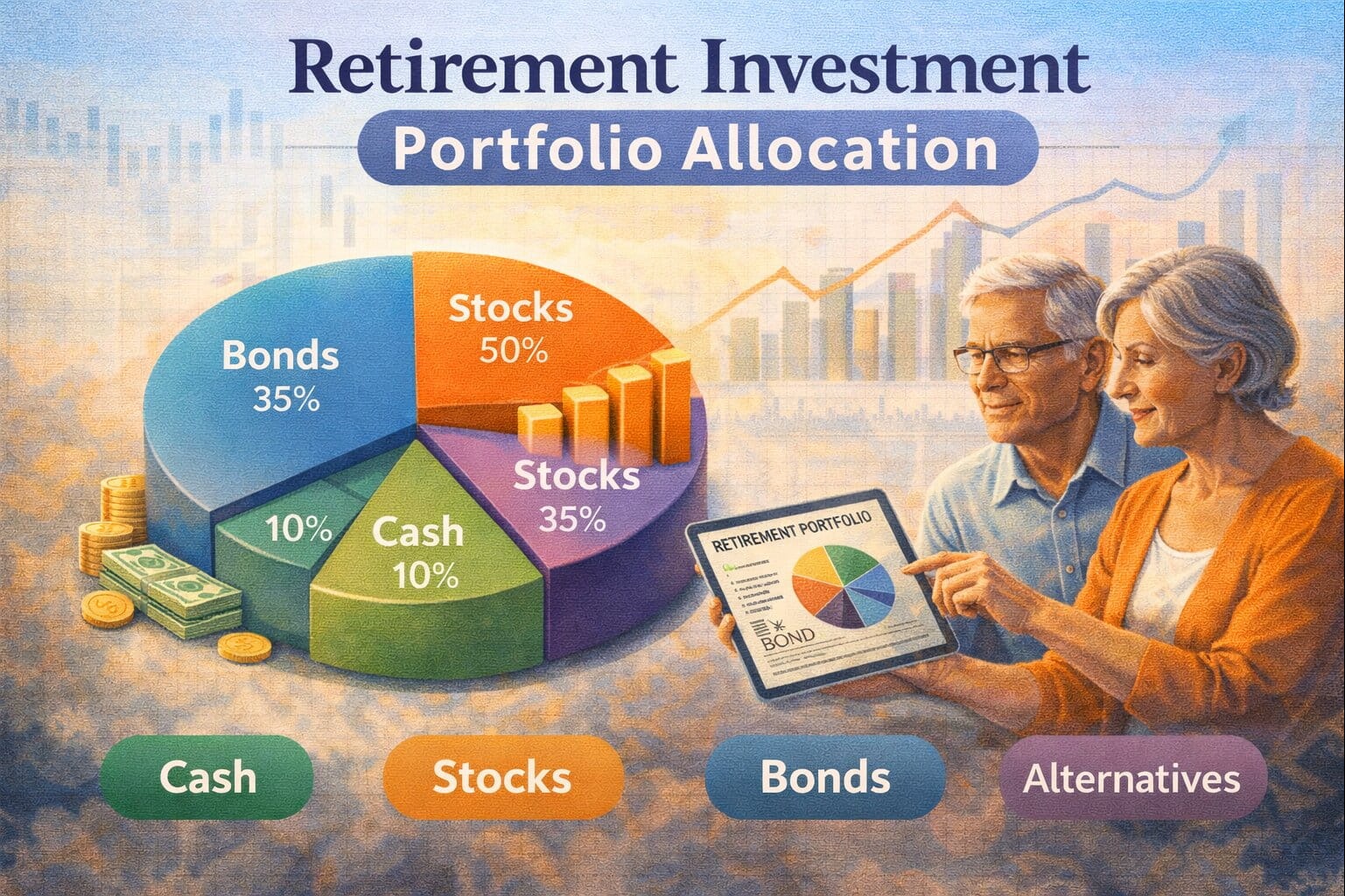
Building a retirement portfolio isn’t just about picking good investments—it’s about how you divide your money across different asset types.
This is called portfolio allocation, and it plays a huge role in:
- Managing risk
- Generating income
- Ensuring long-term growth
A well-balanced allocation can help your savings last decades, even through market ups and downs.
Let’s break it down in a simple, practical way.
What Is Portfolio Allocation?
Portfolio allocation is how you distribute your investments across different asset classes, such as:
- Stocks (growth)
- Bonds (stability)
- Cash (liquidity)
- Real estate (income)
The goal is to balance:
Growth + Stability + Income
Why Allocation Matters More Than Stock Picking
Many people focus on choosing the “best” stocks—but allocation often matters more.
Example:
- Portfolio A: 100% stocks → high growth, high risk
- Portfolio B: Balanced mix → moderate growth, lower risk
Over time, Portfolio B may perform more consistently—especially in retirement.
Basic Asset Allocation Breakdown
Here’s a simple starting point:
| Asset Class | Purpose | Risk Level |
|---|---|---|
| Stocks | Growth | High |
| Bonds | Stability | Low–Medium |
| Cash | Liquidity | Low |
| Real Estate | Income + Growth | Medium |
Each plays a different role in your portfolio.
Age-Based Allocation Strategy
Your allocation should change as you age.
In Your 20s–30s (Growth Focus)
| Asset | Allocation |
|---|---|
| Stocks | 80–90% |
| Bonds | 10–20% |
| Cash | Minimal |
You have time to recover from market downturns.
In Your 40s–50s (Balanced Growth)
| Asset | Allocation |
|---|---|
| Stocks | 60–70% |
| Bonds | 30–40% |
| Cash | Small reserve |
Focus shifts toward stability while maintaining growth.
In Your 60s+ (Income & Preservation)
| Asset | Allocation |
|---|---|
| Stocks | 40–60% |
| Bonds | 30–50% |
| Cash | 5–10% |
The goal is to protect your savings while generating income.
Real-World Example
Case Study:
- Retiree with $1 million portfolio
Allocation:
- $500K in stocks
- $350K in bonds
- $100K in REITs
- $50K in cash
This provides:
- Growth from stocks
- Stability from bonds
- Income from REITs
- Liquidity from cash
The Role of Stocks in Retirement
Stocks are essential—even in retirement.
Why?
- They help your portfolio grow
- They protect against inflation
Without stocks, your savings may lose value over time.
The Role of Bonds
Bonds provide:
- Stability
- Predictable income
- Lower volatility
They act as a cushion during market downturns.
The Role of Cash
Cash is often underestimated.
It helps:
- Cover short-term expenses
- Avoid selling investments during downturns
Example:
Keeping 1–3 years of expenses in cash adds security.
The Role of Real Estate
Real estate (or REITs) provides:
- Income
- Diversification
- Potential appreciation
It’s a useful addition to many retirement portfolios.
Diversification: Your Safety Net
Diversification spreads risk across multiple assets.
Example:
- If stocks drop → bonds may remain stable
- If inflation rises → real estate may perform well
This balance protects your portfolio.
Rebalancing Your Portfolio
Over time, your allocation will shift.
Example:
- Stocks perform well → portfolio becomes stock-heavy
Rebalancing means:
- Selling some assets
- Buying others
- Returning to your target allocation
This keeps your risk level consistent.
Income vs Growth Balance
In retirement, you need both:
| Goal | Investment Type |
|---|---|
| Income | Bonds, dividends |
| Growth | Stocks |
| Stability | Cash |
Balancing these ensures long-term sustainability.
Common Allocation Mistakes
- Being too aggressive near retirement
- Being too conservative too early
- Lack of diversification
- Ignoring rebalancing
For more pitfalls:
https://statush.com/retirement-planning/retirement-mistakes-to-avoid
How Allocation Supports Income Planning
Your allocation directly affects your retirement income.
Example:
- Stocks → long-term growth
- Bonds → steady income
- Dividends → cash flow
To build a full income strategy:
https://statush.com/retirement-planning/retirement-income-planning-strategies
Protecting Against Market Crashes
A good allocation reduces risk during downturns.
Example:
- Stock-heavy portfolio → large losses
- Balanced portfolio → smaller decline
To learn more:
https://statush.com/retirement-planning/how-to-protect-retirement-savings-from-market-crashes
How It Connects to Your Retirement Goals
Your portfolio allocation should match:
- Your risk tolerance
- Your retirement timeline
- Your income needs
To align with savings goals:
https://statush.com/retirement-planning/how-much-should-you-save-for-retirement-by-age
Practical Tips
- Adjust allocation as you age
- Diversify across asset classes
- Rebalance annually
- Keep a mix of growth and income investments
- Avoid emotional decisions
Final Thoughts
Portfolio allocation is the backbone of retirement investing.
It determines how your money grows, how it’s protected, and how it supports your lifestyle.
The best allocation isn’t the most aggressive or the most conservative—it’s the one that fits your goals and adapts over time.
With a well-structured portfolio, you can navigate market changes, generate income, and enjoy a more secure retirement.