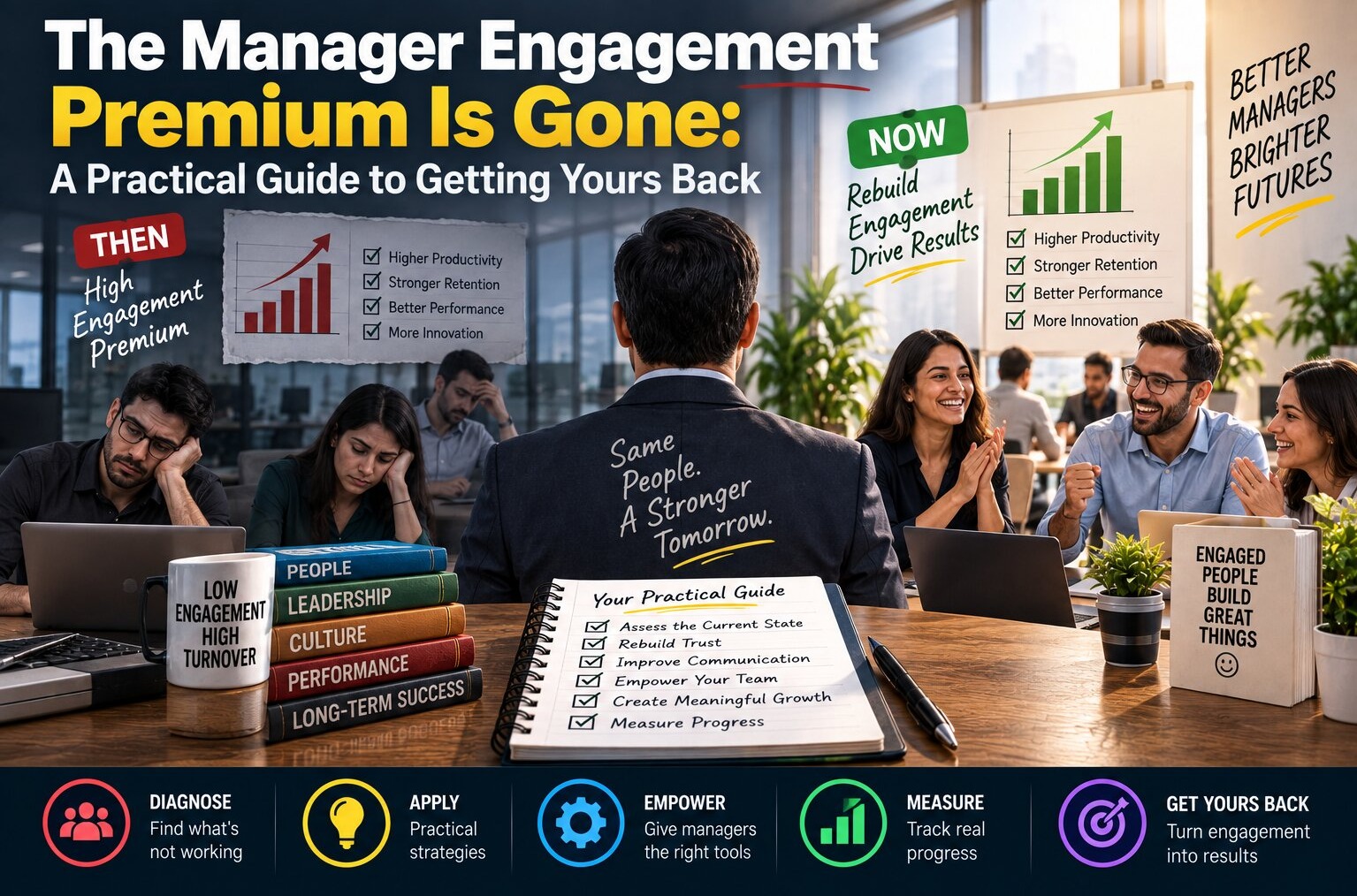
Gallup's State of the Global Workplace 2026 report, drawn from workers across dozens of countries, contains a number that should worry anyone with direct reports: global employee engagement has fallen to 20%, the lowest level since 2020 and the second straight annual decline. Gallup puts the economic toll at roughly $10 trillion in lost productivity worldwide, close to 9% of global GDP. But the harder number, if you're a manager, is this one: managers used to be meaningfully more engaged than the people they lead — an 11-point “engagement premium” back in 2022. By 2025, that premium had shrunk to just 3 points. Manager engagement itself dropped from 31% to 22% over the same three years, with the single biggest one-year fall — five points — landing between 2024 and 2025.
In plain terms, the people whose job is to keep everyone else engaged are now barely more engaged than the teams they manage. That matters well beyond the US: Gallup's data spans North America, the UK, Western Europe, and Australia and New Zealand, and the erosion shows up broadly, not in one market. If you manage people anywhere in a Tier 1 economy, this is a guide to figuring out where you actually stand and what to do about it before it shows up in your own performance review or your team's turnover numbers.
What the Report Actually Found
Gallup didn't just report a single bad number. The report breaks the manager engagement collapse into pieces that point to different fixes, and it's worth separating them before you decide what to act on.
| Measure | What Gallup Found | What It Means for You |
|---|---|---|
| Global engagement | 20% of employees engaged in 2025, down for the second consecutive year, lowest since 2020 | The floor under everyone's motivation, including yours, is lower than it's been in five years |
| Manager engagement | Fell from 31% (2022) to 22% (2025), a 9-point drop, with 5 of those points lost in the last year alone | If you feel less invested than you did two years ago, the data says you're not imagining it |
| The “engagement premium” | Managers led individual contributors by 11 points in 2022; by 2025 the gap was down to 3 | Being promoted no longer comes with a built-in motivation boost — you have to build it yourself now |
| Best-practice organizations | Manager engagement of 79% versus the 22% global average — roughly 4x higher | The gap is driven by what your organization does, not by geography, sector, or company size |
| Younger managers | Managers under 35 saw one of the sharpest single-year drops, around 5 points | If you're early in your management career, you're in the highest-risk group, not a protected one |
Why the Premium Disappeared
Three forces are doing most of the damage, and none of them are going away on their own. First, organizations have been cutting management layers and widening spans of control, so the average manager now oversees more people with less structural support than five years ago. Second, AI adoption has added a genuine new set of responsibilities — reviewing AI-generated output, deciding when to override it, coaching a team through a tool that changes monthly — without removing any of the old workload. Managers are absorbing net-new work, not trading old tasks for new ones. Third, the role itself used to come with real autonomy and a clear line of sight to results, which is part of why managers were historically more engaged than their teams. Flatter structures and tighter oversight have quietly stripped away some of that autonomy, so the psychological payoff of being “the boss” has shrunk right along with the engagement premium.
None of this means you're doing a bad job. It means the job itself has gotten structurally harder to feel good about, at the exact moment your team is watching you for cues on how to feel about their own work.
How to Diagnose Where You Actually Stand
Before you try to fix anything, get an honest read on your own engagement rather than assuming you're fine because you're still hitting targets. Gallup's engagement research is built around specific, checkable behaviors and feelings, not vague mood. Run through these:
- You can name, specifically, what you're expected to deliver this quarter — not generally, but in terms someone could check.
- You have the materials and tools you need to do your job well, including for AI-related tasks you've picked up in the last year.
- You've had a genuine conversation about your development, not just your team's, in the last six months.
- Someone above you has expressed real interest in you as a person, not just as a manager delivering output.
- You feel your opinion counts when decisions are made that affect your team.
- You can point to something specific in the last week that made you feel like your work matters.
If you're honestly answering no to three or more of these, you're likely inside the 78% of managers Gallup would classify as not engaged or actively disengaged — and the data says that's now the majority experience, not an outlier one.
A Step-by-Step Plan to Rebuild Your Own Engagement
Fixing this isn't about willpower or a better attitude. Gallup's own data on what works points to concrete, learnable practices rather than motivational tricks, and the biggest gains come from combining more than one of them.
- Get role-specific coaching, not generic leadership training. Gallup found that teaching managers structured coaching skills improved their measured performance by 20% to 28%. This is bigger than most one-off workshops deliver, and it's specific enough to ask for by name.
- Pair training with ongoing support. Managers who received both initial training and continued development support saw their wellbeing scores nearly double, from 28% to 50%. A single seminar won't move that number; a coach or peer group checking in monthly will.
- Renegotiate what's actually on your plate. If AI oversight has been added to your role in the last year, ask your own manager explicitly what should come off in exchange. Don't let net-new work sit silently on top of the old list.
- Rebuild your line of sight to results. Part of the old engagement premium came from managers seeing a clear connection between their work and outcomes. Ask for direct access to the metrics your decisions actually move, rather than a summarized version several layers removed from the work.
- Find or build a peer group. Isolation compounds disengagement. Managers who talk regularly with other managers facing the same structural pressures catch problems earlier and feel less alone carrying them.
How to Get Your Organization to Actually Invest in You
The 4x gap between best-practice organizations (79% manager engagement) and the global average (22%) is not explained by industry, company size, or country — Gallup is explicit that it comes down to organizational choices. That means you can make a specific case to your own leadership rather than hoping culture improves on its own. Bring the numbers: a 20-28% performance lift from coaching, and a near-doubling of wellbeing when training is paired with ongoing support, are concrete enough to justify a training or coaching budget line. If your organization already tracks employee engagement, ask whether it tracks manager engagement separately — Gallup recommends this specifically, because folding managers into the general employee number hides exactly the problem this report identifies. Separating the two metrics is free, takes one conversation with HR or people analytics, and gives your organization an early warning system it doesn't currently have.
Why This Also Protects Your Team
This isn't only about your own wellbeing. Gallup's longer-running research shows managers account for roughly 70% of the variance in their team's engagement scores — more than any other single factor measured. A disengaged manager doesn't just underperform quietly; the effect cascades. On the flip side, managers who actively champion new tools see outsized returns: employees whose manager actively supports their use of AI are 8.7 times more likely to say AI has meaningfully changed how they work, compared to teams without that active support. Rebuilding your own engagement is, in a very literal sense, the highest-leverage thing you can do for your team's engagement too.
Common Mistakes Managers Make When Trying to Fix This
- Treating it as a personal failing. Assuming disengagement means you've lost your edge, rather than recognizing a structural, industry-wide shift the data confirms.
- Waiting for HR to notice. Manager engagement is easy to miss when it's averaged into general employee engagement numbers — you may need to raise it yourself.
- Taking on more without renegotiating scope. Absorbing AI-oversight duties as a favor rather than a real addition to the job, then wondering why nothing feels sustainable.
- Choosing one-off training over ongoing support. A single workshop rarely moves the needle the way continued coaching does — the wellbeing jump from 28% to 50% required both.
- Assuming this is a US-only trend. The underlying report is global; a manager in Manchester, Toronto, Sydney, or Berlin is looking at the same structural pressures as one in Chicago.
What to Do Next
Start with the self-diagnostic above this week, not next quarter. If three or more answers came back “no,” put a specific ask in front of your own manager within the next two weeks: name the coaching or development support you want, and name what you'd trade off your plate to make room for it. Separately, ask whether your organization tracks manager engagement as its own metric. If it doesn't, suggest it does — you'll be giving your organization visibility into a problem this report shows most companies are currently flying blind on. None of this requires waiting for a company-wide initiative. The data suggests the gap is closed one manager, one conversation, at a time.
Related Articles
- Only 42% of Managers Feel Ready to Lead: How to Close Your Own Leadership Readiness Gap
- How to Close the Leadership Readiness Gap: A Manager's Guide to AI Anxiety, Layoffs, and Hard Conversations
- How to Close the Manager Coaching Gap Before It Costs You Your Team
- Companies Are Pouring $2.5 Trillion Into AI. Most Leadership Teams Still Can't Say Who's in Charge of It