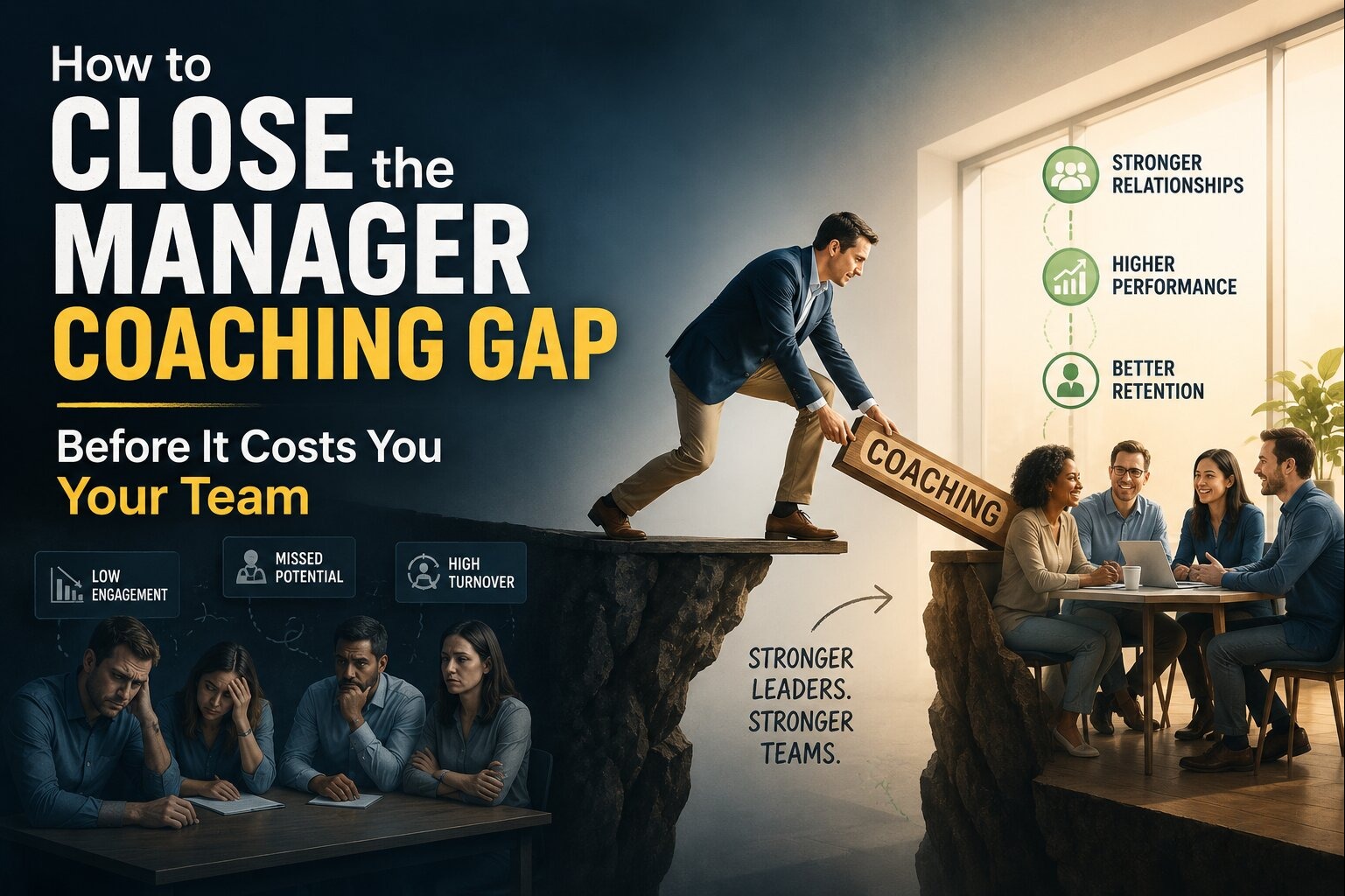
A new report from LifeLabs Learning, drawing on anonymous input from more than 20,000 HR professionals, business leaders, and workshop participants, found that 56% of respondents rated their managers' coaching and feedback capability at 5 out of 10 or lower. Only 14% gave their managers a rating between 8 and 10. The same research found that just 19% of managers report having strong delegation skills — the ability to hand off work effectively between people and, increasingly, AI tools.
Separately, a Harvard Business Review piece published June 26, 2026 by Julia Shin and Sandra J. Sucher, based on 18 interviews with partners, managers, and junior staff at two consulting firms, found that middle managers are now expected to validate AI-generated work, catch its errors, and coach their teams on using it — on top of unchanged delivery targets and with almost no formal training to do any of it. If you manage people right now, both studies are describing your job. Here's how to close the gap before it shows up in your next engagement survey or in someone's exit interview.
What the Numbers Mean for You
These aren't abstract industry statistics. A 56% "below average" coaching rating means that if you picked ten managers at random inside a typical company, roughly six of them would be rated poorly on the single skill most tied to retention, engagement, and team performance: giving people useful, timely feedback and helping them think through problems instead of just handing them answers. The delegation number is arguably worse. Only 19% of managers delegate well, which means most managers are either doing too much work themselves or dumping tasks without the context people need to succeed.
Layer AI on top of that and the pressure compounds. The HBR research found managers absorbing a new, largely unacknowledged job: reviewing AI output for accuracy, deciding when to trust it and when not to, and teaching their teams to do the same — all without a playbook. If your organization hasn't given you one yet, you'll need to build a personal one. The rest of this guide walks through exactly how.
| Core Manager Skill | What Weak Looks Like | What Strong Looks Like | Quick Fix to Start This Week |
|---|---|---|---|
| Feedback | Feedback saved for annual reviews; vague ("good job," "needs improvement") | Specific, timely, tied to a concrete example within days | Give one piece of specific feedback within 48 hours of observing the behavior |
| Coaching | Answering questions directly; solving problems for people | Asking questions that help the person reach their own answer | In your next 1:1, ask "what have you already tried?" before offering a solution |
| Delegation | Keeping high-value work; assigning tasks without context or authority | Matching task to skill level; delegating outcomes, not just steps | Pick one recurring task you still do yourself and hand it off with the "why" attached |
| AI Oversight | Either rubber-stamping AI output or banning it outright | Clear rules for when AI output needs human review and by whom | Write a one-page team guideline on which tasks require a human check before AI output ships |
How to Diagnose Your Own Coaching Gap
Before you can fix a gap, you need to know where yours actually is, and most managers guess wrong. Start by counting, not judging: over the next two weeks, track how many times you answered a direct report's question versus how many times you asked a question back and let them work through it. Most managers who think of themselves as "good coaches" are shocked to find the ratio is 10-to-1 in favor of just answering. That's not coaching, it's being a help desk, and it trains your team to bring you problems instead of solving them.
Next, ask two or three direct reports directly: "When was the last time I gave you feedback that actually changed how you approached something?" If nobody can name a specific instance from the past month, that's your answer. Feedback that isn't remembered didn't land, regardless of how often you think you're giving it.
Step-by-Step: Build a Weekly Coaching Habit
- Block 20 minutes a week per direct report that is protected specifically for coaching conversations, not status updates. Put it on the calendar with a name like "Growth Check-in" so it doesn't get treated as optional.
- Use a simple three-question structure: What's going well? What's harder than it should be? What's one thing you want to get better at? This takes the pressure off you to have answers and puts the thinking where it belongs.
- Write down one commitment from each conversation — yours or theirs — and follow up on it explicitly next time. Coaching that isn't followed up on reads as small talk.
- Separate coaching from performance management. If every coaching conversation feels like a review, people will stop being honest in them. Save formal performance issues for a separate, clearly labeled conversation.
- Ask for feedback on your feedback. Once a quarter, ask directly: "Is the feedback I give you actually useful, or does it feel vague?" Most managers never ask this and have no idea how their feedback actually lands.
How to Delegate Without Losing Control
The 19% delegation statistic tracks with something coaches see constantly: managers either hoard work because handing it off feels riskier than doing it themselves, or they delegate the task without delegating the authority to make decisions about it, which just creates a bottleneck one step removed. Good delegation means being explicit about three things every time: the outcome you need, the boundaries the person is working within, and how much authority they have to make calls without checking back with you.
With AI now doing a growing share of first-draft work, delegation has an added layer. The HBR research is blunt about the risk here: managers who delegate review of AI output without giving people clear standards for what "good" looks like end up either rubber-stamping mistakes or re-doing the work themselves anyway, which erases any time savings AI was supposed to create. Before you hand a team member an AI-assisted task, tell them explicitly what kind of errors to watch for and what level of scrutiny the output needs. That single sentence of context is often the difference between a delegated task that works and one that boomerangs back to your desk.
A Simple Delegation Script
When handing off a task, say: "Here's the outcome I need by [date]. Here's what you have full authority to decide on your own. Here's the one thing I need to be looped in on before it goes out." That's it. Most delegation failures trace back to skipping the second and third sentences.
Who Should Prioritize This Right Now
Not every manager needs to overhaul their approach overnight, but a few groups should treat this as urgent. First-time managers promoted in the past year are the highest-risk group, since they're learning to manage at the exact moment AI tools are reshaping what their teams' day-to-day work looks like. Managers overseeing teams that have recently adopted AI tools for drafting, coding, or analysis should also move fast, since the HBR research specifically flags that layer as absorbing new, unstructured review work. And any manager whose last engagement survey flagged low scores on "feels supported by their manager" or "gets useful feedback" should treat this guide as a direct response to that data, not a general best practice to get to eventually.
Common Mistakes to Avoid
- Treating coaching as a once-a-year event. Annual reviews are too infrequent to change behavior; by the time feedback arrives, the context is gone.
- Confusing being available with being a coach. Answering every Slack message quickly feels helpful but often means you're solving problems your team should be learning to solve themselves.
- Delegating tasks but not decisions. If someone has to come back to you for every judgment call, you haven't delegated the work, you've just relocated it.
- Letting AI review go unowned. If nobody on the team knows whose job it is to catch an AI mistake before it ships, assume it's currently nobody's job.
- Waiting for company-wide training. Formal leadership programs are valuable, but the report data suggests most organizations haven't rolled them out fast enough to match how quickly AI adoption is changing managers' day-to-day workload. Build your own habits in the meantime.
What to Do Next
Pick one skill from the table above, not all four, and commit to a single concrete change this week: one coaching conversation using the three-question structure, or one task delegated with the full script instead of a half-explained handoff. Managers who try to fix feedback, coaching, delegation, and AI oversight simultaneously tend to improve none of them. The organizations behind this data agree on one thing: manager readiness in 2026 is being built in small, repeated habits, not in a single training session, and the managers who start now will be the ones their teams actually remember as good bosses.