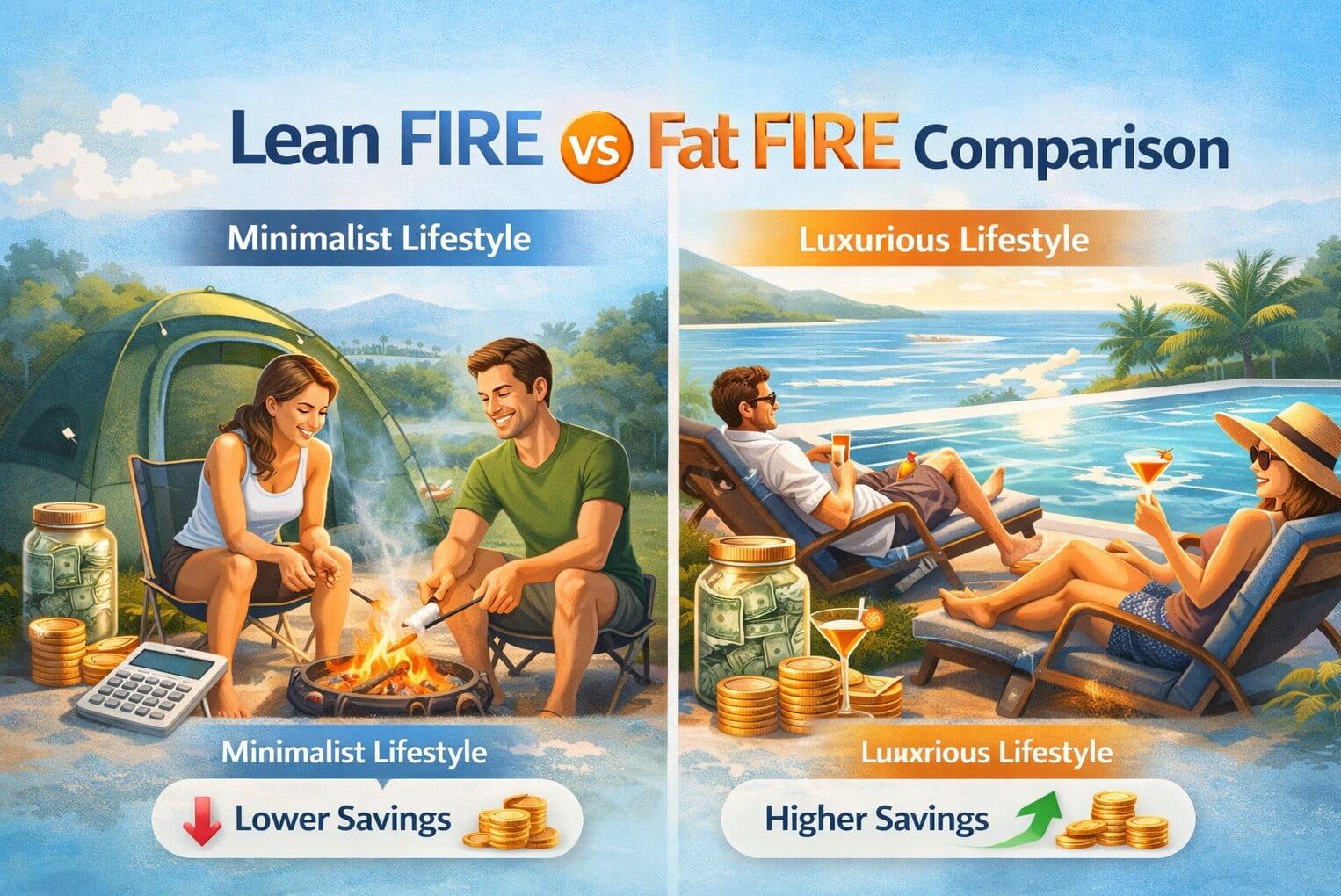
If you’ve been exploring the FIRE movement (Financial Independence, Retire Early), you’ve probably come across two popular variations: Lean FIRE and Fat FIRE.
Both aim for financial independence—but they take very different paths when it comes to lifestyle, savings, and spending.
Understanding the difference can help you choose a strategy that actually fits your life—not just your numbers.
What Are Lean FIRE and Fat FIRE?
At a high level:
- Lean FIRE focuses on retiring early with a minimal, budget-conscious lifestyle
- Fat FIRE focuses on retiring early with a comfortable or even luxurious lifestyle
Both rely on the same core principle:
Build enough investments so your money can cover your living expenses.
If you’re new to the FIRE concept, start here:
https://statush.com/retirement-planning/what-is-the-fire-movement
Lean FIRE vs Fat FIRE (Simple Comparison Table)
| Feature | Lean FIRE | Fat FIRE |
|---|---|---|
| Lifestyle | Minimal | Comfortable / Luxury |
| Annual Expenses | Low ($25K–$40K) | High ($80K+) |
| Required Savings | Lower | Much higher |
| Savings Rate | High | Moderate to high |
| Retirement Age | Earlier possible | Slightly later |
| Flexibility | Limited | High |
This table gives a quick snapshot—but the real difference lies in lifestyle choices.
What Is Lean FIRE?
Lean FIRE is about achieving financial independence with lower living expenses.
Instead of aiming for a large retirement fund, you reduce how much you need.
Example:
- Annual expenses: $30,000
- Required savings: $30,000 × 25 = $750,000
That’s a much smaller target compared to traditional retirement goals.
Real-World Scenario
Case Study:
- Mike, age 35
- Saves aggressively and keeps expenses low
- Lives in a low-cost area
- Reaches $800,000
He retires early and maintains a simple lifestyle—minimal luxury, but full freedom.
What Is Fat FIRE?
Fat FIRE is the opposite approach—you aim for financial independence without sacrificing lifestyle.
Instead of cutting expenses drastically, you increase your savings and investments.
Example:
- Annual expenses: $100,000
- Required savings: $2.5 million
This requires more time, income, or both.
Real-World Scenario
Case Study:
- Sarah, age 40
- High-income professional earning $200,000+
- Saves aggressively but still enjoys lifestyle
- Reaches $2.5–$3 million
She retires early with comfort—travel, dining, and flexibility.
Key Difference: Expenses Drive Everything
The biggest difference between Lean FIRE and Fat FIRE is how much you plan to spend annually.
Here’s why that matters:
- Lower expenses → smaller target → faster retirement
- Higher expenses → larger target → longer timeline
It’s not about right or wrong—it’s about priorities.
Savings Rate Comparison
Your savings rate plays a major role in both strategies.
| Strategy | Typical Savings Rate |
|---|---|
| Lean FIRE | 50%–70%+ |
| Fat FIRE | 20%–50% |
Lean FIRE often requires stricter discipline early on, while Fat FIRE relies more on higher income.
Investment Approach
Both strategies use similar investment principles:
- Index funds
- ETFs
- Retirement accounts
But the scale differs.
For portfolio strategies, check:
https://statush.com/retirement-planning/retirement-investment-portfolio-allocation
Pros and Cons of Lean FIRE
Advantages:
- Faster path to retirement
- Lower savings target
- More freedom earlier in life
Challenges:
- Limited spending flexibility
- Requires disciplined budgeting
- Less margin for unexpected expenses
Pros and Cons of Fat FIRE
Advantages:
- Comfortable lifestyle
- Greater financial flexibility
- Less stress about budgeting
Challenges:
- Requires higher income or longer timeline
- Larger savings goal
- May delay retirement compared to Lean FIRE
Which One Is Right for You?
The answer depends on your personal preferences.
Lean FIRE might suit you if:
- You value simplicity
- You’re comfortable with minimalism
- You want to retire as early as possible
Fat FIRE might suit you if:
- You enjoy a higher standard of living
- You’re willing to work longer
- You want flexibility without strict budgeting
Hybrid Approach: The Middle Ground
Many people don’t fit perfectly into either category.
You might:
- Start with Lean FIRE principles
- Transition toward a more comfortable lifestyle later
Or aim for something in between.
This flexibility is what makes FIRE adaptable.
How Taxes and Accounts Fit In
Regardless of your approach, tax planning is critical.
Using the right accounts can significantly impact your results:
- 401(k) for tax-deferred growth
- Roth IRA for tax-free income
To learn more:
https://statush.com/retirement-planning/best-retirement-accounts-usa
https://statush.com/retirement-planning/how-roth-ira-contributions-work
Long-Term Sustainability
One important factor often overlooked is sustainability.
Example:
- Lean FIRE may require careful budgeting during market downturns
- Fat FIRE provides more cushion but takes longer to achieve
To manage risks, read:
https://statush.com/retirement-planning/how-to-protect-retirement-savings-from-market-crashes
How This Fits Into Your Retirement Plan
Both Lean FIRE and Fat FIRE are variations of the same goal—financial independence.
But you still need:
- A withdrawal strategy
- Income planning
- Long-term projections
To understand how much you should be saving overall:
https://statush.com/retirement-planning/how-much-should-you-save-for-retirement-by-age
Practical Tips to Decide
- Calculate your desired annual expenses
- Multiply by 25 to estimate your target
- Assess your current savings rate
- Adjust based on your lifestyle priorities
The clearer your numbers, the easier your decision becomes.
Final Thoughts
Lean FIRE and Fat FIRE represent two different philosophies—not just financial strategies.
Lean FIRE prioritizes speed and simplicity.
Fat FIRE prioritizes comfort and flexibility.
Neither is better than the other.
The best approach is the one that aligns with your values, lifestyle, and long-term goals.
And remember—you don’t have to choose one forever. Your strategy can evolve as your life changes.
If you want to explore a more balanced approach between the two, Coast FIRE is a great next step:
https://statush.com/retirement-planning/coast-fire-strategy-explained