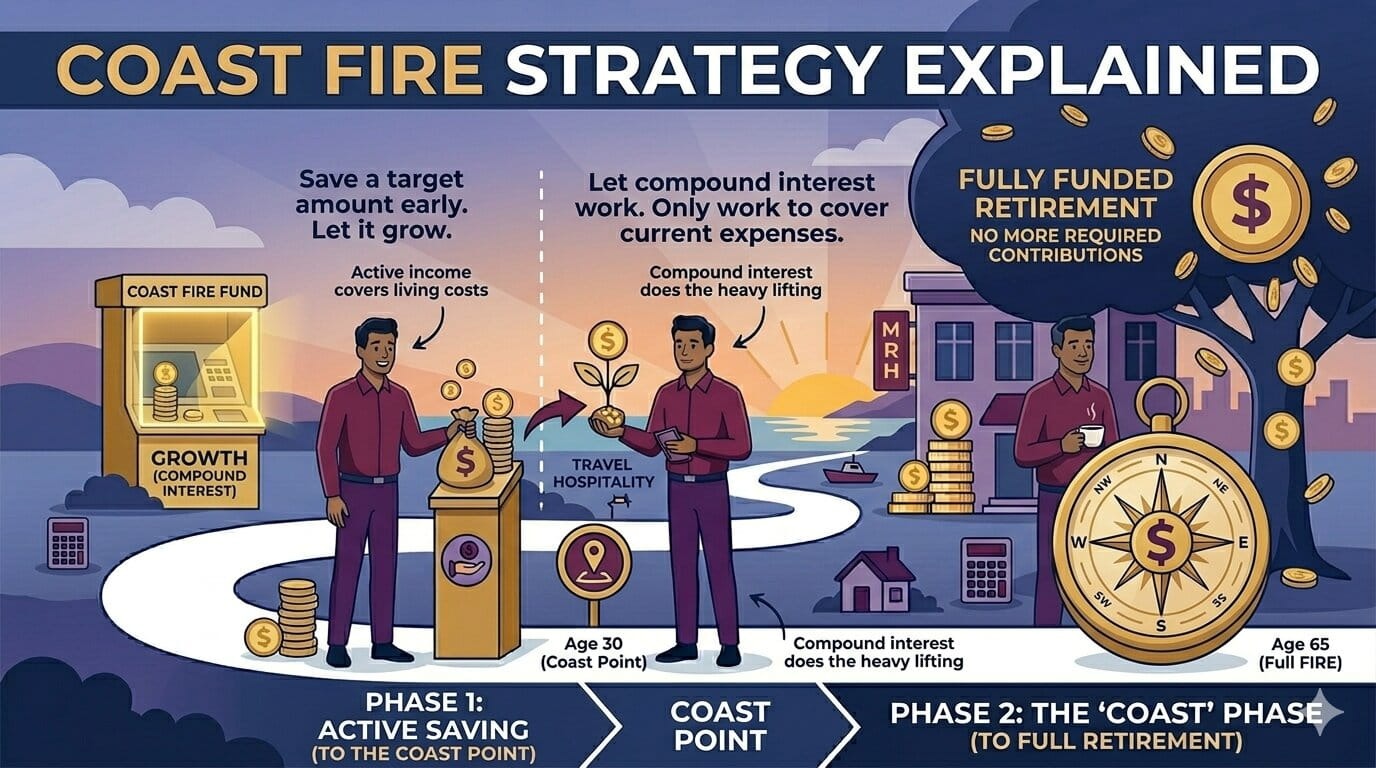
Not everyone wants to aggressively save 50–70% of their income or retire in their 40s. That’s where Coast FIRE comes in—a more balanced, realistic approach to financial independence.
Instead of pushing hard for early retirement, Coast FIRE focuses on doing the heavy lifting early, then letting your investments grow on their own while you “coast” through the rest of your career.
It’s a strategy that blends financial security with lifestyle flexibility.
What Is Coast FIRE?
Coast FIRE means reaching a point where:
Your current investments, without any additional contributions, will grow enough to fund your retirement.
Once you hit that number, you no longer need to aggressively save for retirement. You just need to cover your living expenses.
How Coast FIRE Works (Simple Idea)
The concept is surprisingly simple:
- Save and invest aggressively in your 20s or early 30s
- Reach your “Coast FIRE number”
- Stop contributing (or reduce contributions significantly)
- Let compounding do the rest
You’re not fully retired—you’re just no longer under pressure to save heavily.
What Is the Coast FIRE Number?
Your Coast FIRE number is the amount you need invested today so it grows into your full retirement fund later.
The formula depends on:
- Your age
- Expected return (typically 6–7%)
- Retirement age
- Future expenses
Example:
- Age: 30
- Desired retirement fund at 65: $1 million
You might only need around $200,000–$250,000 invested today for it to grow to $1 million by retirement (assuming steady returns).
Simple Comparison: Traditional FIRE vs Coast FIRE
| Feature | Traditional FIRE | Coast FIRE |
|---|---|---|
| Savings Rate | Very high (50%+) | Moderate early |
| Retirement Timing | Early (40s–50s) | Traditional (60s) |
| Work After Goal | Optional | Continue working |
| Lifestyle Flexibility | Lower early | Higher |
Coast FIRE is less intense but still very effective.
Real-World Example
Let’s make it practical.
Case Study:
- Emma, age 28
- Invests aggressively and reaches $150,000 by age 32
- Calculates she needs $1 million by 65
At this point, she:
- Stops heavy retirement contributions
- Switches to a lower-stress job
- Focuses on enjoying life more
Her investments continue growing in the background.
That’s Coast FIRE in action.
Why Coast FIRE Is So Popular
Coast FIRE appeals to people who want balance.
You’re not sacrificing your entire present for the future. Instead, you’re front-loading the effort and relaxing later.
Benefits include:
- Less financial stress
- More career flexibility
- Ability to switch to passion-driven work
- Better work-life balance
The Power of Compounding
Coast FIRE works because of compound growth.
Money invested early has decades to grow—even without additional contributions.
Example:
- $200,000 invested at age 30
- Grows at 7% annually
By age 65, it becomes over $1 million.
This is why starting early is critical.
Key Strategies to Reach Coast FIRE
1. Save Aggressively Early
Your 20s and early 30s are your most important years.
The more you invest early, the sooner you reach your Coast FIRE number.
2. Invest Consistently
Focus on long-term growth investments like:
- Index funds
- ETFs
For portfolio guidance:
https://statush.com/retirement-planning/retirement-investment-portfolio-allocation
3. Calculate Your Target Clearly
You need to know:
- Your future expenses
- Your retirement timeline
- Expected returns
Without a clear target, it’s easy to under- or over-save.
4. Control Lifestyle Inflation Early
It’s tempting to increase spending as income rises—but doing so can delay your Coast FIRE goal.
Coast FIRE vs Other FIRE Types
Let’s compare briefly:
- Lean FIRE: Minimal lifestyle, smaller savings target
- Fat FIRE: High spending, large savings target
- Coast FIRE: Moderate lifestyle, early savings focus
To explore these differences:
https://statush.com/retirement-planning/lean-fire-vs-fat-fire-comparison
Challenges of Coast FIRE
While Coast FIRE is more relaxed, it still has challenges:
- Requires discipline early on
- Assumes consistent market growth
- Doesn’t eliminate the need to work
- Inflation can impact long-term projections
Example:
If returns are lower than expected, you may need to resume contributions later.
How Coast FIRE Fits Into Your Retirement Plan
Coast FIRE doesn’t replace traditional retirement planning—it complements it.
You still need:
- A withdrawal strategy
- Tax-efficient accounts
- Income planning
To understand withdrawal strategies:
https://statush.com/retirement-planning/best-withdrawal-strategy-for-retirement-accounts
What Happens After You Reach Coast FIRE?
Once you hit your number, you gain flexibility:
- Switch to part-time work
- Change careers
- Start a business
- Focus on personal interests
You’re no longer dependent on aggressive saving.
Is Coast FIRE Right for You?
Coast FIRE works best if you:
- Start investing early
- Prefer balance over extreme saving
- Want flexibility in your career
- Are comfortable working longer (but with less pressure)
It’s ideal for people who don’t want the intensity of traditional FIRE.
Practical Tips to Get Started
- Start investing as early as possible
- Aim to save 20–40% in early years
- Use tax-advantaged accounts
- Track your progress regularly
- Recalculate your Coast FIRE number every few years
Consistency is more important than perfection.
Final Thoughts
Coast FIRE offers a refreshing middle ground in retirement planning.
You work hard early, then let time and compounding do the rest. It removes the pressure of constant saving while still keeping you on track for a secure future.
It’s not about retiring as early as possible—it’s about building freedom gradually.
If you want to align this strategy with your overall savings targets, start here:
https://statush.com/retirement-planning/how-much-should-you-save-for-retirement-by-age