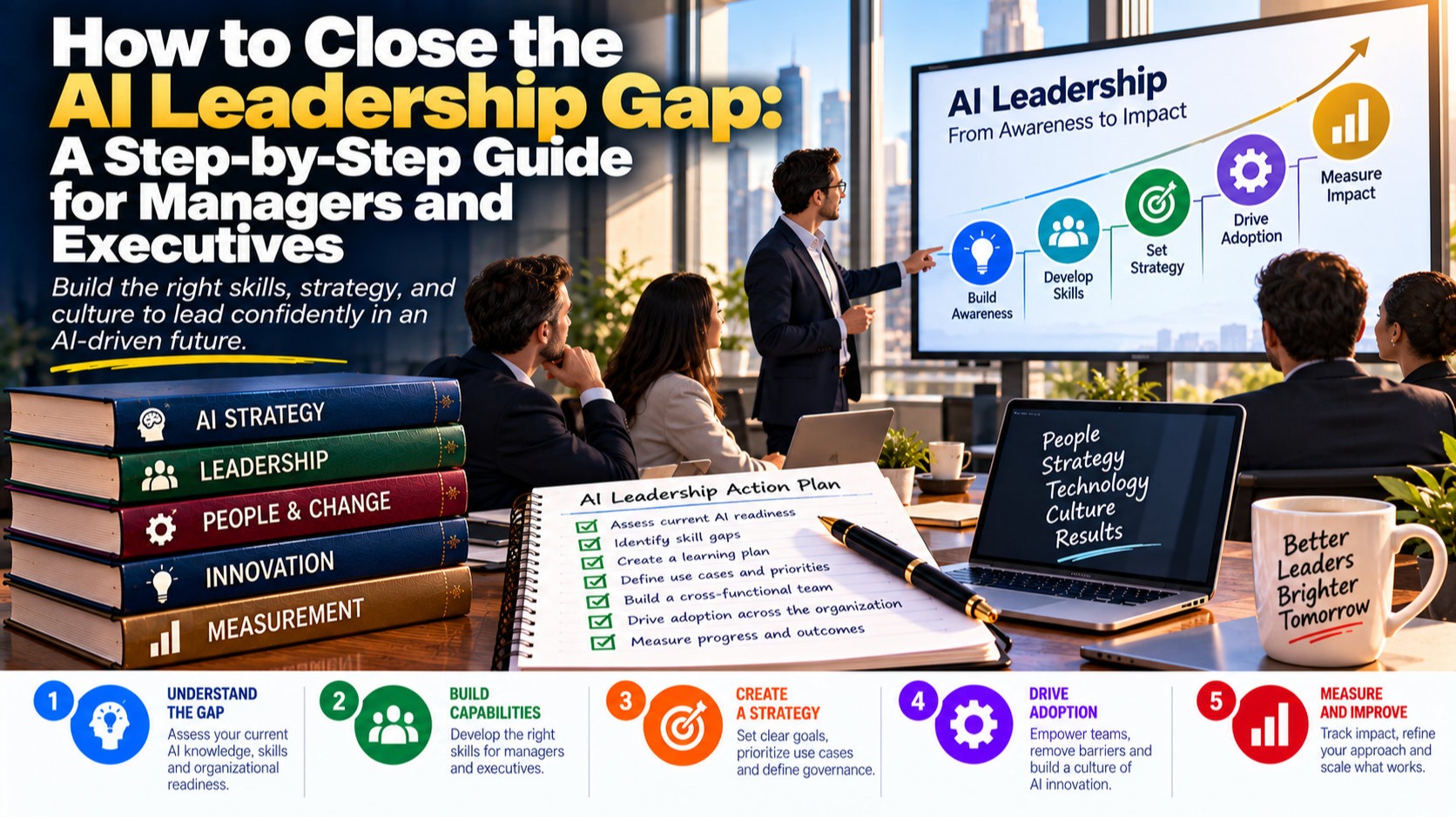
McKinsey published the sixth edition of its Technology Trends Outlook in September 2026, drawing on a global survey across 16 countries, and the leadership finding buried inside the AI data is the one worth sitting with. Organizations that count themselves AI "high performers" are roughly three times more likely to strongly agree that their senior leaders demonstrate visible ownership of and commitment to AI initiatives, compared with everyone else. Enterprise-wide AI scaling has climbed to 44% of organizations, up from 38% a year earlier — but the gap between the companies pulling ahead and the ones treading water isn't really about which tools they bought. It's about whether the people at the top are visibly, personally engaged with how the tools get used. McKinsey followed up on October 5 with a leader's guide built around that same point: judgment, empathy, psychological safety, and a sense of purpose are becoming the primary differentiators as AI absorbs more of the execution work.
If you manage a team, sit on a leadership bench, or run a company of any size, that finding has a direct, practical implication: the AI strategy document sitting in your shared drive matters less than what your team sees you doing. This guide walks through what "visible ownership" actually looks like in practice, how to build it into your week without pretending to be a data scientist, and how to avoid the governance mistakes that quietly undermine it.
What McKinsey's 2026 Data Actually Shows
The Technology Trends Outlook tracks 14 technology trends that McKinsey says AI now underpins or amplifies, from agentic software development to advanced connectivity. But the leadership-specific findings are narrower and more actionable than the headline numbers suggest. Here's the data broken down by what it means for someone actually running a team.
| What McKinsey Found | The Number | What It Means for You |
|---|---|---|
| Organizations where AI is scaling enterprise-wide | 44%, up from 38% a year earlier | Scaling is now the majority trajectory among AI-active companies — falling behind has a real opportunity cost, not just a theoretical one |
| High performers who strongly agree leaders visibly own AI initiatives | ~3x more likely than other companies | Visible, personal leadership engagement correlates with performance more than tooling or budget does |
| Top performers embedding AI across 4+ stages of the development life cycle | 6 to 7x more likely than others | Depth of integration matters more than number of pilots — breadth without follow-through doesn't move the needle |
| Top-performing companies increasing tech budgets more than 10% in 2026 | 28%, vs. 3% of other companies | Resourcing decisions at the top are a visible signal your team reads, whether or not you intend them to be |
Read together, the pattern is consistent: the companies pulling ahead aren't necessarily spending more on AI in absolute terms, or deploying fundamentally different technology. They're the ones where a leader's personal engagement with AI — using it, talking about it specifically rather than abstractly, and backing it with budget and attention — is something employees can actually point to.
Why Visible Ownership Beats a Strategy Deck
There's a reason this finding keeps showing up across multiple 2026 workplace surveys, not just McKinsey's: strategy documents don't change behavior, modeled behavior does. When a VP mentions in a Monday stand-up that she used an AI drafting tool to cut a client proposal from three days to one, that's worth more to adoption than a quarterly all-hands slide about "our AI journey." Employees take their cues on what's safe to try, what's expected, and what gets rewarded from what leaders visibly do, not from what a policy memo says they should do.
This also explains why so many AI rollouts stall at the pilot stage. A leader can authorize a budget, approve a vendor, and still never be seen using the thing personally — and that absence reads as a signal in itself. Teams correctly infer that if it mattered enough, the boss would be using it too. McKinsey's framing of judgment, empathy, psychological safety, and purpose as the "primary drivers" of resilience going forward is really a restatement of an old leadership truth: as the mechanical parts of a job get automated, what's left is the part only a person can model.
Step-by-Step: Becoming a Visibly AI-Engaged Leader
You don't need to become technical to close this gap. You need a short list of habits that are easy to describe and hard to fake.
- Pick one recurring task and use AI on it yourself, in front of people. Drafting an email, summarizing a report, prepping talking points — narrate it out loud in a meeting rather than doing it quietly offline.
- Name the tool and the result, not just the concept. "I used [specific tool] to do [specific task] and it saved me roughly [specific amount of time]" lands differently than "we're exploring AI opportunities."
- Put a recurring 30-minute slot on your own calendar to actually use whatever AI tools your team has access to, the same way you'd block time for reading financial reports.
- Ask your team what they've tried, specifically, in 1:1s — not "are you using AI" but "what's one thing you tried this week and what happened."
- Fund at least one visible experiment per quarter with real budget, even a small one, and report back on what it produced, including if it failed.
- Say "I don't know" out loud when you don't — followed by how you're finding out. Leaders who perform false fluency erode the psychological safety that makes teams willing to experiment and report problems honestly.
How to Set Up an AI Integration Lead Without Creating Bureaucracy
McKinsey's guide recommends appointing an AI integration lead with direct access to the CEO, and the "direct access" part is doing most of the work in that sentence. The point isn't to create a new management layer; it's to remove the layers between whoever is closest to how AI is actually being used and whoever controls budget and priority.
In a smaller company, this role can be a working leader who already has one foot in operations and one in whatever team is furthest along with AI adoption — not a dedicated hire. In a larger organization, it's worth being a named, accountable person rather than a rotating committee, because committees diffuse responsibility exactly where you need concentration of it. Whoever holds the role needs three things to be effective: a standing short meeting with the CEO or top leader (even 15 minutes, biweekly, is enough if it's protected), visibility into what every team is actually trying, and enough authority to kill a failing pilot without a six-week sign-off process.
Common Mistakes to Avoid
- Treating AI governance as a one-time policy document. Risk mitigation needs for things like explainability, privacy, and regulatory compliance have grown steadily since 2022 as deployments have gotten more ambitious — a policy written in January is often out of date by September.
- Letting "high performer" become a vanity label. McKinsey also found that AI high performers report more negative consequences tied to IP infringement and compliance, not fewer, simply because they've deployed roughly twice as many use cases as everyone else. Faster adoption means more surface area for mistakes, not a free pass from oversight.
- Delegating AI entirely to IT or a single innovation team. This is the fastest way to keep leadership ownership invisible, which is precisely the problem the data says to fix.
- Measuring effort instead of outcomes. Counting the number of pilots launched feels productive but doesn't tell you whether any of them changed how work actually gets done.
- Waiting for a finished strategy before starting. The companies ahead didn't wait for certainty; they built the habit of trying, reporting back, and adjusting in public.
Who Should Act On This First
If you're a first-line or middle manager, the leverage point is your own visible behavior and your 1:1s — you likely can't set company-wide AI policy, but you can model use and ask better questions than "are you using AI." If you're a senior executive or founder, the leverage point is resourcing and the integration-lead structure above; your team is watching your budget decisions and your calendar far more closely than your memos. If you're on a board or in an HR leadership seat, the leverage point is making sure visible ownership is actually part of how you evaluate your CEO and senior leaders, not an informal nice-to-have.
Practical Tips for the Next 90 Days
- Audit your own calendar for the last two weeks: is there any block of time where you personally used an AI tool, or did you only discuss AI in meetings about AI?
- In your next team meeting, ask one person to show — screen-share, not just describe — something they tried.
- Set one measurable target for a single workflow (time saved, error rate, turnaround) rather than an organization-wide adoption percentage that's hard to verify.
- Revisit your risk and compliance checklist at least quarterly, not annually, given how fast deployment patterns are changing.
- If you don't already have someone with cross-team visibility into AI use and a direct line to leadership, decide who that person is this month, even informally.
Related Articles
- Companies Are Pouring $2.5 Trillion Into AI. Most Leadership Teams Still Can't Say Who's in Charge of It
- The Manager Engagement Premium Is Gone: A Practical Guide to Getting Yours Back
- How to Close the Manager Coaching Gap Before It Costs You Your Team
- CEO Succession Planning Is Starting Too Late: How to Build a Bench Before You Need One