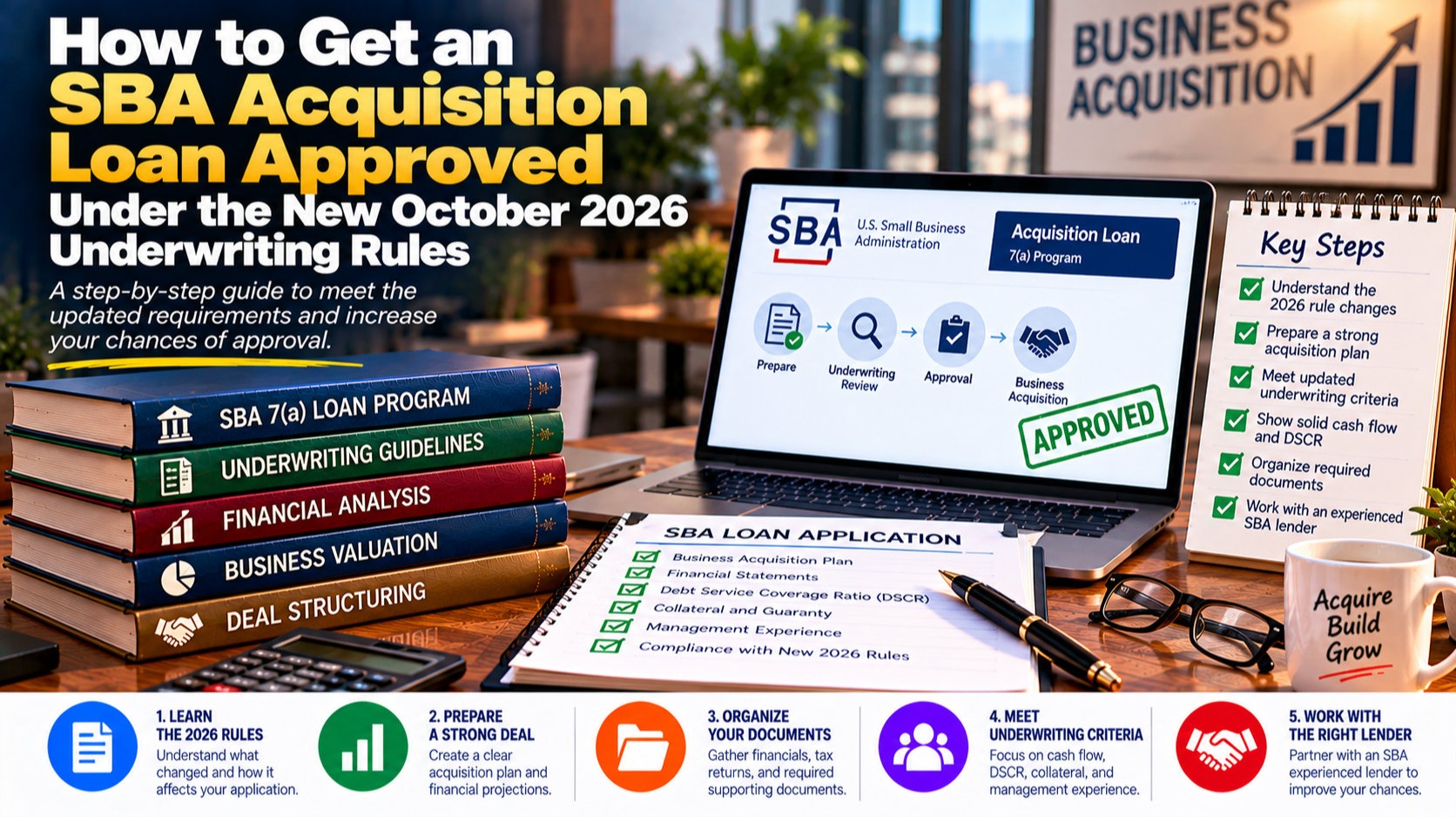
The SBA's new acquisition lending rulebook, SOP 50 10 8.1, took effect October 1, 2026. If you're mid-negotiation on buying a business, taking on a co-owner's share, or financing an ESOP transition, the underwriting standards your lender is using right now are not the ones that applied three weeks ago. Deals must now clear a 1.25:1 debt service coverage ratio based on historical earnings, purchase prices of $3 million or more trigger a mandatory independent Quality of Earnings report, and every single change-of-ownership deal needs its own third-party business valuation from a credentialed appraiser.
None of this is a reason to panic, but it is a reason to move carefully. A deal that looked financeable in September can stall in October if your lender hasn't rebuilt its own paperwork around the new rules yet, and buyers outside the U.S. need a different playbook entirely since the SBA doesn't reach them. This guide walks through exactly what changed, how to qualify, what it costs, and where to go if SBA financing isn't an option where you live.
What Changed in SBA Acquisition Lending
Four separate requirements shifted at once on October 1, and lenders are still adjusting their internal checklists, which is part of why some brokers are seeing inconsistent answers from different banks on the same deal type.
| Requirement | Before SOP 50 10 8.1 | Now (Effective Oct 1, 2026) |
|---|---|---|
| Debt Service Coverage Ratio | Lender discretion, often based on projected earnings | 1.25:1 for Initial Acquisitions, Owner Buyouts, and ESOP/co-op deals; 1.15:1 for Business Expansions — measured on trailing 12-month or two-year average historical earnings, not projections |
| Quality of Earnings report | Not required | Mandatory for Initial Acquisition and Business Expansion deals of $3 million or more, including a "Cash Proof" reconciling bank statements to tax returns |
| Business valuation | Required for most deals, standards varied by lender | Required for every change-of-ownership transaction, prepared by a Qualified Source holding an ASA, CBA, ABV, CVA, or BCA credential, independent of the lender's loan production staff |
| Minimum equity injection | 10%, sometimes reducible | 10% of total project cost for every change-of-ownership type; cannot be reduced or waived for Initial Acquisitions |
The DSCR change is the one most likely to sink a deal that would have cleared six months ago. Lenders can no longer lean on a buyer's optimistic projections or a seller's "it'll grow once I take over" story — the math now has to work using what the business actually earned, not what it might earn under new management. That single shift pushes a meaningful share of thinly-profitable small business sales out of SBA eligibility entirely.
How to Qualify Under the New DSCR Rule
Debt service coverage ratio compares the business's historical cash flow to the total annual debt payments the new loan would create, including any seller financing or existing debt that survives the sale. A 1.25:1 ratio means the business needs to generate $1.25 in available cash for every $1.00 of required debt payments.
- Pull the target's last two full fiscal years of financials and calculate DSCR both on the most recent year alone and on the two-year average — lenders will use whichever method the business qualifies under.
- Add back legitimate one-time or owner-specific expenses (excess owner salary, personal vehicle leases run through the business, one-off legal fees) before the lender does, so you're not surprised by their adjusted number.
- If the ratio falls short, consider a smaller loan amount, a larger cash down payment, or seller financing structured to stand behind the SBA debt rather than count against it.
- Ask your lender early which DSCR threshold applies to your deal type — Business Expansions get the easier 1.15:1 bar, so how your transaction is classified matters.
Step-by-Step: Getting Your Acquisition Loan Approved
- Classify the deal correctly. Initial Acquisition, Owner Buyout, Business Expansion, and ESOP/co-op transactions each carry different DSCR thresholds and equity rules, so get your lender to confirm the classification in writing before you go further.
- Order the independent valuation immediately. Because every deal now needs one, and qualified appraisers with ASA, CBA, ABV, CVA, or BCA credentials are in higher demand since October 1, book this early rather than waiting for the lender to request it.
- Budget for a Quality of Earnings report if the price is $3 million or more. QoE reports typically take two to four weeks and cost between $15,000 and $50,000 depending on deal complexity — build that into your closing timeline and your cash needs.
- Lock in your 10% equity injection. Document where that cash is coming from (personal savings, a 401(k)/ROBS rollover, a gift, or a secondary loan) before underwriting, since sourcing questions are a common cause of delay.
- Request DSCR calculations on both measurement methods. Ask the lender to run the ratio on the most recent fiscal year and the two-year average, and use whichever qualifies the deal.
- Keep a financing fallback in motion. Don't let your purchase agreement hinge entirely on SBA approval — have a conventional loan or seller-financing conversation running in parallel in case the deal doesn't clear the new thresholds.
Who Should Still Pursue SBA Acquisition Financing
SBA-backed loans remain some of the cheapest, longest-term acquisition financing available anywhere, and the new rules don't change that math for buyers who were already financeable under reasonable assumptions. You're in a strong position if the target business has two consecutive profitable years with cash flow comfortably above the new DSCR floor, if you can document 10% equity from a clean source, and if the purchase price is under $3 million so you avoid the QoE requirement altogether. If your deal depends on turnaround assumptions, thin historical margins, or a purchase price clustered right around $3 million, it's worth modeling the new requirements against your numbers before you sign a letter of intent.
How Buyers Outside the U.S. Should Finance an Acquisition
The SBA only lends in the United States, but buyers in the UK, Canada, and Australia are watching comparable shifts toward tighter, more documentation-heavy underwriting in their own government-backed programs.
| Country | Program | What It Covers | 2026 Details |
|---|---|---|---|
| United States | SBA 7(a) / SOP 50 10 8.1 | Acquisitions, buyouts, ESOP/co-op transitions | 1.25:1 DSCR, QoE at $3M+, 10% equity minimum, effective Oct 1, 2026 |
| Canada | Canada Small Business Financing Program (CSBFP) | Equipment, real property, and ownership transitions for small businesses | Up to roughly $1.15 million in financing with an 85% government guarantee to the lender |
| United Kingdom | Growth Guarantee Scheme (GGS) | Term loans and asset finance, including acquisition-related borrowing | Extended to March 31, 2030; 70% lender guarantee on facilities up to £2 million; an additional £6.5bn in lending capacity announced July 2026, with terms extending to 10 years |
| Australia | No direct government-backed acquisition program | Acquisition financing handled through private lenders and commercial banks | Buyers typically rely on commercial term loans, vendor finance, or asset-based lending |
If you're buying a business in Canada, talk to a CSBFP-registered lender or your regional Business Development Bank of Canada office before approaching a conventional bank — the government guarantee materially improves your odds and your rate. In the UK, ask any lender quoting you acquisition finance whether the loan can be written under the Growth Guarantee Scheme; not every bank automatically offers it, and the guarantee can be the difference between approval and decline for a leveraged buyout. In Australia, where no SBA-style guarantee exists, spend more time structuring vendor (seller) finance into the deal, since it effectively does the job a government guarantee does elsewhere by sharing the lender's risk.
Common Mistakes to Avoid
- Assuming your lender already knows the new rules cold. SOP 50 10 8.1 is weeks old; some loan officers are still applying the prior standards by habit. Ask directly which DSCR threshold and equity requirement they're underwriting to.
- Waiting until underwriting to order the valuation or QoE report. Both now sit on the critical path for every deal; ordering late is the single most common reason closings slip past their target date.
- Using projected earnings to justify the price. The new DSCR rule is explicitly built on historical performance. If your pitch to the lender leans on "what it will do under new ownership," expect pushback.
- Underestimating QoE cost and timeline on a borderline $3 million deal. A purchase price of $2.95 million avoids the requirement; $3.05 million doesn't. Know exactly which side of that line your deal sits on before you negotiate the final price.
- Not documenting the source of the 10% equity injection early. Gifted funds, retirement rollovers, and secondary loans all carry their own paperwork requirements that take time to assemble.
Practical Tips for a Faster Closing
Build a two-to-four week buffer into your closing timeline specifically for the Quality of Earnings report if your deal is $3 million or more — it's the single biggest new source of delay in the process. Line up your appraiser before you have a signed letter of intent so the valuation can start the day you need it, rather than after a lender assigns one. If your DSCR is close to the 1.25:1 line, ask the seller about carrying a modest note that's structured to stand on standby behind the SBA loan rather than count as additional debt in the ratio — this is a common and SBA-permitted way to bridge a small shortfall. Finally, get every number in writing from your lender: the deal classification, the DSCR threshold being applied, and the equity requirement, so there's no ambiguity if your file changes hands partway through underwriting.