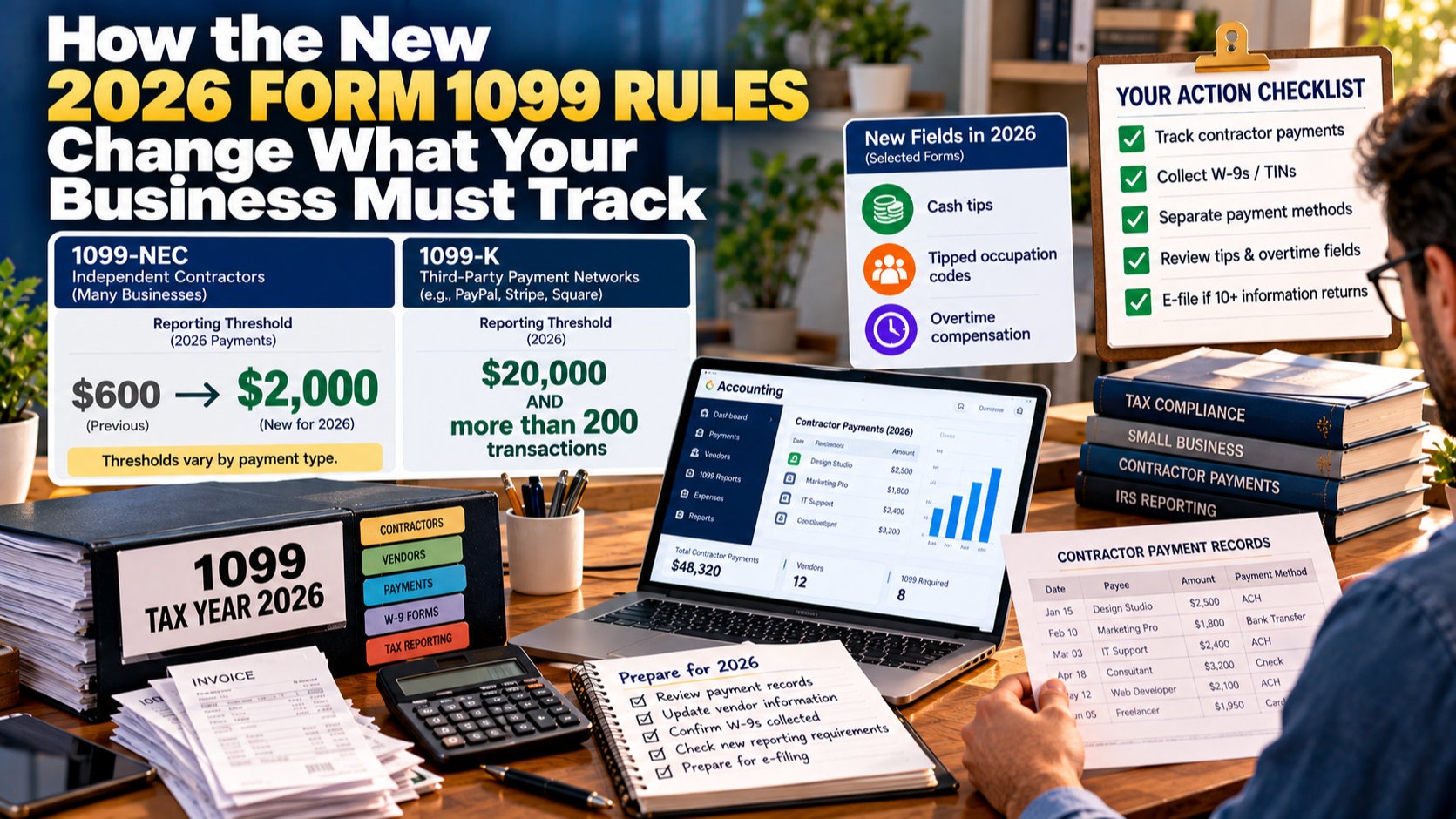
Starting with payments made on or after January 1, 2026, the threshold for sending a contractor a Form 1099-NEC or 1099-MISC jumps from $600 to $2,000, under the One Big Beautiful Bill Act (OBBBA) that President Trump signed in July 2025. The IRS will adjust that $2,000 figure for inflation every year beginning in 2027. At the same time, OBBBA rolled the Form 1099-K threshold — the one that applies to payments you receive through platforms like Stripe, PayPal, Square, or Etsy — back down to its pre-2022 level: more than $20,000 in gross payments and more than 200 transactions in a calendar year, retroactive to 2022. Both conditions have to be true before a payment processor issues you one.
If you run a business and pay freelancers, contractors, or vendors, or if you get paid through a third-party platform, this is not a filing-season footnote. It changes which of your 2026 payments generate a form, which of your contractors you still need a W-9 from, and how clean your bookkeeping needs to be before January 2027 rolls around. Here's exactly what changed, who it affects, and how to adjust your business's recordkeeping now rather than scrambling in the first weeks of next year.
Key Numbers to Know
The two thresholds that matter for most small businesses and solo founders, before and after OBBBA, plus how the closest equivalents work in other Tier 1 countries:
| Form / Country | Old Threshold | New Threshold (2026) | Who It Affects |
|---|---|---|---|
| 1099-NEC / 1099-MISC (US) | $600 per contractor, per year | $2,000 per contractor, per year; inflation-indexed from 2027 | Any business paying freelancers, consultants, or non-employee service providers |
| 1099-K (US) | $600, any number of transactions (2022-2025 rule, largely unenforced) | $20,000 AND more than 200 transactions (reverted to pre-2022 rule) | Sellers and freelancers paid via Stripe, PayPal, Venmo (business), Etsy, Square |
| Self Assessment / CIS (UK) | No minimum; all self-employment income is reportable | Unchanged; MTD for Income Tax phases in from April 2026 for income over £50,000 | Sole traders, contractors paid under the Construction Industry Scheme |
| T4A slips (Canada) | $500 CAD | Unchanged | Businesses paying subcontractors, especially in construction (T5018) |
| TPAR (Australia) | No dollar minimum; contractor payments in specified industries | Unchanged; due 28 August annually | Building, cleaning, courier, IT, and road freight businesses paying contractors |
Who This Change Actually Affects
The $2,000 1099-NEC threshold only changes your filing obligation, not your tax obligation. Your contractors still owe tax on every dollar they earn from you, and you can still deduct every dollar you pay them as a business expense — none of that moved. What changed is the paperwork trigger point. Practically, that means:
- A contractor you paid $1,200 for a one-off project in 2026 no longer needs a 1099-NEC from you, where they would have in 2025
- A contractor you pay $2,000 or more across the year still needs one, counted cumulatively, not per invoice
- Platform sellers and gig workers paid through Stripe, PayPal Goods & Services, or similar processors generally won't get a 1099-K unless they cross both the $20,000 and 200-transaction marks — a bar most small sellers and solo founders won't hit
- Payments to corporations (most C-corps and S-corps) remain exempt from 1099-NEC reporting, exactly as before — this rule never applied to incorporated vendors to begin with
- Rent, royalties, and attorney fees reported on 1099-MISC follow the same new $2,000 line, reversing years of complaints from landlords and small operators about $600 triggering a form for a single month's rent
Step-by-Step: How to Adjust Your Bookkeeping
Most of the compliance headache under the old $600 rule came from businesses not tracking contractor payments consistently through the year, then scrambling every January to reconstruct who crossed the line. The new threshold is a good excuse to fix that process permanently rather than just raise the number you're watching for.
- Re-run your 2026 contractor list against $2,000, not $600. Pull your accounts payable or expense categories tagged "contractor," "freelancer," or "professional services" and total payments per payee for the year to date. Anyone under $2,000 who you'd have flagged under the old rule comes off your January 1099 list — for now.
- Collect a W-9 before the first payment, not after you've crossed the threshold. You often won't know in January whether a contractor will clear $2,000 by December. Getting their taxpayer ID and entity type up front avoids a scramble, and protects you from backup withholding exposure if they refuse to provide one.
- Flag entity type at setup. If a vendor is a corporation, mark that in your accounting software so they're excluded from your 1099 run automatically. Misclassifying this is one of the most common reasons businesses either over-file or miss someone.
- Separate 1099-K exposure from 1099-NEC exposure. If you sell through a marketplace or invoice through a payment app, that income is tracked by the processor, not by you directly — confirm with Stripe, PayPal, or Square how they're applying the $20,000/200-transaction rule to your account so you're not caught off guard by a form (or the lack of one) that doesn't match your own books.
- Update your accounting software's thresholds. QuickBooks, Xero, Gusto, and similar platforms that auto-flag 1099-eligible vendors were built around $600. Check your settings in Q4 2026 to confirm the software has been updated to $2,000 before you run January reports — don't assume an automatic patch caught it.
- Keep paying and deducting as usual. Nothing here changes what you owe or what you can write off. Treat this purely as a filing and recordkeeping adjustment, not a tax-planning opportunity.
How This Compares If You're Outside the US
1099 forms are a US-only mechanism, but every Tier 1 country runs some version of third-party contractor reporting, and none of them just raised their bar the way the US did.
In the UK, there's no minimum threshold for self-employment income reporting under Self Assessment — every pound a sole trader or contractor earns is reportable by the earner themselves. If you're a UK business paying subcontractors in construction, the Construction Industry Scheme (CIS) requires you to verify and deduct tax from nearly every payment, regardless of size. The bigger UK change landing in the same window is Making Tax Digital for Income Tax, which starts phasing in from April 2026 for self-employed people and landlords earning over £50,000, eventually requiring digital record-keeping and quarterly updates to HMRC rather than one annual return.
In Canada, businesses issue T4A slips to subcontractors once payments exceed $500 CAD in a calendar year, and construction businesses specifically file T5018 slips for payments to subcontractors regardless of amount. Neither threshold moved alongside the US changes.
In Australia, the Taxable Payments Annual Report (TPAR) requires businesses in building and construction, cleaning, courier and road freight, IT, and security to report all contractor payments with no dollar floor, due by 28 August each year. New Zealand runs a similar schedular payment withholding system for contractors in specified industries, again without a US-style dollar trigger. If you operate across borders — a US LLC paying a UK-based contractor, for example — the US threshold only governs your US filing obligation; your contractor's own country's reporting rules for them don't change at all.
Common Mistakes to Avoid
- Assuming the $2,000 threshold is retroactive to 2025 payments. It applies to payments made on or after January 1, 2026. Anything paid in 2025 still follows the $600 rule and was due by January 31, 2026.
- Forgetting the 1099-K reversion is also retroactive to 2022. If a platform over-reported you in 2023 or 2024 under the old $600 rule and you never reconciled it against your actual tax return, it's worth revisiting with your accountant, since the correct threshold was never meant to be that low for those years.
- Stopping W-9 collection entirely for small vendors. You still need good records if a relationship grows mid-year past $2,000, and you still need backup withholding protection regardless of the dollar amount.
- Confusing the 1099-NEC threshold with the 1099-K threshold. They're governed by different triggers (a flat dollar amount versus a dollar-and-transaction-count combination) and apply to different payment methods. Paying a contractor by direct deposit or check follows 1099-NEC rules; paying them through a card-based platform may fall under 1099-K instead.
- Not telling contractors about the change. A freelancer who's used to getting a 1099-NEC every year and doesn't receive one in early 2027 may assume you forgot, rather than realizing the threshold moved. A short note saves both of you a confused email exchange.
Practical Tips to Stay Ahead of 1099 Season
- Run a running contractor-payment total monthly, not annually, so nobody crosses $2,000 without you noticing in real time
- Store W-9s in a shared, searchable location (not someone's inbox) so whoever handles bookkeeping in January isn't hunting for paperwork
- Reconcile your own 1099-K expectations against what your payment processor reports before you file, since discrepancies between their numbers and your books are the most common source of IRS mismatch notices
- Set a calendar reminder for early January to confirm your accounting software's 1099 threshold setting reflects $2,000, not the old $600 default
- If you operate in more than one country, keep a one-page reference of each jurisdiction's contractor-reporting threshold so no market gets missed when you expand your contractor base