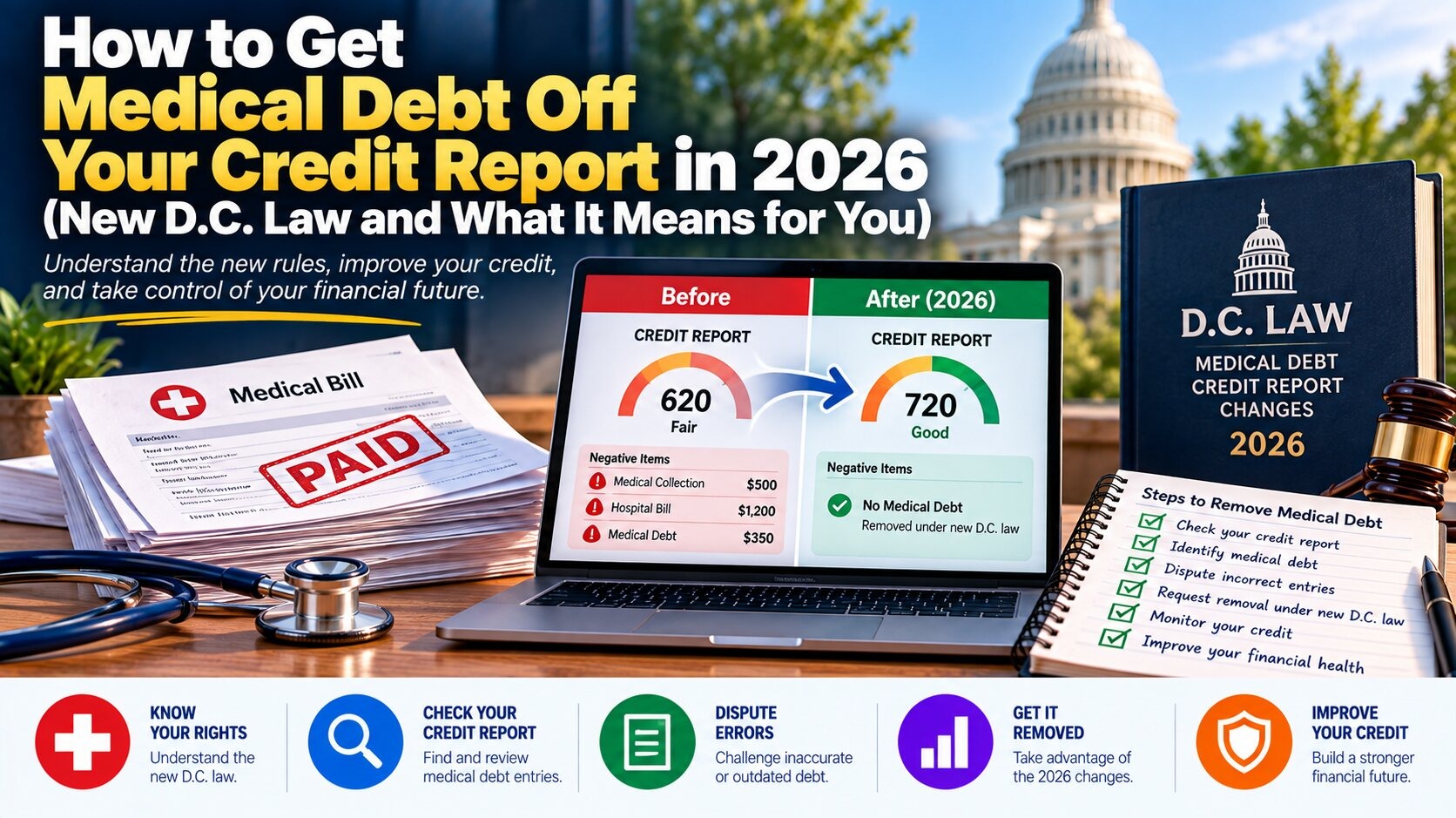
On August 20, 2026, the District of Columbia's Medical Debt Mitigation Amendment Act became law without the mayor's signature, after the D.C. Council passed it unanimously. The law bars hospitals, doctors, and debt collectors from reporting medical debt to Equifax, Experian, or TransUnion, caps interest on unpaid medical bills at 3% a year, and blocks collection activity until 180 days after a patient's first bill goes out. Its substantive provisions take effect October 1, 2026, once a budget-linked delay clears. D.C. now joins fifteen states, including New York, California, Colorado, Illinois, Virginia, and Oregon, that already keep some or all medical debt off consumer credit files.
That patchwork exists because the federal fix collapsed. The Consumer Financial Protection Bureau finalized a rule in January 2025 that would have banned medical debt from credit reports nationwide, erasing roughly $49 billion in reported medical collections for about 15 million people. A federal court in the Eastern District of Texas vacated that rule in July 2025, so there is no nationwide ban today. What you're left with is a state-by-state map, plus a set of voluntary policies the three credit bureaus already put in place. If you have a medical bill in collections, whether it shows up on your credit report right now depends heavily on where you live, how big the bill is, and whether it's been paid. Here's how to figure out where you stand and what to do about it.
What Actually Applies to Your Credit Report Right Now
Two separate layers of protection exist, and it's easy to conflate them. The first is nationwide and comes from the bureaus themselves, not the government. Equifax, Experian, and TransUnion voluntarily agreed to stop reporting any paid medical collection account, regardless of size, and to exclude medical collections with an original balance under $500 entirely. They also extended the waiting period before an unpaid medical bill can appear on a report from six months to a full year, giving insurance and billing disputes time to resolve before your score takes a hit. FICO Score 9 and 10, along with VantageScore 4.0, go a step further and weight remaining medical collections much less heavily than other collection accounts, or ignore them in the score calculation entirely.
The second layer is state law, and it's where D.C.'s new act fits in. States like New York (effective 2023), Colorado (2023), Connecticut and New Jersey (2024), and California, Maine, Rhode Island, Vermont, and Washington (2025) have gone further than the bureaus' voluntary policy by banning medical debt reporting outright, regardless of dollar amount or payment status. Maryland and Delaware followed in late 2025, and Oregon's ban took effect in January 2026. If you live in one of these places, medical debt generally should not appear on your credit report at all. If you don't, the $500 threshold and 12-month delay are your only protections, and a large unpaid medical bill can still hit your score once that year is up.
| Protection Level | Where It Applies | What's Covered | What's Not |
|---|---|---|---|
| Bureau voluntary policy (nationwide baseline) | All 50 states, D.C. | Paid medical collections; unpaid balances under $500; no reporting in first 12 months | Unpaid medical collections over $500 after 12 months |
| State full-ban laws | NY, CO, CT, NJ, VA, IL, CA, ME, RI, VT, WA, MD, DE, OR, MN | Medical debt of any amount, paid or unpaid | Varies; some laws exclude certain provider types or apply only to debt incurred after the law's effective date |
| D.C. Medical Debt Mitigation Act | District of Columbia | Credit reporting ban, 3% interest cap, 180-day collection delay, no property liens on primary residence | Doesn't cancel the underlying debt or stop a lawsuit for the balance owed |
| No specific protection | Remaining states | Only the bureau baseline above applies | Medical collections over $500 can still lower your score after 12 months |
How to Check If Medical Debt Is Still Sitting on Your Report
Don't assume the bureaus already cleaned things up for you. Billing errors, insurance mix-ups, and reporting lag mean collections that should have been removed sometimes aren't. Start by pulling your full file from all three bureaus at AnnualCreditReport.com, which offers free weekly reports to U.S. consumers. Then work through it methodically.
- Search each report for accounts flagged as "medical," "healthcare," or a hospital, lab, or ambulance provider's name.
- Note the original balance for each one; anything under $500 should not appear under the current bureau policy, even if it's unpaid.
- Check whether the account shows as paid; a paid medical collection of any size should be gone.
- Confirm the date of first delinquency; if it's within the last 12 months, it shouldn't be reporting yet regardless of amount.
- If you live in a full-ban state, flag any medical collection at all, since none should be there.
How to Get an Improper Medical Collection Removed
When you find a medical debt entry that violates one of these rules, dispute it directly rather than waiting for it to age off. File a dispute with each bureau reporting the error, either through their online portals or by certified mail, and cite the specific reason: balance under $500, account paid in full, reporting before the 12-month mark, or a state law banning the entry outright. Attach documentation where you have it, such as an explanation of benefits from your insurer, a receipt showing payment, or a copy of the collection notice with its date. Under the Fair Credit Reporting Act, the bureau generally has 30 days to investigate and respond once it receives your dispute.
If the bureau doesn't remove the account after investigating, escalate. File a complaint with the CFPB at consumerfinance.gov, which routes it directly to the company and typically gets a response within 15 days. You can also contact the original medical provider or collection agency and ask them to verify the account meets current reporting standards; if they can't, they're required to stop furnishing it. Keep copies of everything you send and every response you get, since a second dispute with better documentation often succeeds where the first one stalled.
Who Should Prioritize This Right Now
Not everyone needs to act with the same urgency, but a few groups should move quickly. Anyone with a mortgage or auto loan application in progress should check their reports immediately, since an improperly reported medical collection can swing a rate decision. People who had a medical bill go to collections in the past year should also check now, since the reporting delay window means the entry may appear the moment it turns 12 months old if it's over $500 and you're not in a protected state. And if you moved to D.C., Oregon, Maryland, or Delaware recently, it's worth confirming old medical collections tied to your file were actually removed once the new law took effect, since bureaus don't always purge retroactively without a nudge.
If You're Outside the United States
These specific rules, the FCRA dispute process, the $500 threshold, FICO and VantageScore, and the state laws above, are U.S.-only. Medical debt works differently elsewhere because healthcare financing does too. In the UK, most treatment through the NHS carries no direct bill, so medical debt mainly arises from private treatment, dental work, or cosmetic procedures; if it goes to collections, it can appear as a standard default on your file with Experian, Equifax, or TransUnion UK, and you'd dispute it through the same general process used for any inaccurate default, governed by the Consumer Credit Act and overseen by the Financial Conduct Authority. In Canada, provincial health plans cover most core care, but uninsured services, dental, and prescription costs can end up with a collection agency and reported to Equifax Canada or TransUnion Canada; disputes go through each bureau under Canada's provincial consumer reporting laws. Australia and New Zealand have similar public-system baselines, with private health and dental gaps the main source of medical collections reported to bureaus like Equifax, illion, or Centrix under the Privacy Act framework. If you're outside the U.S., the actionable takeaway is the same in spirit: check your file for any medical-related collection, confirm it's accurate and correctly aged, and dispute it with your national bureau if it isn't.
Common Mistakes to Avoid
- Assuming a small medical bill "doesn't count" and ignoring collection notices; the debt itself is still owed and can still be sued over even when it's removed from your credit report.
- Disputing an account without documentation; a bare "this isn't mine" claim is far more likely to get rejected than one with an EOB or payment receipt attached.
- Waiting for the bureaus to fix things on their own instead of filing a dispute the moment you spot an error.
- Confusing a state ban with debt forgiveness; D.C.'s law and similar state statutes stop credit reporting and certain collection tactics, but they don't erase what you owe.
- Overlooking older collections that predate a state's ban; some laws only cover debt incurred after the effective date, so check the specifics for your state.
Practical Tips While You Sort This Out
Set a reminder to re-check your credit report about six weeks after filing any dispute, since that gives the bureau time to investigate and update your file. If you're actively shopping for a mortgage, ask your loan officer which scoring model they're pulling. FICO 10T and VantageScore 4.0 already downweight or exclude many medical collections, so a stale entry might matter less than you'd expect even before it's formally removed. And if the underlying bill is legitimate and within your ability to pay, negotiating directly with the provider's billing office for a reduced lump-sum settlement, before it reaches a collection agency, often resolves things faster and more cheaply than fighting a credit report entry after the fact.