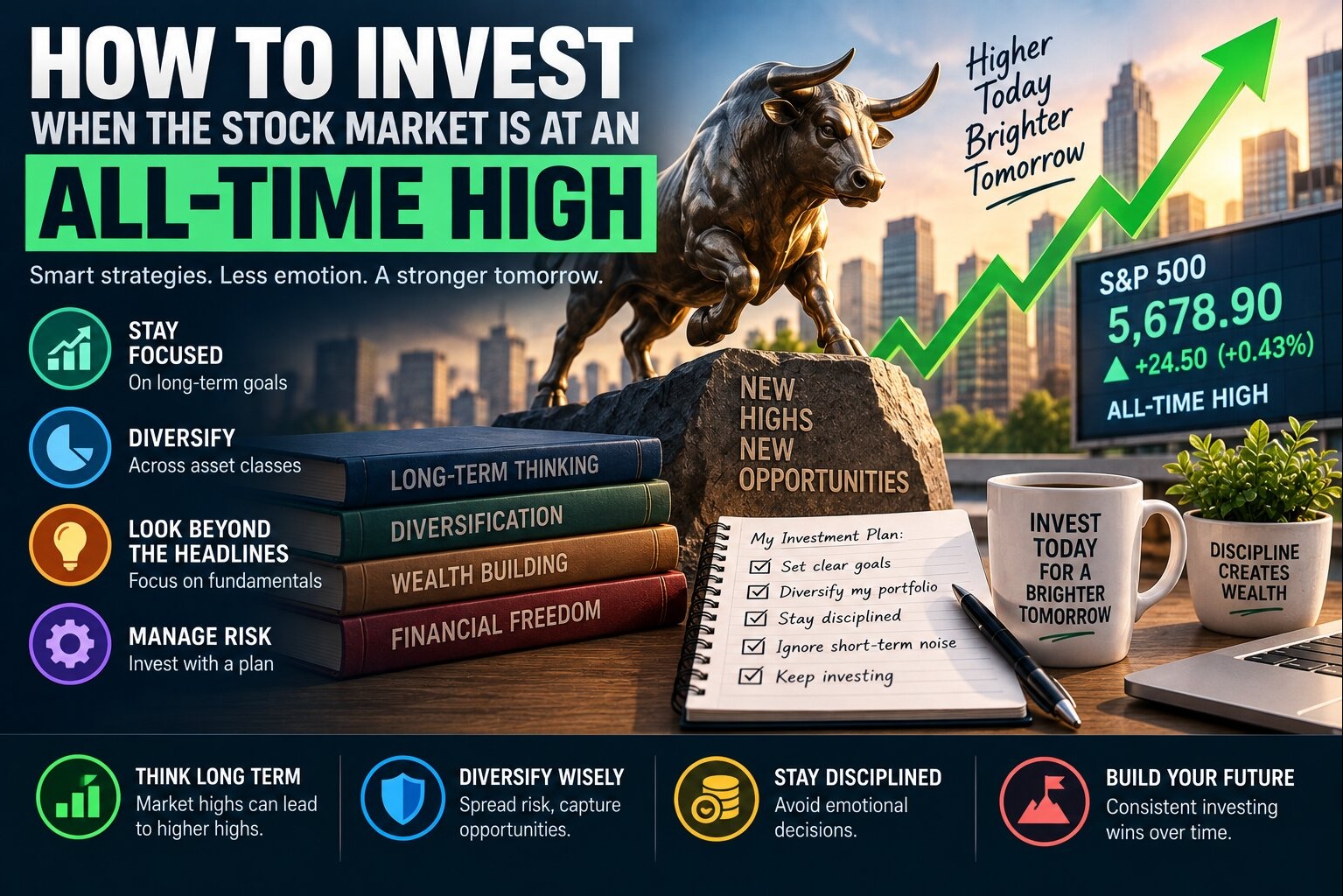
The S&P 500 closed above 7,800 for the first time in mid-August 2026, touching an intraday record of 7,814.88 after cooler-than-expected CPI and PPI inflation readings gave investors confidence the Federal Reserve would hold rates steady rather than tighten further. It was the index's 27th record close of the year, part of a run that has pushed the S&P 500 up roughly 13% year to date. The rally isn't a US-only story: the FTSE 100 has also traded at fresh records above 10,750 in 2026, gaining about 9.5% so far this year on strength in banking and mining shares, while the Dow Jones Industrial Average crossed 54,000 for the first time.
If you've been watching your portfolio balance climb - or you've been sitting on cash waiting for a "better" entry point - a market at all-time highs raises a real, practical question: what do you actually do now? This guide walks through how to keep investing sensibly when prices are elevated, how to rebalance after a big run, and how to use the tax-advantaged accounts available in your own country to make the most of it.
The 2026 Global Rally in Numbers
Record highs tend to grab headlines, but the details matter more than the milestone itself. Here's how the major Tier 1 markets stacked up as of late August 2026:
| Index (Market) | Recent Milestone | Approx. 2026 Gain | Main Driver |
|---|---|---|---|
| S&P 500 (US) | Record intraday high of 7,814.88; closed above 7,800 | ~13% | Cooling CPI/PPI inflation, resilient corporate earnings, steady Fed rate path |
| Dow Jones (US) | Crossed 54,000 for the first time | Broad-based with S&P 500 | Strength across industrials and financials |
| FTSE 100 (UK) | Fresh record above 10,750 | ~9.5% | Banking and mining sector gains |
Notice that none of these moves happened because of a single dramatic event. They're the result of several smaller, unremarkable data points - an inflation report here, an earnings season there - stacking up over months. That pattern matters for how you should think about your own investing decisions, because it means the "right" moment to act rarely announces itself clearly.
Should You Keep Investing at an All-Time High?
The instinctive reaction to a record-setting market is to wait for a pullback before putting more money in. It feels logical, but it works against you more often than it helps. A market hitting a new high simply means prices have exceeded every previous level - it says nothing on its own about what happens next. Historically, US large-cap indices that set a new record have gone on to set another one within the following year far more often than not, because record highs cluster during extended bull markets rather than marking their end.
That doesn't mean valuations are irrelevant or that a correction can't happen. It means the decision to invest should be driven by your own time horizon and cash flow, not by where the index closed yesterday. If you have money you won't need for five, ten, or twenty years, sitting in cash to avoid a record high has a real cost: missed dividends, missed compounding, and the very real risk that prices keep climbing while you wait for a dip that may not come, or may come only after the market has moved much higher first.
Step-by-Step: How to Position Your Portfolio Right Now
Rather than trying to time the next move, work through your portfolio methodically:
- Check your asset allocation against your target. A strong equity rally naturally pushes stocks to a larger share of your portfolio than you originally intended. Compare your current mix against the target you set (for example, 70% stocks / 30% bonds) rather than against what feels comfortable today.
- Keep contributing on your normal schedule. If you invest a fixed amount from every paycheck, don't pause it because prices are high. Dollar-cost averaging is designed precisely for markets like this one - it buys fewer shares when prices are elevated and more when they fall, without you having to guess which is which.
- Separate near-term cash from long-term investments. Money you'll need within the next one to three years - a house deposit, a tax bill, an emergency fund - shouldn't be sitting in equities regardless of where the index sits. Keep it in cash or short-term bonds.
- Review any large lump sum before investing it. If you've received a bonus, inheritance, or sale proceeds, consider phasing it into the market over three to twelve months instead of investing it all on one day, purely to reduce the emotional and financial impact if a short-term pullback follows.
- Revisit your risk tolerance honestly. Gains feel good, but ask whether you'd be comfortable if your portfolio fell 20% from today's level. If the answer is no, that's a signal to trim risk now, not after a decline has already started.
Common Mistakes to Avoid When Markets Are Elevated
A rally this broad tends to bring out the same errors in investors of every experience level. Watch for these in particular:
- Chasing the best-performing sector. Piling into whatever has driven the rally - often mega-cap technology or, in 2026, banking and mining shares in the UK - concentrates risk right when valuations in that sector are least attractive.
- Stopping contributions to "wait it out." Pausing regular investing at a record high, then restarting only after a dip, requires getting two separate timing decisions right. Most investors get neither right consistently.
- Ignoring bonds and cash entirely. A 13% year-to-date equity gain can make bonds look pointless by comparison, but their job - cushioning a portfolio during a downturn - hasn't changed.
- Confusing a record high with overvaluation. A new high is a price level, not a verdict on whether that price is justified. Look at earnings growth and forward guidance, not just the headline number, before deciding a sector is "too expensive."
- Letting fear of missing out drive lump-sum decisions. Investing a full year's savings in a single day because "it might go higher" is speculation, not a plan - phase it in instead.
How to Take Advantage Wherever You Live
However you invest, doing it inside a tax-advantaged account rather than a plain brokerage account meaningfully changes your long-term return, especially after a year like this one. The specific vehicle depends on where you live:
| Country | Account | 2026 Allowance / Limit | Key Feature |
|---|---|---|---|
| United States | 401(k) / IRA | $24,500 (401k); $7,500 (IRA) | Pre-tax or Roth growth; many employers match 401(k) contributions |
| United Kingdom | Stocks & Shares ISA | £20,000 (2026/27 tax year) | All growth and income are entirely tax-free, no reporting needed |
| Canada | TFSA / RRSP | $7,000 TFSA (2026); unused room carries forward | TFSA growth is tax-free; RRSP contributions are tax-deductible |
| Australia | Superannuation | Employer Super Guarantee at 12% of ordinary earnings (FY2026/27) | Concessional tax rate on contributions and earnings |
| New Zealand | KiwiSaver | Set by your chosen contribution rate | Employer and government contributions on top of your own |
| Western Europe | Varies (e.g. PEA in France, Riester/Rürup in Germany) | Country-specific | Check your national tax authority; many offer capital gains relief for long-term holdings |
If you're in the US and haven't checked your 401(k) contribution rate since the new $24,500 limit took effect for 2026, that's worth five minutes this week - especially if you're 60 to 63, where the special catch-up limit sits at $11,250 on top of the standard amount. UK investors should note that ISA season effectively resets every April 6, so any unused allowance from the current tax year cannot be carried forward - use it or lose it. Canadian investors should confirm their cumulative TFSA room, since it accumulates every year from age 18 even in years you didn't contribute.
Key Numbers to Know Before You Act
- S&P 500 record intraday high: 7,814.88; first close above 7,800 (August 2026)
- S&P 500 record closes in 2026 so far: 27
- S&P 500 approximate year-to-date gain: 13%
- FTSE 100 approximate year-to-date gain: 9.5%, trading above 10,750
- 2026 401(k) contribution limit: $24,500; IRA limit: $7,500
- 2026/27 UK ISA allowance: £20,000
- 2026 Canada TFSA limit: $7,000
- Australia Super Guarantee rate, FY2026/27: 12%