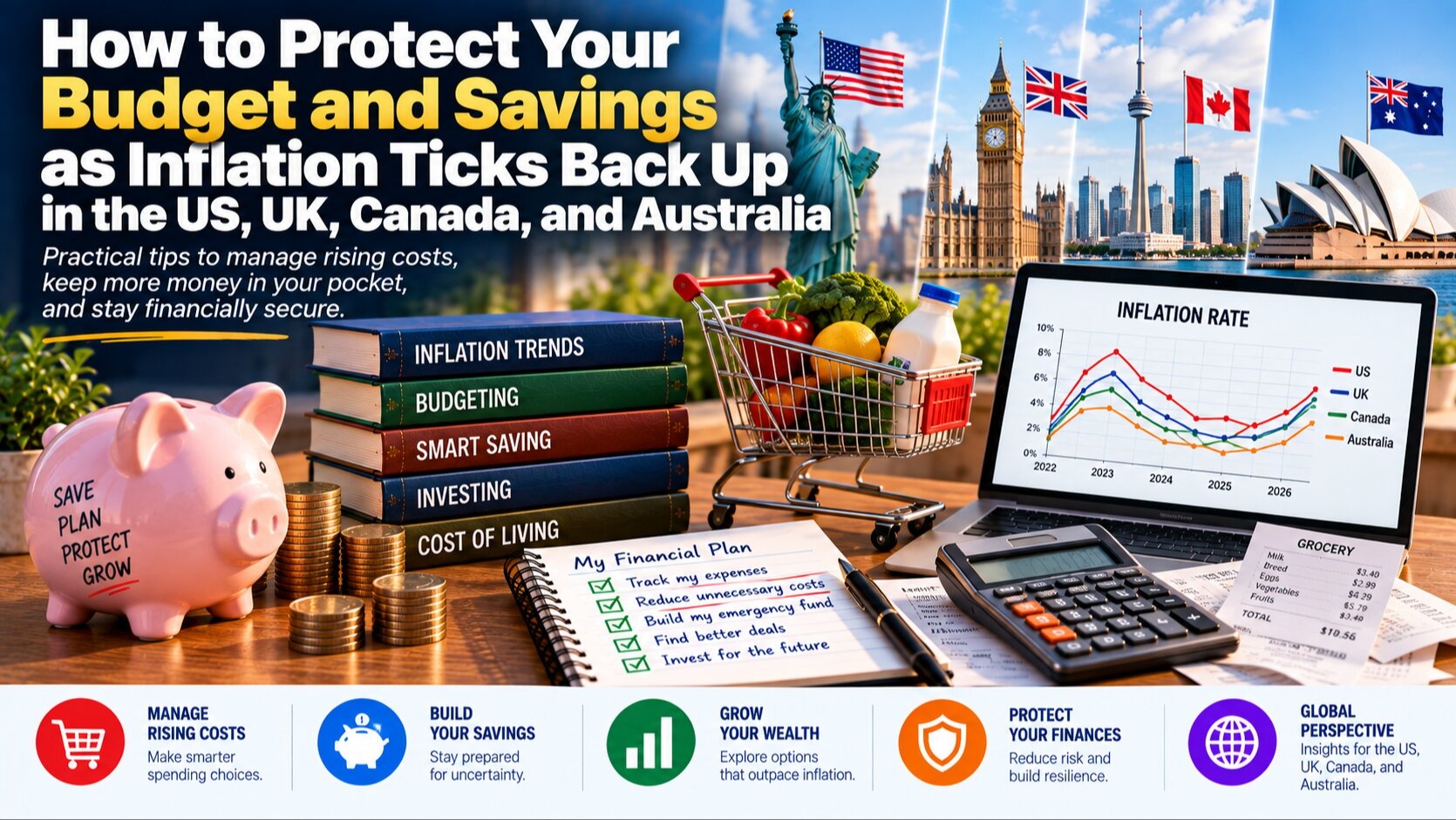
The Bureau of Labor Statistics released its August 2026 Consumer Price Index on September 11, and the headline number moved the wrong way: prices rose 0.4% for the month, pushing the annual rate to 3.4%, up from 2.9% back in April. Core CPI, which strips out food and energy, climbed 0.3% in August and now sits at 2.4% year-over-year. Shelter, still the biggest single line in the index, rose 3.0% annually. None of that is a crisis on its own, but it's the third straight month of headline inflation accelerating rather than cooling, and the next reading — covering September data — lands October 14 with economists already penciling in something close to 3.7%.
This isn't a U.S.-only story. The UK's Office for National Statistics put annual CPI at 3.1% for August, up from 2.9% in July, with transport costs jumping to 4.6% on the back of motor fuel prices. Statistics Canada reported August inflation at 3.0%, driven by a 15.4% jump in energy costs even as shelter costs there stayed relatively tame at 1.5%. Australia's Bureau of Statistics showed CPI easing slightly to 3.5% for the year to July, down from 3.8% in June, though housing and food remain the biggest contributors. Four different statistical agencies, four different methodologies, and the same basic message: inflation has stopped falling and started drifting back up almost everywhere in the Tier 1 world. Here's how to actually read what's happening in these reports, and the specific moves to make with your budget and savings while it's happening.
What's Driving Prices Back Up in Each Country
The mistake most people make when a CPI report lands is reacting to the single headline number without checking what's actually pushing it. In the U.S., the August acceleration wasn't broad-based — it was concentrated in energy (gasoline prices rose sharply during the month) and the persistently sticky shelter category, which has now run above 3% annually for over two years running. Airfares and used vehicle prices also ticked up, both categories the BLS and private economists have flagged as "sticky" components that resist cooling even when broader disinflation trends hold.
The UK's jump was almost entirely a transport story, with motor fuel prices doing the heavy lifting. Canada's August number leaned even harder on energy, up 15.4% year-over-year, while the categories that usually worry households most — food and shelter — actually decelerated to 2.8% and 1.5% respectively. Australia is the outlier moving in the right direction, with its easing from 3.8% to 3.5% driven by softer prices in housing, food, and recreation, though all three remain elevated versus pre-2024 norms.
| Country | Latest Annual CPI | Change from Prior Reading | Biggest Driver |
|---|---|---|---|
| United States | 3.4% (August 2026) | Up from 2.9% in April | Energy and sticky shelter costs |
| United Kingdom | 3.1% (August 2026) | Up from 2.9% in July | Transport, led by motor fuel |
| Canada | 3.0% (August 2026) | Roughly flat month over month | Energy, up 15.4% year-over-year |
| Australia | 3.5% (12 months to July 2026) | Down from 3.8% in June | Housing, food, and recreation |
The takeaway: if you live in the U.S., the UK, or Canada, watch your fuel and energy spending closely right now, since that's the category doing most of the damage in three of the four countries. If you're a renter or mortgage holder in the U.S. specifically, shelter costs deserve extra attention because they're both large and unusually persistent.
How to Inflation-Proof Your Monthly Budget
A rising CPI print doesn't automatically mean your personal cost of living is rising at the same rate — the index is a weighted average across thousands of households, and your own basket of spending might be more or less exposed than the national number suggests. The first step is figuring out your own inflation rate, not just reading the headline one.
Pull your last three months of bank and card statements and total your spending in four buckets: housing, transportation, food, and everything else. Compare that total to the same three months a year ago. If your overall spending is up more than the national CPI figure for your country, you're more exposed than average and need to act with more urgency than the headline number implies. If it's below, you likely have more room to keep your current habits while still building a buffer.
Once you know your number, build in a specific inflation buffer rather than just "trying to spend less." A practical target is adding 3-4% to your monthly budgeted amounts for the categories running hottest in your country's CPI report — energy and fuel almost everywhere right now, shelter specifically in the U.S. That buffer should come from somewhere concrete: a discretionary category you can trim, not from assuming your income will simply stretch further.
Where to Cut First: A Category-by-Category Guide
Not every cut delivers the same value. Based on which categories are actually driving inflation right now, here's where trimming spending does the most good:
- Fuel and transport: Combine errands into fewer trips, compare gas station loyalty programs, and if you're shopping for a vehicle, factor a higher effective fuel cost into your monthly budget math rather than pricing based on last year's averages.
- Housing (U.S. renters and mortgage holders especially): If your lease is up for renewal, get comparable rental listings in hand before you negotiate — landlords in most Tier 1 markets are still pricing in expected inflation, and a documented lower comparable gives you real leverage.
- Groceries: Shift toward store brands for staples, since branded goods have generally seen larger price increases than private-label alternatives across all four countries covered here.
- Subscriptions and recurring services: These rarely show up in a CPI breakdown but are the easiest dollars to reclaim immediately, since most people are paying for at least one service they no longer use.
- Variable-rate debt: If you're carrying a variable-rate mortgage, line of credit, or credit card balance, rising inflation often precedes central bank rate decisions that affect your payment directly — check your rate reset date now rather than when the bill changes.
How to Protect Your Savings and Investments from Inflation
Cash sitting in a low-yield account loses real purchasing power every month inflation runs above the interest rate you're earning. The fix looks slightly different depending on where you live, but the underlying logic is the same everywhere: match at least part of your savings to something that moves with prices.
In the U.S., Series I Savings Bonds and Treasury Inflation-Protected Securities (TIPS) are built specifically for this, with I bond rates resetting every six months based on CPI data and TIPS principal adjusting with inflation directly. A high-yield savings account currently paying above the 12-month CPI rate is also a reasonable place to park an emergency fund, though rates vary by institution and are worth shopping across at least three providers. In the UK, National Savings & Investments offers index-linked savings certificates when available, and a Cash ISA paying a rate above the current 3.1% CPI print at least preserves purchasing power on funds you're not investing. Canadian savers should compare Guaranteed Investment Certificate (GIC) rates against the 3.0% CPI figure and consider Real Return Bonds for a portion of a fixed-income allocation, while keeping tax-advantaged room in a TFSA filled first since growth there isn't taxed at all. In Australia, term deposit rates should be benchmarked directly against the 3.5% CPI figure, and Australian Government Capital Indexed Bonds offer a similar inflation-linked mechanism to U.S. TIPS for investors who want direct exposure.
For money you don't need in the next few years, equities have historically outpaced inflation over long holding periods better than fixed-income alternatives, though they carry short-term volatility that cash and inflation-linked bonds don't. The right split depends on your timeline: money needed within 12 months belongs in cash or short-term instruments matched to inflation, not markets.
Common Mistakes to Avoid When Inflation Ticks Up
- Reacting to the headline number alone. As the table above shows, the same 3.0%-3.5% range can be driven by completely different categories in different countries — know what's actually moving before you decide what to cut.
- Leaving a large cash buffer in a zero- or near-zero-interest account. If your rate is meaningfully below your country's CPI print, that cash is losing value every month it sits there.
- Assuming a variable-rate loan will stay the same because "rates haven't moved yet." Central banks typically respond to inflation trends with a lag of one to two meetings, not immediately.
- Cutting savings contributions instead of discretionary spending first. Protecting your buffer matters more when the cost of an emergency is also rising.
- Ignoring inflation-linked options because they sound complicated. I bonds, TIPS, Real Return Bonds, and indexed certificates all function on the same simple principle — the payout adjusts with the same index you're trying to protect against.
What to Do Next
Treat this month's CPI report the way you'd treat a fuel gauge, not a fire alarm: it's telling you something is trending in a direction worth planning around, not that you need to panic. Calculate your own personal inflation rate against your last twelve months of spending this week. Check whether your emergency fund is earning more or less than your country's current CPI figure, and move it if it's falling behind. If you're on a variable rate for anything — mortgage, credit line, or otherwise — find out your next reset date before it arrives as a surprise. And mark October 14 on your calendar, since that's when the next U.S. CPI print lands and will show whether August's acceleration was a blip or the start of a trend worth budgeting around more permanently.