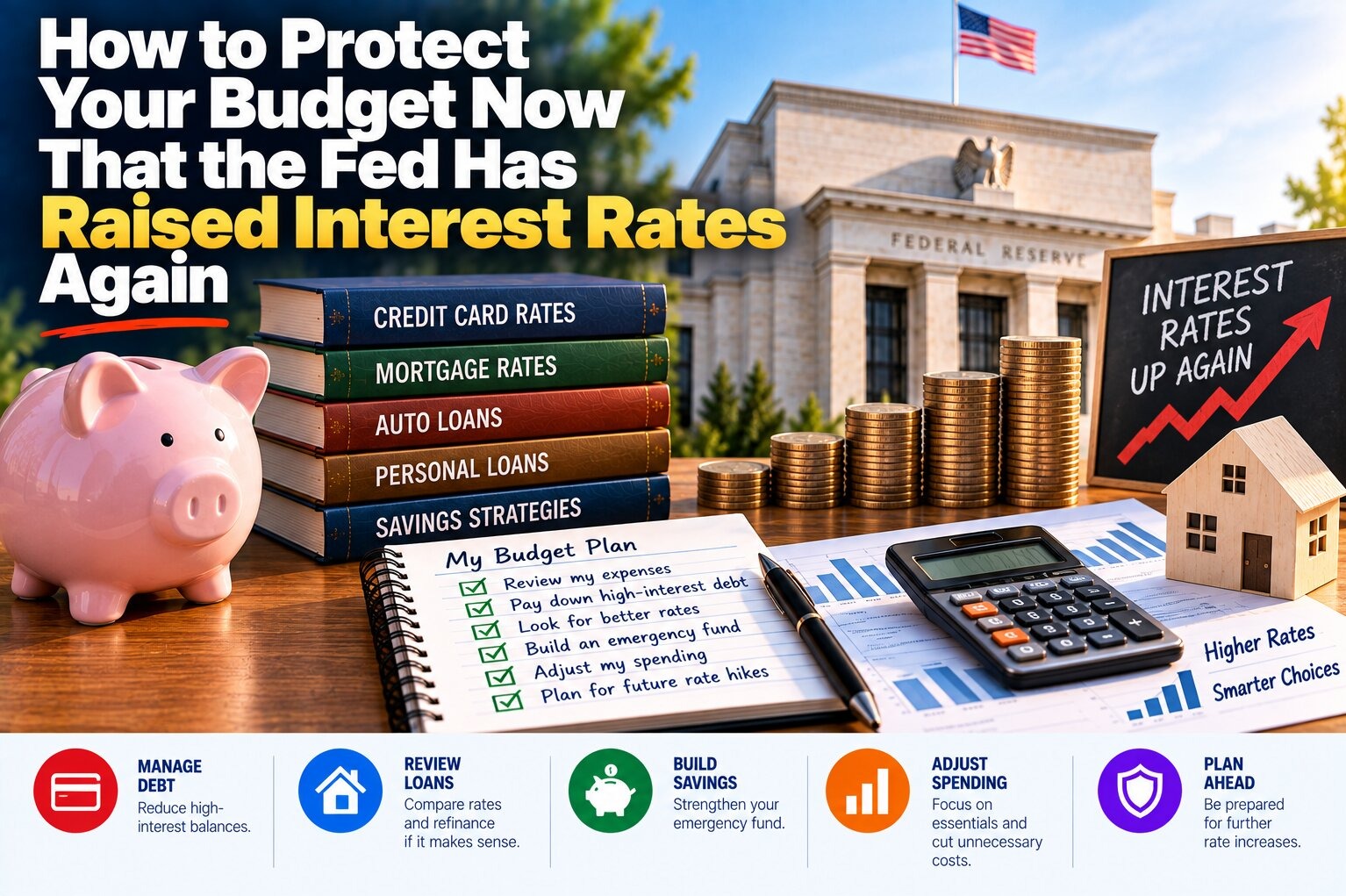
The Federal Reserve raised its benchmark rate by a quarter point on September 16, 2026, pushing the target range to 3.75%-4.00%. It was the first Fed hike in more than three years, approved unanimously after policymakers spent the summer watching core PCE inflation run above 3% every single month of 2026. Thirteen days later, on September 29, the Reserve Bank of Australia followed with its own quarter-point increase, lifting the cash rate to 4.60%, the highest level in Australia since late 2011. The Bank of England held its base rate at 3.75% at its most recent meeting, and the Bank of Canada's overnight rate has sat at 2.25% since spring 2026, so the picture across Tier 1 economies right now is mixed rather than uniform.
None of that matters much if you don't know what to do with it. A rate hike is not a headline you read and move past; it is a signal that borrowing is about to cost more and saving is about to pay a little better, and both of those facts have a shelf life. This guide walks through exactly how to adjust your budget, your debt payoff order, and your savings strategy over the next few weeks, whether you bank in the US, the UK, Canada, Australia, or elsewhere in Western Europe.
What the Rate Hike Actually Changes for You
Most credit cards carry a variable APR tied to the prime rate, which moves in step with the Fed funds rate. When the Fed hikes, card issuers typically pass the increase through within one to two billing cycles. A borrower carrying the average Q2 2026 credit card balance of $6,610 at a 22% APR would see minimum payments creep up almost immediately, and the cost compounds every month the balance isn't paid down. Auto loans and other variable-rate credit work the same way, just with longer horizons.
Mortgages are the exception that trips people up. Fixed-rate mortgages don't reprice when the Fed moves, because lenders already bake expected rate paths into the yield on long-term bonds months in advance. If you're shopping for a new mortgage or refinancing, though, you may still see lenders adjust offered rates over the coming weeks as they digest the hike and whatever comes out of the Fed's December meeting, which JPMorgan Global Research currently expects to bring another quarter-point increase.
On the savings side, this is a rare case where a rate hike works in your favor. Online high-yield savings accounts are already paying between 3.14% and 4.34% APY at major banks, six-month CDs are averaging 4.14% APY, and five-year CDs are averaging around 4.9%. Those numbers tend to drift upward, not downward, in the weeks after a hike, since banks compete harder for deposits when their own cost of funds rises.
Key Numbers to Know
| Central Bank | Latest Move | Current Rate | What It Means for You |
|---|---|---|---|
| US Federal Reserve | +0.25% on Sept. 16, 2026 | 3.75%-4.00% | Variable card and loan APRs rise; savings and CD yields improve modestly |
| Reserve Bank of Australia | +0.25% on Sept. 29, 2026 | 4.60% (15-year high) | Mortgage and business loan costs rising fastest of the four; term deposits more attractive |
| Bank of England | Held steady | 3.75% | No immediate change, but easy-access savings rates remain elevated from prior hikes |
| Bank of Canada | Held since spring 2026 | 2.25% | Borrowing costs stable; savings yields lower than US, UK, or Australia |
Step-by-Step: Rebalance Your Budget This Week
You don't need a financial advisor to respond to a rate hike, but you do need to move with some urgency, since variable-rate costs start climbing before most people notice.
- Pull your last two statements for every card and loan with a variable rate. Compare the APR on each to what it was in July, before the hike was priced in, so you know exactly how much more you're paying.
- Rank your debts by interest rate, not balance. The highest-APR debt is now getting more expensive fastest, so it should be the first target for extra payments.
- Call your card issuer and ask for a lower rate. If your credit score has improved since you opened the account, issuers will often shave a point or two off your APR just for asking, especially for customers with a track record of on-time payments.
- Move idle cash into a high-yield account or short-term CD. Checking account balances above your monthly spending needs are earning close to nothing; even $2,000 moved into a 4% APY account generates roughly $80 a year it wasn't earning before.
- Re-run your budget with the new minimum payments. A $1.38 increase in a single card's minimum payment sounds trivial, but add it up across every variable-rate account you hold and the monthly hit is real.
How to Cut the Cost of Rising Debt
If you're carrying a revolving balance, the math has shifted against you, and the fix is the same one that always works, just more urgent now. Consider a balance transfer to a 0% introductory APR card if your credit is strong enough to qualify; most transfer offers run 12 to 21 months interest-free, which is enough time to make real progress on principal while the rate environment settles. If a transfer isn't available to you, a personal loan at a fixed rate can sometimes beat a variable card APR, particularly once card issuers finish repricing over the next month or two.
For anyone with a variable-rate home equity line of credit, now is a reasonable moment to ask your lender about converting some or all of the balance to a fixed rate. Many HELOC lenders offer this as a standard feature, and locking in before a possible December hike protects you from a second increase on top of this one.
How to Make Your Savings Work Harder
Rate hikes are one of the few moments where doing nothing actively costs you money, because the gap between what a top-paying account offers and what your current bank pays keeps widening. Check the APY on your existing savings account first; the national average sits far below what competitive online banks pay, so a bank that hasn't moved its rate in months is quietly shortchanging you.
A CD ladder is worth considering if you have cash you won't need for six months to a few years. Splitting a lump sum across a six-month, one-year, and two-year CD lets you capture today's higher yields on the longer terms while keeping a portion accessible sooner, in case rates keep climbing and you want to reinvest at an even better rate later.
Who Should Act Immediately vs. Who Can Wait
Not everyone needs to overhaul their finances this week. If you hold only fixed-rate debt, a fixed mortgage, and a fixed personal loan, this hike changes very little for you directly, though it's still worth checking whether your savings account is competitive. The people who should move fastest are anyone carrying a revolving credit card balance, a variable-rate HELOC, or a variable-rate small business loan, since those costs are already adjusting. Savers sitting on a large cash cushion in a low-yield account are the other group with a clear, immediate opportunity: every week that money sits at 0.37% instead of 4% is a week of lost income with no offsetting benefit.
Common Mistakes to Avoid
- Panicking about your fixed mortgage. A Fed hike does not reprice a loan you already locked in; only adjustable-rate mortgages and HELOCs are directly exposed.
- Chasing a promotional rate without reading the fine print. Many of the highest advertised APYs are introductory offers that drop sharply after three to twelve months.
- Ignoring small APR increases because they look minor month to month. A quarter-point increase compounds over a year, especially on larger balances.
- Moving all your cash into a long-term CD. Locking up your entire emergency fund removes the flexibility to respond if rates rise further or you need the money unexpectedly.
- Assuming every country moved together. The Bank of Canada hasn't hiked and the Bank of England held steady, so a UK or Canadian reader shouldn't assume their own borrowing costs just rose.
Practical Tips for International Readers
If you bank in the UK, your base rate hasn't moved this cycle, but several building societies and online banks have kept easy-access rates elevated from earlier increases, so it's still worth comparing what you're earning against the best available easy-access and fixed-rate ISAs. Canadian readers are in the most stable position among the four markets discussed here, with the Bank of Canada's overnight rate unchanged since spring 2026, meaning neither your variable mortgage nor your high-interest savings account has much reason to move in the near term. Australian readers face the sharpest change: with the cash rate at a 15-year high, anyone on a variable-rate mortgage should model the impact of another possible increase and consider whether a fixed or split-rate loan makes more sense for the next year.