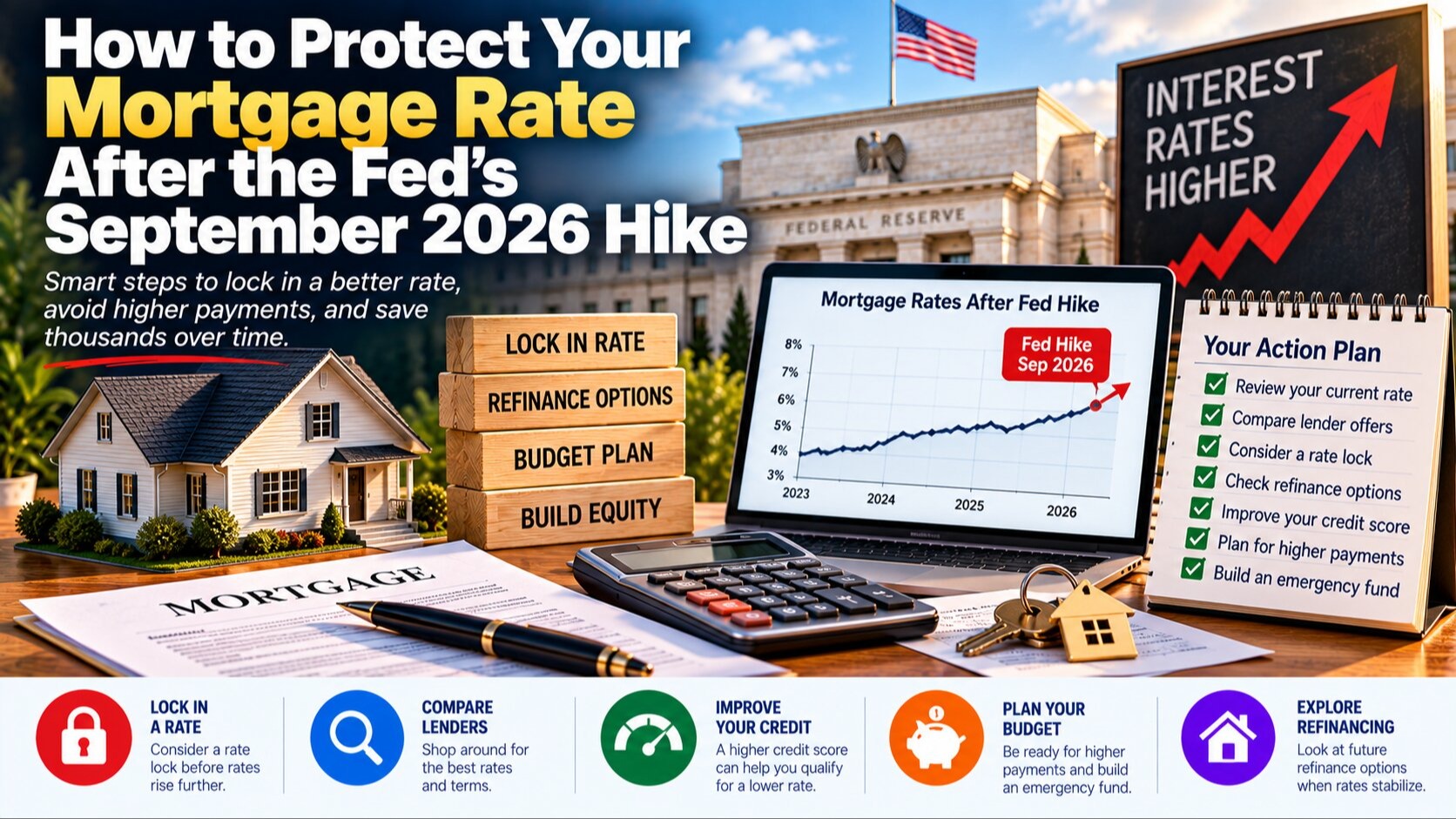
On September 16, 2026, the Federal Reserve's Federal Open Market Committee voted 12-0 to raise the federal funds rate a quarter point, pushing the target range from 3.50%-3.75% up to 3.75%-4.00%. It was the Fed's first rate hike since 2023, and it landed hard: Freddie Mac's weekly Primary Mortgage Market Survey showed the average 30-year fixed mortgage rate jumping from 6.76% to 6.95% in just seven days. Fed projections released the same day showed 16 of the 18 FOMC participants expect at least one more hike before the end of the year.
If you're house hunting, mid-contract, or sitting on an adjustable-rate loan right now, this isn't background noise you can wait out. Rates moved fast, more movement is signaled, and the choices you make in the next few weeks about locking, financing structure, and timing will show up in your monthly payment for years. This guide walks through exactly what to do next, whether you're in the U.S. or shopping for a mortgage in the UK, Canada, or Australia.
What the Fed's September Hike Actually Changed
The Fed doesn't set mortgage rates directly, but its benchmark rate shapes the bond market that mortgage pricing tracks closely, particularly the 10-year Treasury yield. When the Fed signals more tightening is coming, lenders bake that expectation into rate sheets immediately, which is why the 30-year average moved nearly 20 basis points in a single week rather than drifting slowly. That's a real cost: on a $400,000 loan, the jump from 6.76% to 6.95% adds roughly $50 to $55 to the monthly payment, and it can shift how much home a lender says you qualify for.
Central banks elsewhere are not all moving in the same direction, which matters if you're comparing markets or have flexibility about where you buy. The Bank of Canada held its policy rate at 2.25% on September 2, 2026, for a seventh straight decision, keeping big-bank prime rates around 4.45%. The Reserve Bank of Australia has held its cash rate at 4.35% since August 12, 2026, with a decision due September 29, 2026, and several bank economists forecasting a 25-basis-point increase to 4.60%. In the UK, the 2026 Budget left stamp duty thresholds for first-time buyers unchanged from the April 2025 rules, so buyers there face stable transaction costs even as mortgage pricing continues to move with gilt yields.
| Market | Benchmark Rate (Sept 2026) | Recent Move | What It Means for Borrowers |
|---|---|---|---|
| United States (Fed Funds) | 3.75%-4.00% | +25bps on Sept 16, first hike since 2023 | 30-yr fixed jumped to ~6.95%; more hikes signaled |
| Canada (BoC policy rate) | 2.25% | Held for 7th straight meeting (Sept 2) | Prime rate steady near 4.45%; less urgency to lock |
| Australia (RBA cash rate) | 4.35% | Held since Aug 12; hike expected Sept 29 | Variable-rate borrowers should model a possible +25bps |
| United Kingdom (Bank Rate) | Tracks gilt yields | Stamp duty thresholds unchanged in 2026 Budget | Transaction costs stable; rate risk is on financing side |
Step-by-Step: What to Do Right Now If You're House Hunting
You don't need to panic, but you do need to move with more intention than you would in a stable-rate environment. Here's the order of operations worth following this week:
- Get re-quoted, not just pre-approved. If your pre-approval letter is more than two or three weeks old, ask your lender for a fresh rate quote. Pre-approval amounts are usually based on a rate assumption, and a 20-basis-point move can change your maximum purchase price.
- Ask every lender for a rate-lock quote, not just an advertised rate. Advertised rates often assume a specific credit score, loan-to-value ratio, and lock period. Get the real number for your file before comparing lenders.
- Check whether your lender offers a float-down option. Some lenders let you lock now but drop to a lower rate if rates fall before closing, usually for a fee. In a rate environment where the Fed itself is split on direction, this can be worth the cost.
- Re-run your debt-to-income math at the new rate. A payment that fit your budget at 6.76% may not fit as comfortably at 6.95% or higher. Recalculate before you get emotionally attached to a listing.
- Ask about temporary buydowns. Sellers or builders in a softening market may agree to fund a 2-1 or 1-0 buydown, which lowers your effective rate for the first one or two years while you adjust.
Should You Lock Your Rate or Float? How to Decide
Locking freezes your rate for a set window, typically 30, 45, or 60 days, protecting you if rates rise further before closing. Floating means your rate isn't set until later, which only pays off if rates fall. Given that 16 of 18 Fed officials are projecting another hike this year, floating is a directional bet against the Fed's own median forecast. That doesn't make it wrong, but it does mean the odds currently favor locking for most buyers who are within 45 days of closing.
The calculation changes if you're further out, say 60 to 90 days from closing, since a lot can shift before then. In that case, ask your lender about a longer lock with a slightly higher fee, or a lock with one float-down right built in. What you want to avoid is drifting into closing week with no lock and no plan, because that's when a bad week in the bond market costs you the most.
Fixed vs. Adjustable: Which Makes Sense in This Environment
Adjustable-rate mortgages (ARMs) typically start lower than fixed rates, but they reset periodically based on an index plus a margin. With the Fed signaling more hikes and inflation still running above target, a 5/1 or 7/1 ARM taken out today carries real reset risk if you plan to hold the loan past its fixed period. ARMs still make sense for buyers who are confident they'll sell or refinance within the fixed window, but "confident" needs to mean a real plan, not a hope that rates fall.
If you already hold an ARM and it's approaching its first adjustment, call your servicer now and ask for your projected new payment. Many ARM borrowers are surprised at reset time; you have time to plan for it if you ask before the adjustment date, not after the new bill arrives.
How to Qualify for the Best Available Rate Right Now
Lenders are pricing more conservatively across the board, which means the gap between the best available rate and the average rate has widened. A few concrete levers still move the number you're quoted:
- Credit score tiers matter more. The jump from a 680 to a 740 FICO score can be worth a quarter point or more on your rate in this pricing environment; pull your credit report and dispute any errors before you apply.
- Lower your loan-to-value ratio if you can. Putting down 25% instead of 20% can move you into a better pricing tier with many conventional lenders.
- Buy points strategically. Paying discount points to lower your rate makes more sense the longer you plan to hold the loan; run the breakeven math (points cost divided by monthly savings) before deciding.
- Shop at least three to five lenders in the same week. Rate sheets move daily, so quotes gathered a week apart aren't a fair comparison. Get them within the same 48-hour window.
- Ask about relationship or first-time-buyer discounts. Some banks and credit unions still shave a small amount off the rate for existing depositors or qualifying first-time buyers.
Who Should Consider Waiting, and Who Shouldn't
If your home search is driven by a hard deadline, a lease ending, a job relocation, a growing family, waiting on rates rarely makes sense, since nobody, including the Fed itself, has certainty about where rates go next. If you have real flexibility on timing and your local market is showing signs of softening (more price cuts, longer days on market), it may be worth negotiating harder on price or seller-paid buydowns rather than betting on a rate drop. The math that matters is total cost of ownership over the years you'll actually hold the property, not just the headline rate on day one.
What This Means If You're Buying Outside the U.S.
If you're in Canada, the Bank of Canada's seventh consecutive hold gives you more breathing room than U.S. buyers currently have, but it's worth confirming with your lender whether you're on a fixed or variable mortgage and when your term renews, since Canadian mortgages typically renew every few years rather than locking for the full amortization period. If you're in Australia, model your budget for the RBA's September 29 decision now: with a 25-basis-point hike being the base case among several bank economists, a variable-rate borrower with $500,000 owing should plan for roughly $75 to $80 more per month if that hike lands. UK buyers face stable stamp duty costs through the rest of 2026, so your main variable is mortgage pricing tied to gilt yields; get a fresh quote before your existing mortgage offer expires, since UK offers typically only hold for a matter of months.
Common Mistakes to Avoid Right Now
- Assuming your pre-approval rate is still accurate after a Fed announcement.
- Floating a rate with no lock plan while sitting inside a 30-day closing window.
- Taking an ARM without a concrete exit plan before the first reset.
- Comparing lender quotes gathered on different days as if they're equivalent.
- Ignoring seller or builder buydown offers that could offset the rate increase for the first year or two.
Key Numbers to Know
Keep these figures handy when you're talking to lenders or agents this month: the Fed's target range is now 3.75%-4.00%, the average 30-year fixed mortgage rate sat at 6.95% as of Freddie Mac's September 17 survey, and a 20-basis-point rate move adds roughly $50 to $55 a month to payments on a $400,000 loan. In Australia, a 25-basis-point move changes minimum repayments by about $15 to $16 a month for every $100,000 owed on a 25-year loan.