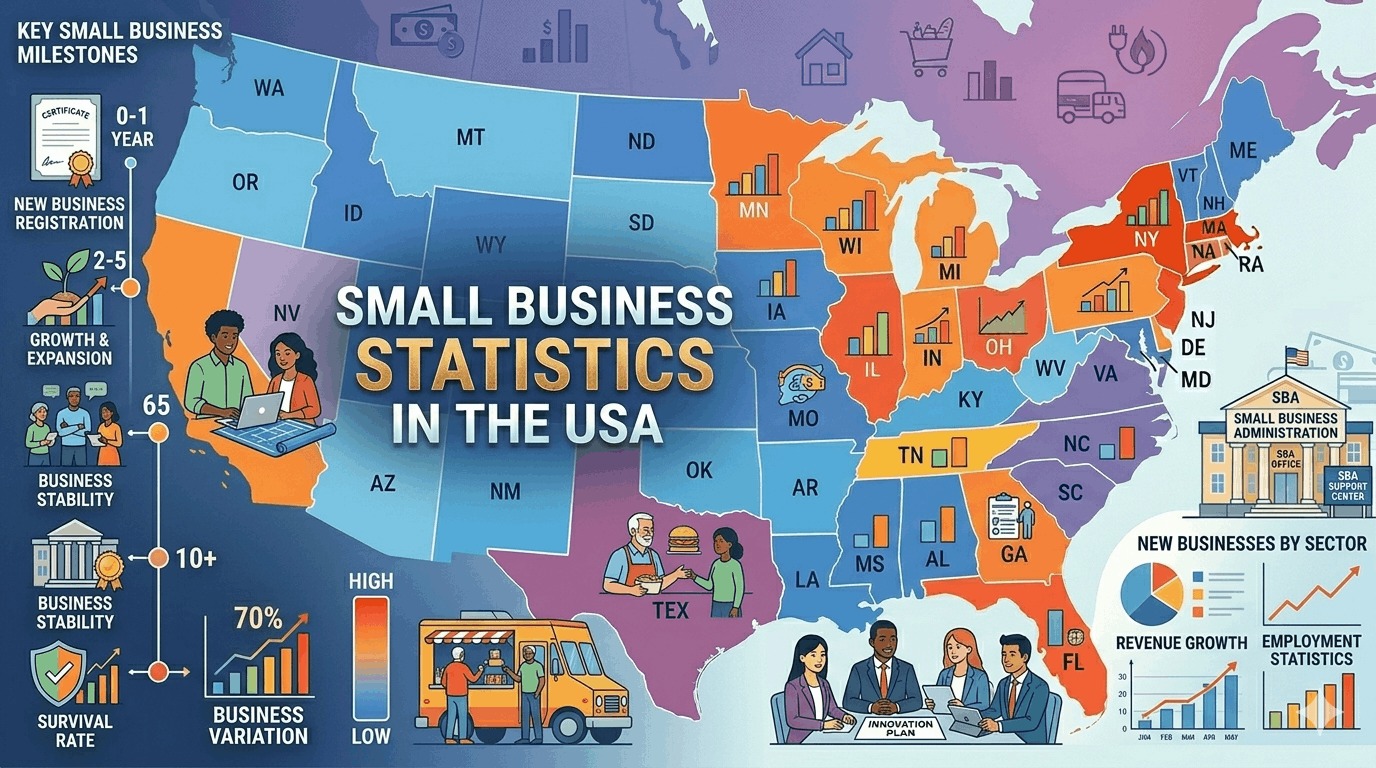
Small businesses are often called the backbone of the U.S. economy—and for good reason. From local coffee shops to growing startups, small businesses drive innovation, create jobs, and support communities.
But behind the success stories, the data tells a more detailed picture—one that includes growth, risk, challenges, and opportunity.
Let’s break down the most important small business statistics in America in a simple, practical way.
What Counts as a Small Business?
In the U.S., a small business is generally defined as a company with fewer than 500 employees. However, most small businesses are much smaller than that.
Here’s a simple breakdown:
| Category | Employees | Example |
|---|---|---|
| Micro Business | 1–9 | Freelancers, solo founders |
| Small Business | 10–99 | Local stores, small agencies |
| Medium Small Business | 100–499 | Growing companies |
Understanding this range matters because most businesses fall into the smallest category.
Total Number of Small Businesses in the USA
Small businesses dominate the U.S. economy.
- There are over 33 million small businesses in the United States
- They make up 99.9% of all businesses
What This Means
Almost every business you interact with daily is likely a small business.
Real-World Example
Think about your neighborhood—restaurants, salons, repair shops, and local service providers are all small businesses. Even many online businesses with a strong digital presence are run by small teams or individuals.
These businesses collectively contribute to broader trends like Economic Growth Trends in the US https://statush.com/finance-statistics/economic-growth-trends-in-the-us.
Small Businesses and Job Creation
Small businesses play a major role in employment.
- They employ nearly 46% of the U.S. workforce
- They create about two-thirds of new jobs annually
Key Insight
Small businesses are not just part of the economy—they actively shape it.
Real-World Example
When a small company expands from 5 to 20 employees, it directly creates jobs in its community. Multiply this by millions of businesses, and you get a massive impact on employment.
This connects closely with broader workforce patterns in Remote Work Statistics in the USA https://statush.com/finance-statistics/remote-work-statistics-in-the-usa.
Small Business Revenue and Economic Impact
Small businesses contribute significantly to the U.S. economy.
- They generate over 40% of total economic activity
- Many industries depend heavily on small businesses
What This Means
Large corporations may dominate headlines, but small businesses keep the economy running at the ground level.
Real-World Example
A local construction company hires workers, buys materials, and pays taxes—creating a ripple effect in the economy. This indirect impact often goes unnoticed but is extremely powerful.
You can see how this ties into broader patterns in Digital Economy Growth Statistics https://statush.com/finance-statistics/digital-economy-growth-statistics.
Small Business Survival Rates
Starting a business is one thing—keeping it alive is another.
- About 20% of small businesses fail within the first year
- Around 50% fail within five years
Key Insight
Entrepreneurship comes with risk, and survival depends on planning and execution.
Real-World Example
A new restaurant might start strong but struggle due to high rent, poor location, or lack of cash flow management. Even a good idea can fail without proper financial planning.
You can explore deeper insights in Startup Failure Rates in the USA https://statush.com/finance-statistics/startup-failure-rates-in-the-usa.
Small Business Ownership Trends
Ownership patterns are evolving over time.
- Increasing number of women-owned businesses
- Growth in minority-owned businesses
- Rise in solo entrepreneurs and freelancers
What This Means
The business landscape is becoming more diverse and accessible.
Real-World Example
Platforms like e-commerce and social media have made it easier for individuals to start businesses with low capital. A single person can now run a profitable online store or service-based business from home.
This trend is closely related to Side Hustle Statistics in America https://statush.com/finance-statistics/side-hustle-statistics-in-america.
Industries Dominated by Small Businesses
Certain industries are heavily driven by small businesses.
- Retail
- Food services
- Construction
- Professional services
- Real estate
Key Insight
Small businesses thrive in industries that require flexibility and local presence.
Real-World Example
A local real estate agent or rental property investor is typically a small business owner. These individuals play a major role in housing markets.
You can explore this further in Housing Price Trends in the USA https://statush.com/finance-statistics/housing-price-trends-in-the-usa.
Access to Capital and Funding Challenges
One of the biggest challenges for small businesses is access to funding.
- Many businesses rely on personal savings
- Loans and credit can be difficult to obtain
What This Means
Financial barriers limit growth opportunities.
Real-World Example
A small business owner may have a great idea but struggle to expand due to lack of funding. Without proper capital, hiring employees or scaling operations becomes difficult.
Debt plays a major role here, as shown in Personal Loan Debt Statistics in the USA https://statush.com/finance-statistics/personal-loan-debt-statistics-in-the-usa.
Impact of Technology on Small Businesses
Technology has transformed how small businesses operate.
- Growth of e-commerce
- Increased use of digital marketing
- Automation of operations
Key Insight
Technology reduces barriers but increases competition.
Real-World Example
A small clothing brand can now sell nationwide using online platforms. However, it also competes with thousands of similar businesses, making differentiation important.
This shift is reflected in Digital Economy Growth Statistics https://statush.com/finance-statistics/digital-economy-growth-statistics.
Financial Management Challenges
Many small businesses struggle with financial management.
Common Issues
- Poor cash flow management
- Lack of budgeting
- Underestimating expenses
Real-World Example
A business might generate high revenue but still fail due to poor cash flow. For example, delayed payments from customers can create financial stress even when sales are strong.
Understanding financial fundamentals is critical. Topics like How Taxes Impact Wealth Building https://statush.com/finance-statistics/how-taxes-impact-wealth-building help business owners make better decisions.
Why Small Businesses Matter Today
Small businesses are more important than ever.
They:
- Drive innovation
- Create jobs
- Support local economies
Practical Takeaways
If you’re starting or running a small business:
- Focus on cash flow, not just revenue
- Start small and scale gradually
- Use digital tools to increase efficiency
- Plan for risks and uncertainty
Understanding long-term trends can help guide decisions. You can explore Future Financial Trends in the US https://statush.com/finance-statistics/future-financial-trends-in-the-us.
Final Thoughts
Small businesses are the foundation of the American economy—but they also face real challenges.
The statistics show both sides:
- Massive opportunity
- Real risk
Success in small business isn’t just about having a good idea. It’s about:
- Financial discipline
- Strategic thinking
- Consistent execution
And just like personal finance, small business success compounds over time—small improvements lead to big results.