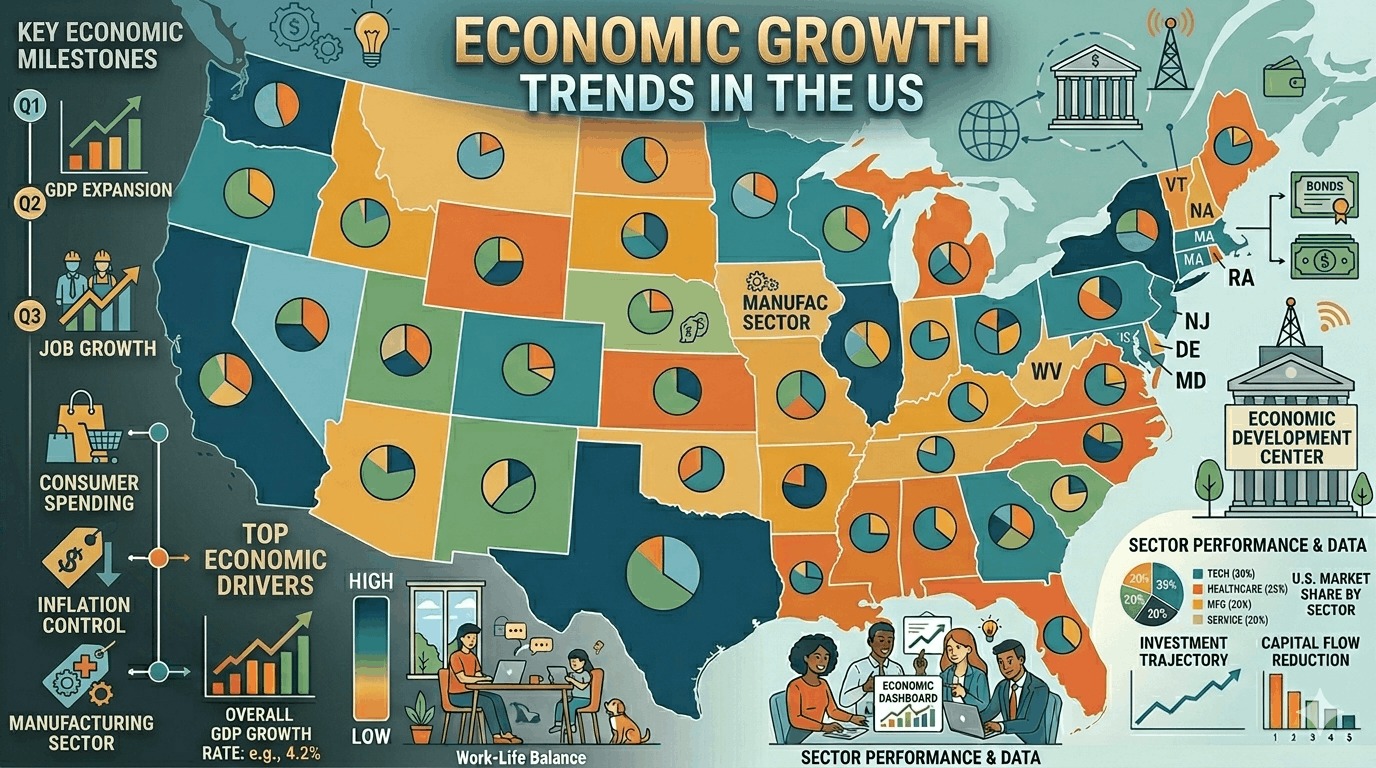
The U.S. economy is one of the largest and most influential in the world. Its growth trends impact everything—from job opportunities and wages to investments, housing, and global markets.
But economic growth isn’t always steady. It moves in cycles, shaped by factors like inflation, interest rates, technology, and consumer behavior.
Let’s break down economic growth trends in the U.S. in a clear, practical way, with real-world examples and insights you can actually use.
What Is Economic Growth?
Before diving into trends, it’s important to understand what economic growth actually means.
Simple Definition
Economic growth refers to the increase in the production of goods and services in a country over time, usually measured by Gross Domestic Product (GDP).
Basic Breakdown
| Term | Meaning |
|---|---|
| GDP | Total value of goods and services produced |
| Growth rate | Percentage increase in GDP |
| Expansion | Period of economic growth |
| Recession | Period of economic decline |
Example
If the U.S. produces more goods, services, and income this year compared to last year, the economy is growing.
Historical Growth Patterns
The U.S. economy has experienced cycles of growth and slowdown over time.
Key Observations
- Average long-term GDP growth: ~2% to 3% annually
- Periods of rapid growth followed by slowdowns or recessions
- Recovery phases often driven by innovation and policy changes
Real-World Example
After major downturns, such as financial crises, the economy typically rebounds due to:
- Government stimulus
- Job creation
- Increased consumer spending
Understanding these cycles helps investors and individuals make better financial decisions.
Key Drivers of Economic Growth
Several factors contribute to economic growth in the U.S.
Main Drivers
| Factor | Impact |
|---|---|
| Consumer spending | Largest contributor to GDP |
| Business investment | Expands production and jobs |
| Government spending | Supports infrastructure and programs |
| Net exports | Trade balance with other countries |
| Technology | Increases productivity |
Simple Explanation
When people spend more, businesses earn more, hire more workers, and invest further—creating a cycle of growth.
Consumer Spending Trends
Consumer spending is the backbone of the U.S. economy.
Key Statistics
- Accounts for ~65% to 70% of GDP
- Driven by income, employment, and confidence
Real-World Example
When consumers feel financially secure, they:
- Buy homes
- Spend on travel and entertainment
- Invest in goods and services
This increased spending fuels business growth and economic expansion.
Role of Technology in Economic Growth
Technology has become one of the strongest drivers of modern economic growth.
Key Trends
- Growth of digital businesses
- Automation increasing efficiency
- Expansion of AI and cloud computing
Example
Companies can now:
- Operate globally through digital platforms
- Reduce costs using automation
- Scale faster than traditional businesses
This aligns with
Digital Economy Growth Statistics (https://statush.com/finance-statistics/digital-economy-growth-statistics)
Employment and Job Market Trends
A strong job market is essential for economic growth.
Key Trends
- Low unemployment supports consumer spending
- Job creation drives income growth
- Shift toward service and tech-based jobs
High-Growth Sectors
- Technology
- Healthcare
- Financial services
- E-commerce
Explanation
When more people are employed, they earn income and spend more, which boosts the economy.
Inflation and Interest Rates
Inflation and interest rates are critical factors that influence economic growth.
Key Relationships
| Factor | Effect on Economy |
|---|---|
| High inflation | Reduces purchasing power |
| Low inflation | Supports stable growth |
| High interest rates | Slows borrowing and spending |
| Low interest rates | Encourages investment |
Example
When interest rates rise:
- Loans become more expensive
- Businesses invest less
- Consumers spend less
This can slow down economic growth.
You can explore this further in
Inflation Trends in the United States (https://statush.com/finance-statistics/inflation-trends-in-the-united-states)
Housing Market and Economic Growth
The housing market plays a significant role in economic activity.
Key Contributions
- Construction creates jobs
- Home purchases drive spending
- Property values impact wealth
Example
When the housing market is strong:
- Builders construct more homes
- Buyers spend on furniture and appliances
- Local economies benefit
This connects with
Housing Market Forecast in the USA (https://statush.com/finance-statistics/housing-market-forecast-in-the-usa)
Investment Trends and Capital Markets
Investments are another key driver of economic growth.
Key Trends
- Growth in stock market participation
- Increased interest in long-term investing
- Expansion of alternative investments
Explanation
When businesses receive investment:
- They expand operations
- Create jobs
- Increase productivity
This aligns with
Investment Trends in the US Market (https://statush.com/finance-statistics/investment-trends-in-the-us-market)
Government Policy and Economic Growth
Government decisions play a major role in shaping economic trends.
Key Areas
- Fiscal policy (taxes and spending)
- Monetary policy (interest rates)
- Regulations and trade policies
Example
Government stimulus programs can:
- Boost spending
- Support businesses
- Accelerate recovery during slowdowns
Challenges Facing the U.S. Economy
Despite its strength, the U.S. economy faces several challenges.
Common Challenges
| Challenge | Impact |
|---|---|
| Inflation | Reduces purchasing power |
| Income inequality | Uneven distribution of wealth |
| National debt | Long-term financial pressure |
| Global uncertainty | Impacts trade and markets |
Real Insight
Economic growth is not always evenly distributed—some sectors and individuals benefit more than others.
This is reflected in
Income Inequality Statistics in the USA (https://statush.com/finance-statistics/income-inequality-statistics-in-the-usa)
Future Economic Growth Outlook
Looking ahead, the U.S. economy is expected to grow steadily, but with some uncertainties.
Future Trends
- Continued growth in technology sectors
- Expansion of digital and remote work
- Moderate GDP growth rates
- Ongoing impact of global economic conditions
What This Means
- Opportunities for innovation and investment
- Need for adaptability in careers and businesses
- Continued importance of financial planning
Practical Tips to Navigate Economic Trends
Understanding economic trends can help you make smarter financial decisions.
1. Stay Informed
Follow key indicators like inflation, employment, and GDP.
2. Diversify Income
Relying on one income source can be risky—consider side hustles or investments.
3. Invest for the Long Term
Economic cycles come and go, but long-term investing remains effective.
4. Manage Expenses
Adjust spending based on economic conditions.
5. Build Financial Security
Use tools like the
Emergency Fund Calculator (https://statush.com/emergency-fund-calculator)
to prepare for uncertainties.
Final Thoughts
Economic growth trends in the U.S. show a dynamic and evolving system shaped by technology, consumer behavior, and global forces.
What’s important to understand is that growth is not always linear—it comes with ups and downs. However, over the long term, the U.S. economy has consistently expanded and adapted.
For individuals, this means opportunities—but also the need to stay informed and flexible.
For businesses, it means innovation and adaptation are essential.
In the end, economic growth is not just about numbers—it’s about how those numbers affect real lives, opportunities, and financial futures.