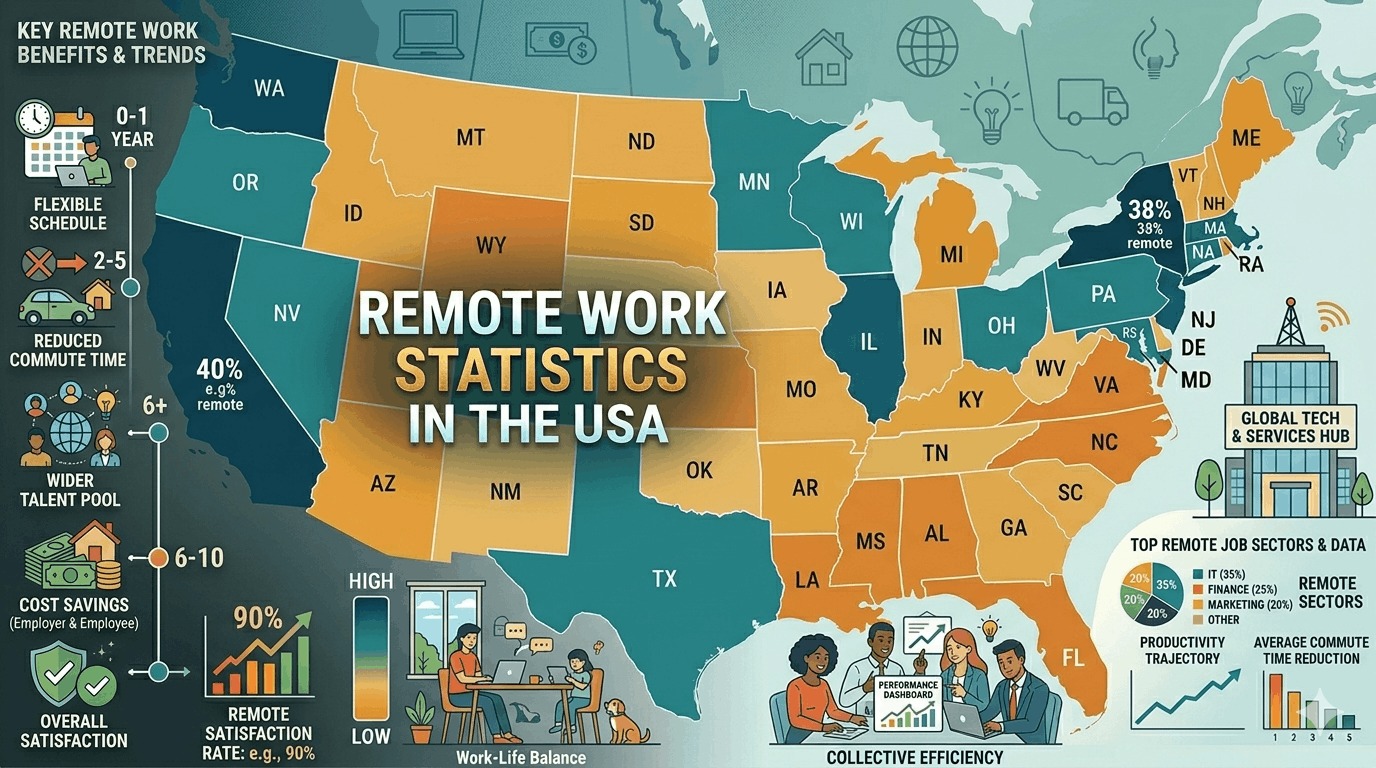
Remote work has shifted from a temporary solution to a long-term transformation in how Americans work. What started as a necessity during global disruptions has now evolved into a preferred work style for millions of employees and a strategic advantage for companies.
But beyond the headlines, what do the actual numbers tell us? And more importantly, what do they mean for workers, businesses, and the future of the economy?
Let’s break down remote work statistics in the USA with clear explanations, real-world examples, and practical insights.
The Growth of Remote Work in the USA
Remote work adoption has grown dramatically over the past few years. Before 2020, only about 5% to 7% of U.S. workers were fully remote. Today, that number has increased significantly.
Key Statistics
- Around 25% to 35% of workers now work remotely at least part-time
- Approximately 15% to 20% are fully remote
- Over 60% of employees prefer hybrid work models
This shift is closely tied to broader changes in the economy, as highlighted in
Digital Economy Growth Statistics (https://statush.com/finance-statistics/digital-economy-growth-statistics)
Simple Explanation
Remote work became possible at scale because of:
- Faster internet and cloud tools
- Collaboration platforms like Zoom and Slack
- Increased trust in digital productivity
In simple terms, work is no longer tied to a physical office—it’s tied to outcomes.
Why Companies Are Embracing Remote Work
Companies didn’t just adopt remote work because they had to—they kept it because it works.
Main Reasons Businesses Support Remote Work
| Reason | Impact on Business |
|---|---|
| Lower operating costs | Reduced office rent and utilities |
| Access to global talent | Hire from anywhere |
| Higher productivity | Fewer office distractions |
| Employee retention | Better work-life balance |
For example, a tech startup in California can now hire a developer from Texas or even internationally, often at a lower cost.
This aligns with trends in
Small Business Statistics in America (https://statush.com/finance-statistics/small-business-statistics-in-america), where flexibility is becoming a competitive advantage.
Employee Preferences and Work Trends
Remote work isn’t just a company decision—it’s strongly driven by employee demand.
What Workers Want
- 70%+ of employees want flexible work options
- 50%+ would consider switching jobs for remote flexibility
- Hybrid work is the most preferred model
Real-World Example
An employee working a traditional 9-to-5 office job might save:
- 1–2 hours daily commute time
- Transportation costs
- Meal expenses
That saved time often gets reinvested into personal life, side hustles, or skill development.
This connects with trends in
Side Hustle Statistics in America (https://statush.com/finance-statistics/side-hustle-statistics-in-america), where flexible schedules enable additional income streams.
Productivity: Is Remote Work More Effective?
One of the biggest debates around remote work is productivity. The data, however, tells a nuanced story.
Productivity Insights
- Many studies show equal or higher productivity in remote settings
- Employees report fewer interruptions
- Output-based performance is increasing
Why Productivity Improves
| Factor | Explanation |
|---|---|
| Flexible schedule | Work during peak energy hours |
| Fewer distractions | No office noise or interruptions |
| Personalized setup | Comfortable work environment |
| Time savings | No commute fatigue |
However, it’s not perfect. Some workers struggle with:
- Isolation
- Communication gaps
- Overworking
So while productivity can increase, it depends heavily on how remote work is managed.
Financial Impact of Remote Work
Remote work doesn’t just change how people work—it also changes how they spend and save money.
For Employees
Savings:
- Transportation costs
- Daily meals and coffee
- Work clothing
Additional Costs:
- Home office setup
- Higher electricity bills
For Employers
Savings:
- Office rent
- Utilities
- Maintenance
This shift is also influencing broader economic patterns discussed in
Average Cost of Living by State (https://statush.com/finance-statistics/average-cost-of-living-by-state)
Real Example
Someone moving from New York City to a lower-cost state while working remotely could save thousands annually on rent alone.
Remote Work by Industry
Not all industries can adopt remote work equally. Some are naturally more suited than others.
Industry Breakdown
| Industry | Remote Work Adoption |
|---|---|
| Technology | Very high |
| Finance | High |
| Marketing | High |
| Healthcare | Low |
| Manufacturing | Very low |
Explanation
Jobs that rely on:
- Computers → easier to go remote
- Physical presence → harder to go remote
For example, a software developer can work from anywhere, but a factory worker cannot.
The Rise of Hybrid Work Models
Fully remote work isn’t the only trend—hybrid work is becoming the dominant model.
What Is Hybrid Work?
A mix of:
- Remote work (home)
- In-office work (few days per week)
Why Hybrid Is Popular
- Balance between flexibility and collaboration
- Maintains company culture
- Reduces burnout
Many companies now require employees to come into the office 2–3 days a week while working remotely the rest of the time.
Challenges of Remote Work
Despite its benefits, remote work comes with real challenges that both employees and companies must address.
Common Challenges
| Challenge | Explanation |
|---|---|
| Communication gaps | Less face-to-face interaction |
| Isolation | Reduced social connection |
| Work-life balance | Difficulty “switching off” |
| Management issues | Harder to supervise teams |
Real-World Insight
Some remote workers report working longer hours than before because boundaries between work and personal life blur.
This is why structure and discipline are critical for long-term success.
The Future of Remote Work in the USA
Remote work is not going away—it’s evolving.
Future Trends
- More companies adopting hybrid models
- Increased use of AI and automation tools
- Growth in global hiring
- Expansion of digital-first businesses
These changes align with broader insights in
Future Financial Trends in the US (https://statush.com/finance-statistics/future-financial-trends-in-the-us)
What This Means
- Workers will have more flexibility and choices
- Companies will compete globally for talent
- Cities may see changes in housing demand
Practical Tips for Remote Workers
If you’re working remotely—or planning to—here are some practical tips:
1. Create a Dedicated Workspace
Even a small desk can improve focus and productivity.
2. Set Clear Working Hours
Avoid overworking by defining start and end times.
3. Take Regular Breaks
Short breaks improve long-term productivity.
4. Invest in Good Tools
A reliable laptop, internet connection, and chair make a big difference.
5. Stay Connected
Regular communication with your team prevents isolation.
Final Thoughts
Remote work statistics in the USA show a clear transformation: work is becoming more flexible, digital, and outcome-driven.
What’s especially interesting is that remote work isn’t just about convenience—it’s reshaping:
- Where people live
- How companies hire
- How careers are built
For some, it offers freedom.
For others, it creates new challenges.
But overall, one thing is clear: remote work is no longer the future—it’s the present, and it’s here to stay.