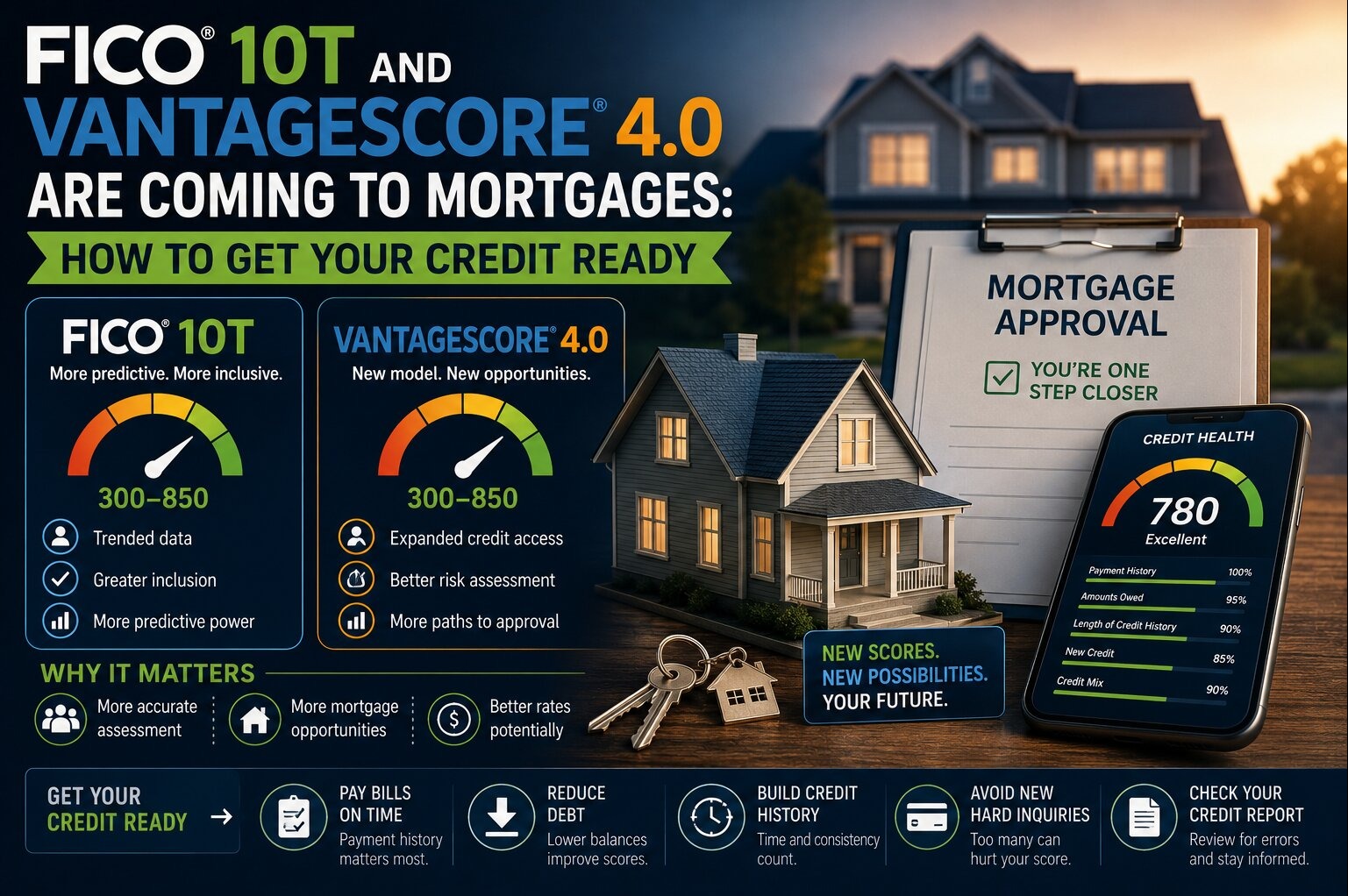
On April 22, 2026, the Federal Housing Finance Agency announced that Fannie Mae and Freddie Mac would begin allowing an initial group of approved lenders to use VantageScore 4.0 in mortgage underwriting, alongside the long-standing Classic FICO model. It is the first change to the credit scoring models accepted by the government-sponsored enterprises in decades.
FICO Score 10T is following close behind. The Enterprises are expected to publish historical FICO 10T scores for loans acquired between April 2013 and September 2025 by summer 2026, and as of July 28, 2026, more than 70 mortgage lenders had already committed to using the new model. The Federal Housing Administration has signaled it will allow both VantageScore 4.0 and FICO 10T in the coming months as well. If you're planning to buy a home, refinance, or simply want to understand why your score might look different the next time you check it, this is the update that explains it — and here's exactly what to do about it.
What's Actually Changing
For roughly 20 years, mortgage lenders working with Fannie Mae and Freddie Mac were required to pull Classic FICO scores from all three credit bureaus — a rule known as the tri-merge requirement. That requirement isn't going away, but the models feeding into it are finally getting an upgrade.
VantageScore 4.0 is available immediately to a limited group of approved lenders. FICO Score 10T implementation will follow on a longer timeline, tied to the publication of historical score data this summer. Lenders can choose to keep using Classic FICO for now, so most borrowers won't see an overnight change — but the rollout will accelerate through the rest of 2026 and into 2027 as more lenders opt in.
How Trended Data and BNPL Data Change Your Score
The "T" in FICO 10T stands for trended data. Instead of judging your balances at a single moment, the model reviews up to 24 months of payment and balance history. That means a borrower who has been steadily paying down a credit card balance will likely score better than someone whose balance sits flat or creeps upward, even if both people owe the same amount today.
FICO also launched FICO Score 10 BNPL and FICO Score 10T BNPL in fall 2025 — the first mainstream credit scores built to incorporate Buy Now, Pay Later data. If you've been using services like Klarna, Afterpay, or Affirm and paying on schedule, that positive history can now work in your favor under these newer models. Miss those payments, though, and the opposite is true.
Both newer models also tend to treat paid medical collections and small-dollar debts — generally under $500 — as less damaging or exclude them from scoring entirely, a shift that has already been showing up in Classic FICO and VantageScore updates over the past few years.
Old Model vs. New Models: What Lenders Will See
| Factor | Classic FICO (still in use) | FICO Score 10T | VantageScore 4.0 |
|---|---|---|---|
| Balance history reviewed | Single snapshot | Up to 24 months (trended) | Trended data included |
| Buy Now, Pay Later data | Not scored | Included via 10T BNPL variant | Being evaluated for future versions |
| Paid medical collections | Weighted heavily in older versions | Reduced or excluded impact | Reduced or excluded impact |
| Rent and utility payments | Not typically included | Can be incorporated where reported | Can be incorporated where reported |
| Mortgage lender adoption (as of July 2026) | Standard for decades | 70+ lenders committed | Limited approved-lender rollout |
| Tri-merge bureau requirement | Applies | Still applies | Still applies |
What This Means If You're Outside the US
VantageScore and FICO are US-specific brands, so this particular rollout only directly affects mortgage applicants working with US lenders through Fannie Mae, Freddie Mac, or the FHA. But the underlying shift — scoring models that reward paying down debt over time and weigh alternative payment data more heavily — mirrors changes already underway elsewhere.
In the UK, Experian, Equifax, and TransUnion each run their own scoring models (typically on a 0–999 or 0–700 scale) and have been steadily adding rental payment data through services like the Rental Exchange. In Canada, Equifax and TransUnion use Beacon scores that already weigh trended balance behavior. In Australia, Equifax, illion, and Experian use comprehensive credit reporting, which factors in up to 24 months of repayment history on loans and credit cards — conceptually close to what FICO 10T is now doing for the first time in the US. Wherever you live, the practical advice below holds: bureaus and lenders everywhere are moving toward rewarding consistent, sustained good behavior rather than a single good month.
Step-by-Step: How to Prepare Your Credit for the New Models
- Pull your credit reports now. In the US, get your free reports at AnnualCreditReport.com from all three bureaus. UK, Canadian, and Australian readers can request free reports from their national bureaus (Experian, Equifax, TransUnion, or illion) at least once a year.
- Start paying down revolving balances steadily, not sporadically. Because trended models look at your trajectory over roughly two years, a consistent pattern of shrinking balances matters more now than it used to.
- Keep utilization below 30%, and aim lower if you're mortgage shopping. Under trended scoring, a declining utilization trend can help even before you hit an ideal ratio.
- Check whether your BNPL provider reports to the bureaus. Not all do yet. If yours does, treat those installments with the same discipline as a credit card payment — they can now help or hurt your mortgage-ready score.
- Dispute any medical collections under $500 or already paid. These are increasingly excluded from newer models, but errors on your report won't fix themselves — file disputes directly with the bureau.
- Ask your mortgage lender which model they're using. With adoption still uneven across the industry, two lenders may view the same credit file differently right now.
- Ask about rent and utility reporting. Services that report on-time rent payments to the bureaus can help build trended history, particularly useful if you have a thin credit file.
Who Should Pay Close Attention Right Now
First-time homebuyers with thin credit files stand to benefit the most from this shift, since rent payments and consistent BNPL repayment can now count toward a mortgage-ready score where they previously didn't count at all. Borrowers who have been steadily paying down debt but still show a high balance today should also benefit, because trended data finally gives credit for that progress instead of only judging the snapshot.
On the other hand, if your balances have been climbing over the past two years — even if your current utilization looks fine — you may want to move faster to reverse that trend before applying, since FICO 10T is specifically built to catch that pattern.
Common Mistakes to Avoid
- Assuming every lender has switched already. Adoption is still limited and uneven; ask before assuming your file will be read under the new model.
- Ignoring BNPL payments because they "aren't a real loan." Under FICO 10T BNPL, missed installment payments can now show up in your score the same way a missed credit card payment does.
- Paying off a big balance right before applying and stopping there. A single good month won't move a trended score much — lenders are looking at your pattern over roughly two years.
- Forgetting to check reports from all three bureaus. The tri-merge requirement means an error at just one bureau can still drag down your file.
What to Do Next
If a mortgage application is on your calendar in the next six to twelve months, start acting on the trended data now rather than waiting for FICO 10T's summer 2026 historical scores to be finalized. Pull your reports, dispute what's wrong, bring down revolving balances on a steady monthly basis, and ask any lender you're shopping with which scoring model they currently use. None of this requires waiting for the rollout to finish — the habits that score well under FICO 10T and VantageScore 4.0 are also simply good financial habits, so there's no downside to starting today.