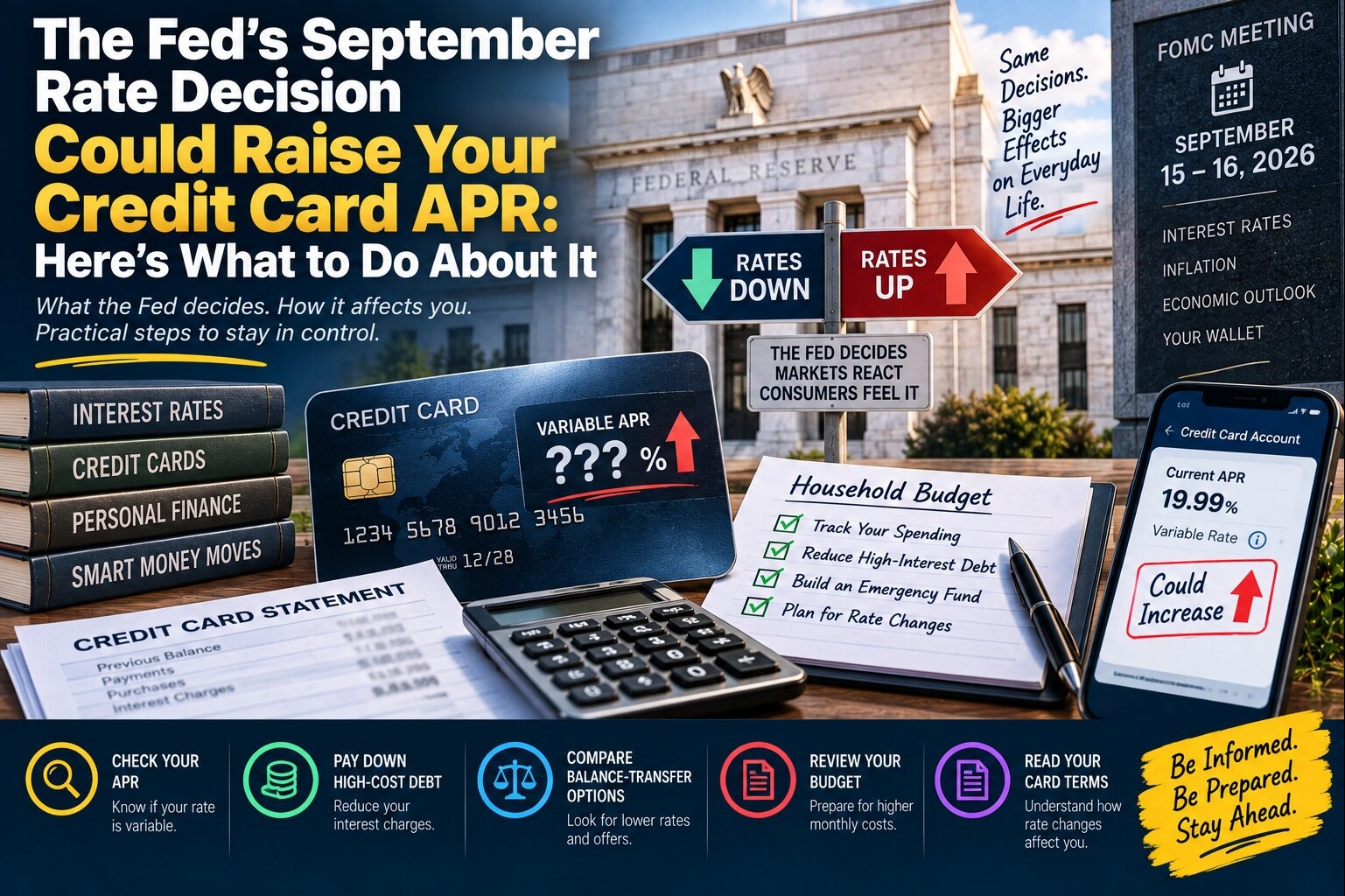
The Federal Reserve meets on September 15 and 16, 2026, and for the first time in this rate cycle, the debate isn't whether policymakers will cut rates further — it's whether they'll raise them. After Fed Governor Kevin Warsh's hawkish remarks at the Jackson Hole symposium in late August, futures markets priced in roughly a 60% chance of a quarter-point hike, pulling the target range up from its current 3.50%–3.75% band. That shift comes after six straight months of Fed cuts through late 2025 barely dented what cardholders actually pay: the average APR on new card offers has climbed to 23.82%, and cards that carry a revolving balance are averaging 22.15% APR in the most recent quarterly data.
The US isn't alone. The European Central Bank already raised its deposit rate a quarter point, from 2.25% to 2.5%, at its September 10 meeting, citing inflation pressure tied to the conflict in the Middle East. The Bank of England's Monetary Policy Committee announces its own decision on September 17. If you carry a balance on a credit card anywhere in the US, UK, or eurozone, the next two weeks could genuinely change what you owe next month. Here's what's actually happening, how to check whether it affects your cards, and what to do about it — whether or not the Fed actually pulls the trigger.
What's Actually Driving the Rate Moves Right Now
Almost every US credit card sold today carries a variable APR tied to the prime rate, which itself moves in lockstep with the Fed's target range. When the Fed cut rates through the back half of 2025, banks were supposed to pass at least some of that relief on to cardholders. They mostly didn't: variable APR ranges dropped by roughly half a percentage point over several months, a fraction of what the underlying rate cuts implied. Issuers have been slower to lower rates than they are to raise them, and margins on revolving credit have stayed historically wide.
Now the direction may reverse. Warsh's Jackson Hole speech reset expectations almost overnight — the odds of a September hike were sitting near 79% earlier in the week before settling closer to 60% by the time markets digested his full remarks. Either way, a hold at the current range is no longer the safe assumption it was a few months ago, and a hike would flow through to variable-rate cards within one or two billing cycles.
What a Quarter-Point Hike Actually Costs You
A 0.25 percentage point move sounds small, but it compounds on a revolving balance every single month it's outstanding. The table below shows the added interest cost on three common balance sizes if your card's APR moves from 22.15% (the current average for accruing balances) up by a quarter point, and what a full percentage point of drift would look like if the Fed hikes more than once this cycle.
| Revolving Balance | Extra Interest per Year at +0.25% | Extra Interest per Year at +1.00% |
|---|---|---|
| $2,500 | ~$6 | ~$25 |
| $6,000 | ~$15 | ~$60 |
| $12,000 | ~$30 | ~$120 |
That may not look dramatic on its own, but remember this stacks on top of an APR that's already averaging above 22% — roughly double what it was a decade ago. On a $6,000 balance at 22.15% APR making only minimum payments, you're already paying over $1,300 a year in interest before any new hike. The marginal cost of a hike matters less than the fact that your baseline is already high, and every rate increase makes it harder to dig out.
Step-by-Step: Check Whether Your Own Rate Just Moved
- Pull your most recent statement. Every US issuer is required to disclose your current APR on each monthly statement — look for the "Interest Charge Calculation" box, usually near the back page.
- Compare it to your account-opening disclosure. If your card has a variable rate, it's listed as prime rate plus a margin (for example, "Prime + 14.99%"). The margin stays fixed; only the prime portion moves with the Fed.
- Watch for a Change in Terms notice. Issuers are required to notify you in writing before certain rate changes take effect, though rate changes tied to a variable-rate index typically don't require 45-day advance notice the way a repricing for other reasons would.
- Log into your online account after September 17. Most issuers update the displayed APR within a few days of a Fed decision, often faster than the paper statement arrives.
- Set a calendar reminder for your next statement date. If the Fed hikes on the 16th, the change typically shows up on the first billing cycle that starts on or after the effective date.
How to Negotiate a Lower APR With Your Issuer
Cardholders skip this step far more often than they should, and it works more often than most people expect. Issuers would rather shave a few points off your rate than lose you to a balance transfer or, worse, have you default.
Call the number on the back of your card and ask for the retention or customer loyalty department specifically — the front-line phone rep usually can't approve a rate change. Have your payment history ready to cite: if you've paid on time for the last 12 months, say so. Mention a specific competing offer if you have one, even informally ("I've been offered a 0% balance transfer elsewhere"). Ask directly: "Is there anything you can do about my APR?" rather than a vaguer complaint. If the first person says no, it's reasonable to call back another day and try again; approval often depends on which representative you reach and how your account looks that week.
Is a Balance Transfer or a Personal Loan the Better Move?
If negotiating doesn't get you far enough, moving the debt is usually the next lever. Which option makes sense depends on your credit and how fast you can realistically pay the balance down.
| Option | Typical Rate | Best For | Watch Out For |
|---|---|---|---|
| 0% APR balance transfer card | 0% for 15–21 months, then variable APR | Good/excellent credit, can repay within the promo window | Balance transfer fee of 3%–5%, full APR resumes on any leftover balance |
| Fixed-rate personal loan | Roughly 10%–18% depending on credit | Larger balances, or credit not strong enough for the best transfer offers | Origination fees; rate is fixed but still well above 0% |
| Credit union share-secured or signature loan | Often several points below bank personal loans | Members with an existing relationship or strong local credit union | Membership eligibility rules; smaller loan amounts |
| Do nothing, keep paying minimums | Current card APR (now averaging above 22%) | Nobody, realistically | Interest compounds monthly and grows with every future hike |
A 0% balance transfer card only pays off if you can realistically clear the balance before the promotional window ends — divide your balance by the number of promo months to see the fixed payment you'd need to make. If that number isn't realistic given your budget, a fixed-rate personal loan that locks in today's rate is often the safer bet precisely because it can't move again if the Fed keeps hiking.
Common Mistakes to Avoid When Rates Are Moving
- Opening a new card for the sign-up bonus while carrying high-interest debt. A new hard inquiry and a lower average account age can dent the credit score you need for the best balance transfer offers.
- Ignoring the balance transfer fee. A 3%–5% upfront fee on a $10,000 transfer is $300–$500 before you've saved a cent in interest — run the math before assuming a transfer is automatically cheaper.
- Assuming a rate hold means nothing changes. Even if the Fed holds on September 16, issuers have been slow to pass cuts through and quick to pass hikes through — your APR can still drift up based on issuer-specific repricing.
- Making only the minimum payment during a promotional 0% period. The point of a transfer is to pay the balance down faster while it's not accruing interest, not to stretch the same slow payoff over a longer runway.
- Missing the promo window by a few weeks. Any balance still outstanding when a 0% period ends usually starts accruing interest at the card's standard variable rate immediately, sometimes with retroactive interest depending on the card's terms.
If You Bank Outside the US: What to Watch
The mechanics differ by country, but the underlying pattern — central bank moves flowing through to variable consumer credit — is the same across every Tier 1 market right now.
- United Kingdom: Most UK credit cards carry a fixed representative APR rather than one tied directly to the Bank of England base rate, but store cards, some retail finance products, and variable-rate overdrafts move more directly with Bank Rate. The MPC's September 17 decision is worth watching if you carry a variable-rate balance or an overdraft.
- Eurozone: The ECB's move to a 2.5% deposit rate on September 10 raises the reference rate that Euribor-linked consumer credit products track. If your card or personal loan is explicitly indexed to Euribor, expect the change to show up within one or two repricing cycles.
- Canada: The Bank of Canada has held its policy rate steady at 2.25% as of its most recent announcement, but Canadian credit cards are priced off the prime rate the same way US cards are — any future Bank of Canada move flows through just as directly.
- Australia and New Zealand: The Reserve Bank of Australia's cash rate and the RBNZ's official cash rate drive variable home-loan and some credit-card pricing similarly. Even if your own central bank isn't moving this month, global funding costs tied to the Fed and ECB can still nudge issuer pricing.
Wherever you bank, the practical response is identical: know whether your rate is fixed or variable, know what index it's tied to, and don't wait for a statement to tell you after the fact.
Practical Tips to Stay Ahead of Rising Rates
- Automate at least the minimum payment, then manually add extra whenever you can, targeting the card with the highest APR first (the avalanche method saves the most in interest over time).
- Check your issuer's app or online portal for a real-time APR display rather than waiting for the paper statement, especially in the week after a central bank decision.
- If you're rate-shopping for a balance transfer, apply within a short window (roughly two weeks) so multiple hard inquiries are more likely to be treated as one event by scoring models.
- Build a small buffer in a high-yield savings account so a rate hike doesn't force you further onto the card in the first place.
- Revisit any card you haven't used in over a year — if it carries an annual fee and a high APR with no rewards you actually use, closing or downgrading it may be worth more than keeping it open.