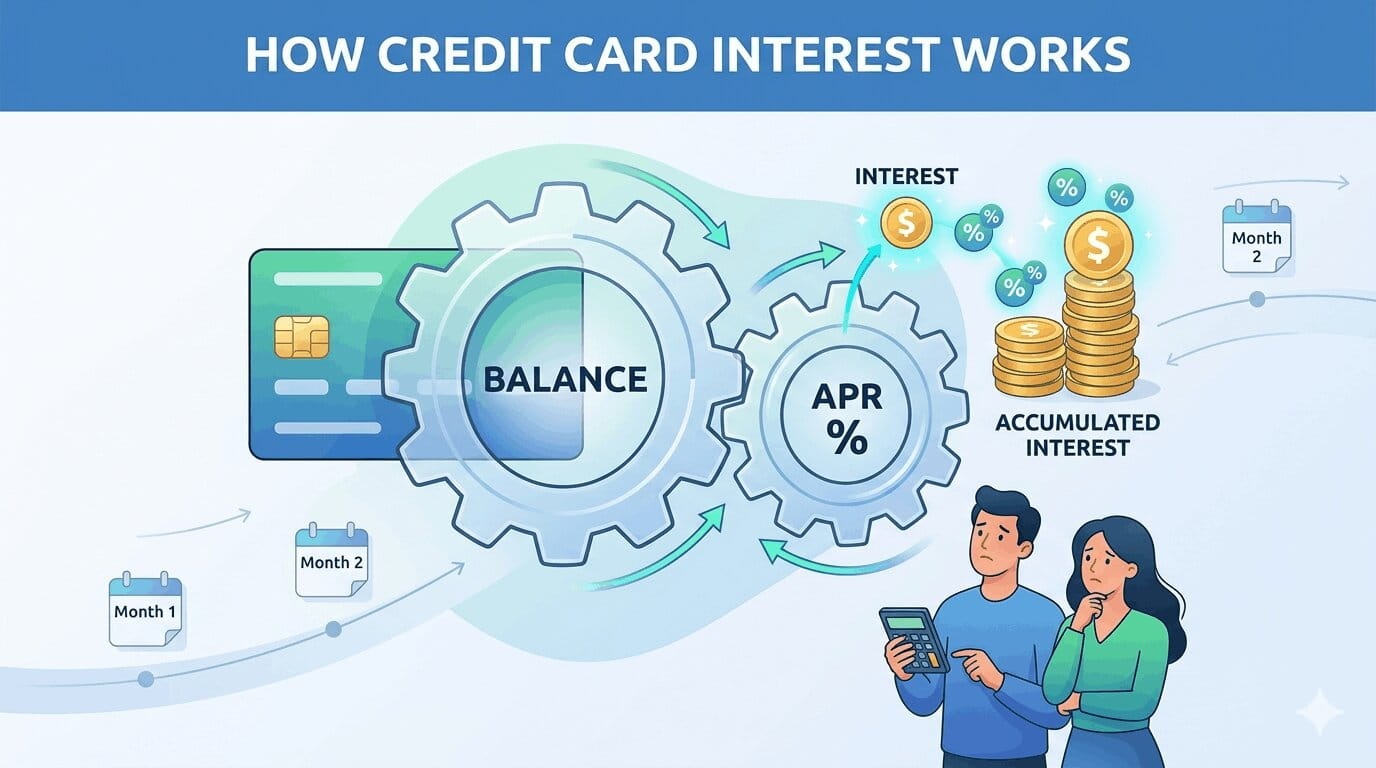
Credit card interest is one of the most misunderstood parts of personal finance in the United States. Many people know they should “avoid interest,” but few fully understand how it’s calculated, when it applies, and why it can grow so quickly.
The truth is, credit card interest isn’t complicated—but it is powerful. If you understand how it works, you can avoid paying it altogether. If you don’t, it can quietly cost you hundreds or even thousands of dollars over time.
Let’s break it down in a simple, practical way.
What Is Credit Card Interest?
Credit card interest is the cost you pay for borrowing money from your credit card issuer. When you don’t pay your full balance by the due date, the remaining amount starts accruing interest.
This interest is expressed as an APR (Annual Percentage Rate), but it’s actually calculated on a daily basis.
If you’re unfamiliar with APR:
What Is APR on Credit Cards?
https://statush.com/credit-cards-banking/what-is-apr-on-credit-cards
When Do You Pay Interest?
One of the most important things to understand is that you don’t always pay interest.
If you pay your full statement balance by the due date, you typically avoid interest completely. This is thanks to something called the grace period.
However, interest starts applying in these situations:
- You carry a balance from one month to the next
- You miss a payment
- You take a cash advance (usually no grace period)
This is why many experienced users never pay interest—they simply pay their balance in full every month.
To understand how credit cards function overall:
How Credit Cards Work in the USA
https://statush.com/credit-cards-banking/how-credit-cards-work-in-the-usa
How Interest Is Calculated
This is where things get slightly technical—but we’ll keep it simple.
Credit card companies convert your APR into a daily interest rate.
Step-by-step breakdown:
- Take your APR (for example, 20%)
- Divide it by 365 days
- Apply that daily rate to your balance
So:
- 20% APR ÷ 365 ≈ 0.055% per day
This daily interest is then applied to your balance every day you carry it.
The Power of Daily Compounding
Credit card interest compounds daily, which means interest is charged not only on your original balance but also on previously added interest.
This is why debt can grow faster than expected.
Example:
- Balance: $1,000
- APR: 20%
If you don’t make payments, interest is added daily, and your balance gradually increases. Over time, you end up paying interest on interest.
This compounding effect is what makes credit card debt so expensive.
Real-World Example
Let’s look at a practical situation.
Alex has a $2,000 balance on a credit card with a 18% APR. He decides to pay only $100 this month instead of the full balance.
The remaining $1,900 starts accruing interest daily.
By the next billing cycle, Alex may see an additional $25–$30 in interest added to his balance. If he continues this pattern, interest keeps stacking up.
Over several months, this can turn into hundreds of dollars in extra cost.
Minimum Payments and Interest
Minimum payments can make things look manageable—but they’re often misleading.
When you pay only the minimum:
- Most of your payment goes toward interest
- Very little reduces your actual balance
This slows down repayment significantly.
For example:
- Balance: $3,000
- Minimum payment: $75
It could take years to pay off the balance, and you might pay more in interest than the original amount borrowed.
Learn more:
How Minimum Payments Affect Credit Card Debt
https://statush.com/credit-cards-banking/how-minimum-payments-affect-credit-card-debt
Types of Interest Charges
Not all credit card interest is the same. Different transactions can have different rates and rules.
Purchase APR
This is the standard interest rate applied to regular purchases if you carry a balance.
Cash Advance APR
Usually higher than the purchase APR and starts accruing interest immediately—no grace period.
Penalty APR
A higher rate applied if you miss payments or violate terms.
Understanding these differences helps you avoid unexpected costs.
Simple Interest Overview Table
| Factor | What It Means |
|---|---|
| APR | Yearly interest rate |
| Daily Rate | APR divided by 365 |
| Grace Period | Time to avoid interest |
| Compounding | Interest added daily |
Why Interest Feels So Expensive
Credit card interest often feels high compared to other loans, and there’s a reason for that.
Unlike fixed loans, credit cards are revolving credit, meaning you can keep borrowing and carrying balances indefinitely.
This flexibility comes at a cost—higher interest rates.
Also, because interest compounds daily, even small balances can grow quickly if left unpaid.
How to Avoid Paying Interest
The good news is that avoiding credit card interest is actually simple.
The most effective strategy is to pay your full statement balance every month. This ensures you never enter the interest cycle.
Another helpful approach is to track your spending regularly so you don’t end up with a surprise balance at the end of the month.
Setting up automatic payments can also protect you from missing due dates.
If you’re trying to stay debt-free:
How to Avoid Credit Card Debt
https://statush.com/credit-cards-banking/how-to-avoid-credit-card-debt
What Happens If You Miss a Payment?
Missing a payment makes things worse quickly.
Not only does interest continue to accumulate, but you may also face:
- Late fees
- Penalty APR (higher interest rate)
- Damage to your credit score
Over time, this can significantly increase the cost of your debt.
Learn more:
What Happens If You Miss a Credit Card Payment
https://statush.com/credit-cards-banking/what-happens-if-you-miss-a-credit-card-payment
Interest vs Rewards: The Trade-Off
Many people focus on earning rewards, but interest can cancel out those benefits.
For example:
- Rewards earned: $150
- Interest paid: $250
In this case, the rewards don’t actually help—you’re still losing money.
That’s why experienced users prioritize avoiding interest over earning rewards.
A Simple Way to Think About Interest
Credit card interest is not a penalty—it’s a cost of borrowing.
If you use your card and repay it fully, you borrow money for free.
If you carry a balance, you pay for that convenience—and often at a high rate.
Final Thoughts
Understanding how credit card interest works gives you a major advantage. It allows you to use credit cards strategically instead of falling into costly habits.
The key takeaway is simple:
- Pay your full balance whenever possible
- Avoid carrying debt
- Stay aware of your APR
Do that consistently, and you’ll never have to worry about interest—while still enjoying all the benefits credit cards offer.