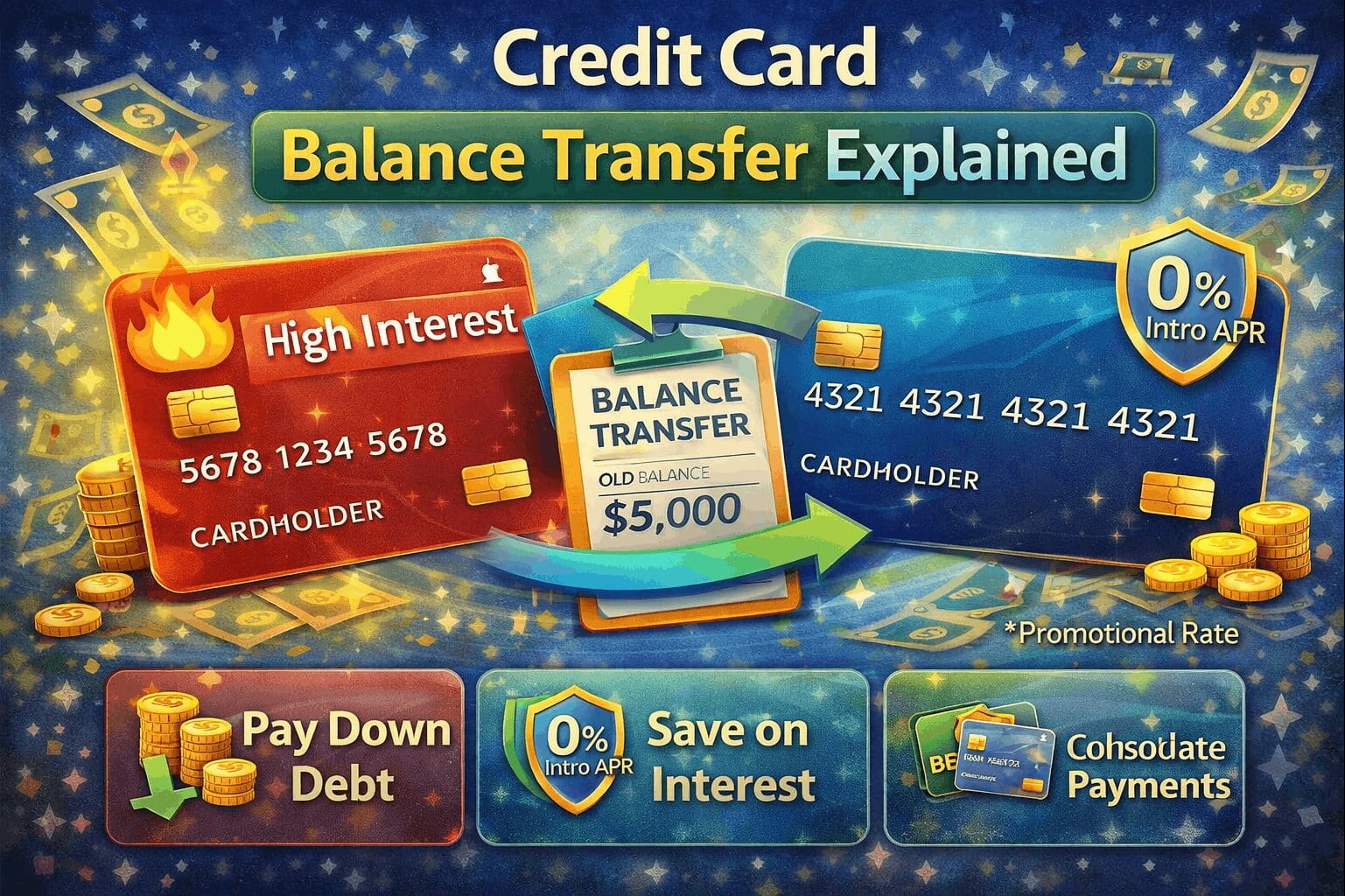
A credit card balance transfer is one of the most effective tools for managing and reducing credit card debt—if used correctly. It allows you to move your existing balance from one credit card to another, usually with a lower interest rate or even a 0% introductory APR.
At first glance, it sounds like a simple trick: move your debt and pay less interest. But there’s more to it than that. Understanding how balance transfers work, when to use them, and what to watch out for can help you save a significant amount of money.
What Is a Balance Transfer?
A balance transfer is the process of moving debt from one credit card to another, typically to take advantage of better terms.
For example:
- Card A: $3,000 balance at 20% APR
- Card B: 0% APR for 12 months
You transfer the $3,000 from Card A to Card B and avoid interest for a limited period.
This gives you time to pay down your balance without additional interest costs.
How a Balance Transfer Works
The process is straightforward but involves a few steps.
First, you apply for a credit card that offers a balance transfer promotion. Once approved, you request the transfer, and the new card issuer pays off your old card.
Your balance then appears on the new card, and you begin making payments there.
It’s important to note that you don’t receive cash—the transfer happens directly between card issuers.
For a broader understanding:
How Credit Cards Work in the USA
https://statush.com/credit-cards-banking/how-credit-cards-work-in-the-usa
Why People Use Balance Transfers
The main reason people use balance transfers is to save money on interest.
Credit card interest can be very high, and carrying a balance means you’re constantly paying extra.
By moving your balance to a lower or 0% APR card, you can:
- Reduce interest costs
- Pay off debt faster
- Simplify multiple balances into one
To understand interest better:
How Credit Card Interest Works
https://statush.com/credit-cards-banking/how-credit-card-interest-works
Real-World Example
Let’s look at a simple example.
Neeraj has a $5,000 balance on a card with a 22% APR.
If he continues paying it off normally, he could pay hundreds or even thousands in interest.
Instead, he transfers the balance to a card offering 0% APR for 12 months with a 3% transfer fee.
- Transfer fee: $150
- Interest saved: potentially $800+
Even after the fee, he comes out ahead—if he pays off the balance within the promotional period.
Balance Transfer Fees
Balance transfers are not completely free. Most cards charge a fee, typically:
- 3% to 5% of the transferred amount
For example:
- Transfer amount: $2,000
- Fee (3%): $60
This fee is added to your balance on the new card.
While it may seem like a drawback, the interest savings often outweigh the fee—especially for larger balances.
Introductory APR Period
Many balance transfer cards offer a 0% introductory APR for a limited time, usually between 6 and 18 months.
During this period:
- No interest is charged on the transferred balance
- All your payments go toward reducing the principal
However, once the promotional period ends, the regular APR applies to any remaining balance.
Simple Balance Transfer Overview
| Feature | What It Means |
|---|---|
| Balance Transfer | Moving debt to a new card |
| Intro APR | Temporary low or 0% interest |
| Transfer Fee | Cost of moving the balance |
| Promo Period | Limited interest-free time |
When a Balance Transfer Makes Sense
A balance transfer is most useful when you:
- Have high-interest credit card debt
- Can qualify for a lower APR card
- Have a plan to pay off the balance during the promo period
It’s not a solution for ongoing overspending—it’s a tool for managing existing debt.
When It May Not Be a Good Idea
Balance transfers aren’t always the right choice.
If you continue using your old card and adding new debt, you can end up with more total debt instead of less.
If you don’t pay off the balance before the promotional period ends, you may face high interest again.
And if the transfer fee is too high compared to your balance, the savings may be minimal.
Common Mistakes to Avoid
One of the biggest mistakes is treating a balance transfer like a permanent solution.
It’s temporary. The goal is to eliminate your debt during the promotional period.
Another mistake is missing payments. Even with a 0% APR offer, missing a payment could cancel the promotion.
Overspending after transferring the balance is another common issue. This defeats the purpose entirely.
To avoid long-term problems:
How to Avoid Credit Card Debt
https://statush.com/credit-cards-banking/how-to-avoid-credit-card-debt
How to Maximize a Balance Transfer
To get the most out of a balance transfer, you need a clear plan.
Start by calculating how much you need to pay each month to clear your balance before the promotional period ends.
You can use this tool:
Debt Payoff Calculator
https://statush.com/debt-payoff-calculator
For example:
- Balance: $3,000
- Promo period: 12 months
- Monthly payment needed: $250
Sticking to this plan ensures you avoid interest completely.
Balance Transfer vs Personal Loan
Some people compare balance transfers with personal loans for debt repayment.
Balance transfers:
- Lower or 0% interest (temporarily)
- Flexible payments
- Short-term solution
Personal loans:
- Fixed interest rate
- Fixed repayment schedule
- Longer-term structure
The better option depends on your situation and discipline.
Impact on Your Credit Score
A balance transfer can affect your credit score in different ways.
It may temporarily lower your score due to a new account or inquiry.
However, it can also improve your score over time by:
- Lowering your credit utilization
- Simplifying your debt
Used correctly, the long-term impact is usually positive.
A Simple Way to Think About It
A balance transfer is not a way to escape debt—it’s a way to manage it more efficiently.
It gives you a window of opportunity to pay off your balance without interest.
What you do during that window determines whether it helps or hurts you.
Final Thoughts
Credit card balance transfers can be a powerful financial tool when used with discipline and planning.
They can reduce interest, simplify your payments, and help you get out of debt faster.
But they are not a shortcut—they require commitment.
If you create a clear repayment plan, avoid new debt, and stay consistent, a balance transfer can save you a significant amount of money and help you regain control of your finances.