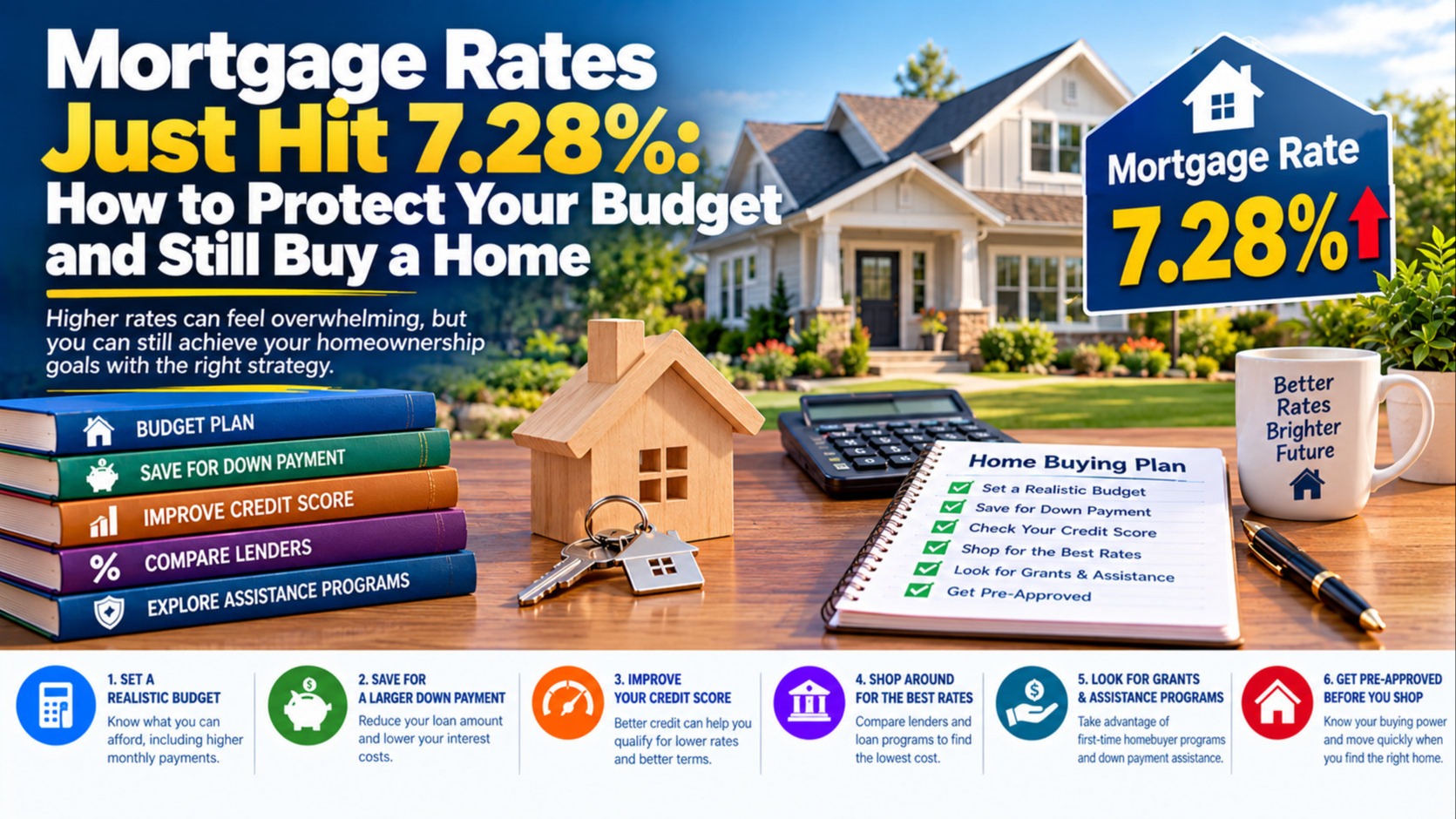
Freddie Mac's Primary Mortgage Market Survey for the week ending October 1, 2026 showed the average 30-year fixed mortgage rate jumping a full quarter point, from 7.03% to 7.28% in seven days — the largest single-week increase in four years. A year earlier, the same loan averaged 6.34%. The driver wasn't the Fed this time: a selloff in global government bonds pushed the 10-year Treasury yield above 5% for the first time in nearly two decades, and mortgage pricing tracks that yield closely. Existing home sales for August 2026 had already slipped to a seasonally adjusted annual rate of 3.98 million, the slowest pace since June 2025, before this latest jump even hit lenders' rate sheets.
If you're shopping for a home, mid-contract, or holding an adjustable-rate loan that's due to reset, a move this size changes the math on what you can afford and how you should structure your financing. This guide walks through what the jump actually costs you, how it compares across the US, UK, Canada, and Australia, and exactly what to do in the next week or two to protect your budget.
What a Quarter-Point Jump Actually Costs You
A 25-basis-point move sounds small until you run it against a real loan balance. On a $400,000 mortgage, the difference between 7.03% and 7.28% adds roughly $66 a month and nearly $24,000 in interest over 30 years. Compared with the 6.34% rate available a year ago, today's borrower on the same loan amount is paying almost $260 more every month — money that no longer goes toward principal, savings, or anything else.
| Loan Amount | Rate a Year Ago (6.34%) | Last Week (7.03%) | This Week (7.28%) | Monthly Cost vs. a Year Ago |
|---|---|---|---|---|
| $300,000 | $1,864 | $2,012 | $2,062 | +$198/mo |
| $400,000 | $2,486 | $2,683 | $2,749 | +$263/mo |
| $500,000 | $3,107 | $3,353 | $3,436 | +$329/mo |
| $600,000 | $3,728 | $4,024 | $4,123 | +$395/mo |
These figures use a standard 30-year fixed principal-and-interest calculation and exclude taxes and insurance, which have also been climbing in many markets. The practical effect for most buyers is a lower maximum purchase price: lenders qualify you based on a debt-to-income ratio, so as the rate rises, the home price you can support at the same income falls, often by 5% to 8% for every half-point move.
How This Compares Across the US, UK, Canada, and Australia
Not every Tier 1 market is moving the same way, which matters if you have flexibility about timing or are comparing financing options across borders. The bond-market selloff behind the US jump has been more muted elsewhere, and other central banks are in different phases of their own cycles.
- United States: 30-year fixed at 7.28% as of October 1, driven by 10-year Treasury yields above 5%; the Mortgage Bankers Association still forecasts rates ending 2026 near 6.4%, while Fannie Mae's more optimistic call is 5.9%.
- United Kingdom: Average two-year fixed rates have been in the high-5% to low-6% range, with swap rates (which lenders use to price fixed deals) drifting up on broader bond-market volatility rather than a single UK-specific shock. Stamp duty thresholds have not changed, so the cost pressure for UK buyers is almost entirely on the financing side.
- Canada: The Bank of Canada has held its policy rate at 2.25% for seven straight decisions, keeping prime rates near 4.45% and giving Canadian borrowers more rate stability than their US counterparts right now.
- Australia: The Reserve Bank of Australia has held its cash rate at 4.35% since mid-August, though a rate decision was pending and some bank economists were pricing in a possible quarter-point move.
The takeaway: if you're comparing a purchase in more than one country, or you have remote-work flexibility about where you buy, the US bond-market spike is currently the sharpest of the four, which is exactly why US buyers need to act with more urgency on locking terms than buyers in Canada or Australia right now.
Step-by-Step: What to Do This Week If You're House Hunting
You don't need to freeze, but you do need to move with more precision than you would in a stable-rate environment. Work through these steps in order:
- Get re-quoted, not just re-approved. If your pre-approval is more than two or three weeks old, ask your lender for a current rate quote before you make an offer. Pre-approval ceilings are usually built on a rate assumption, and a quarter-point move can shrink your approved purchase price by tens of thousands of dollars.
- Ask for a rate-lock quote, not an advertised rate. Advertised rates typically assume a specific credit score and loan-to-value ratio. Get a written lock quote tied to your actual file, and ask how many days the lock holds and what a 15-day versus 45-day lock costs in rate.
- Ask every lender about a float-down option. Many lenders now offer a one-time float-down if rates drop after you lock. In a volatile market like this one, that clause can be worth more than a slightly lower headline rate.
- Re-run your debt-to-income math before you write an offer. Use your lender's updated rate, not last month's number, to confirm the top of your price range hasn't moved.
- Price out mortgage points. Ask your lender for the exact cost to buy down your rate by a quarter or half point and compare that upfront cost against your expected monthly savings and how long you plan to keep the loan.
Should You Buy Down Your Rate, Choose an ARM, or Wait?
There's no single right answer here — it depends on how long you plan to stay in the home and how much cash you have available at closing.
| Strategy | Best For | Trade-Off |
|---|---|---|
| Buy points to lower rate | Buyers staying 7+ years with cash to spare | Upfront cost; only pays off if you keep the loan long enough to recoup it |
| 5/1 or 7/1 ARM | Buyers expecting to move or refinance within the fixed period | Lower initial rate, but payment risk if rates are still high at reset |
| Lock now with float-down | Buyers mid-contract who need rate certainty | Protects against further increases while preserving upside if rates fall |
| Wait and keep renting | Buyers with flexible timelines and no urgent housing need | Risk that rates and prices both move against you; no guarantee of a better entry point |
If you're genuinely unsure, run the numbers on a 2-1 buydown as well: many builders and some lenders will subsidize a temporary rate reduction for the first two years of the loan, which can ease the payment shock while you wait to see where rates settle.
How to Use Down Payment Assistance to Offset a Higher Rate
A higher rate doesn't have to mean giving up on buying this year — it means it's worth spending an extra hour checking what assistance programs you actually qualify for. Several programs opened or expanded in 2026 across Tier 1 markets:
- California Dream for All (US): A shared-appreciation loan program offering up to 20% of the purchase price in down payment help for first-time buyers, with up to $200 million available for 2026 through a random-selection process.
- FHLB San Francisco Middle-Income Downpayment Assistance (US): Matching grants up to $50,000 for eligible middle-income first-time buyers in Arizona, California, and Nevada earning roughly 80% to 140% of area median income.
- Kentucky Welcome Home Grant (US): Up to $20,000 in down payment assistance through the Federal Home Loan Bank of Cincinnati, allocated first-come, first-served.
- Nova Scotia First-Time Homebuyers Program (Canada): Launched in partnership with Atlantic Central and local credit unions, reducing the required down payment to as little as 2% for eligible buyers.
- Conventional low-down-payment options: Fannie Mae's HomeReady and Freddie Mac's Home Possible programs allow qualified US buyers to put down as little as 3% while keeping conventional loan terms; USDA loans offer 0% down in eligible rural and some suburban areas.
Before you apply anywhere, confirm the income limits and property location rules directly with the program administrator. Many buyers lose time chasing a "3% down" or "$20,000 grant" headline without first checking whether their household income or the home's location actually qualifies.
Common Mistakes to Avoid When Rates Are Moving Fast
- Shopping with a stale pre-approval letter. A letter issued three weeks ago may no longer reflect what you can actually afford at today's rate.
- Comparing only the headline rate, not the APR. Lender fees and points change the true cost of the loan; always compare APR, not just the quoted rate.
- Assuming an ARM is automatically riskier than a fixed rate. For a buyer who will sell or refinance within the fixed period, an ARM can be the lower-risk, lower-cost choice.
- Skipping the float-down conversation. Not every lender offers one, and not every loan officer mentions it unprompted — ask directly.
- Waiting for a "better time" with no plan. Rates and home prices don't always move together, and a wait-and-see approach without a specific trigger point (a rate level, a price drop, a savings target) can leave you waiting indefinitely.
Key Numbers to Know
- 30-year fixed mortgage rate: 7.28% as of October 1, 2026 (Freddie Mac), up from 7.03% a week earlier and 6.34% a year earlier.
- 10-year Treasury yield: above 5% for the first time in nearly two decades, the main driver of the mortgage rate move.
- Existing home sales: 3.98 million seasonally adjusted annual rate in August 2026, the slowest pace since June 2025.
- Home price growth: S&P Cotality Case-Shiller national index up 1.9% year-over-year in July 2026, with wide regional variation — Chicago led major metros at +6.9% while Seattle was weakest at -1.6%.
- Bank of Canada policy rate: held at 2.25% for seven consecutive decisions.
- Reserve Bank of Australia cash rate: held at 4.35% since mid-August, with a decision pending.
Related Articles
- How to Protect Your Mortgage Rate After the Fed's September 2026 Hike
- How to Use the 2026 FHA Loan Limit Increase to Buy More Home With a Smaller Down Payment
- Treasury's Surprise Bond Buyback Just Nudged Mortgage Rates Down — Here's What It Really Means for Homebuyers
- How Interest Rates Affect Real Estate Prices