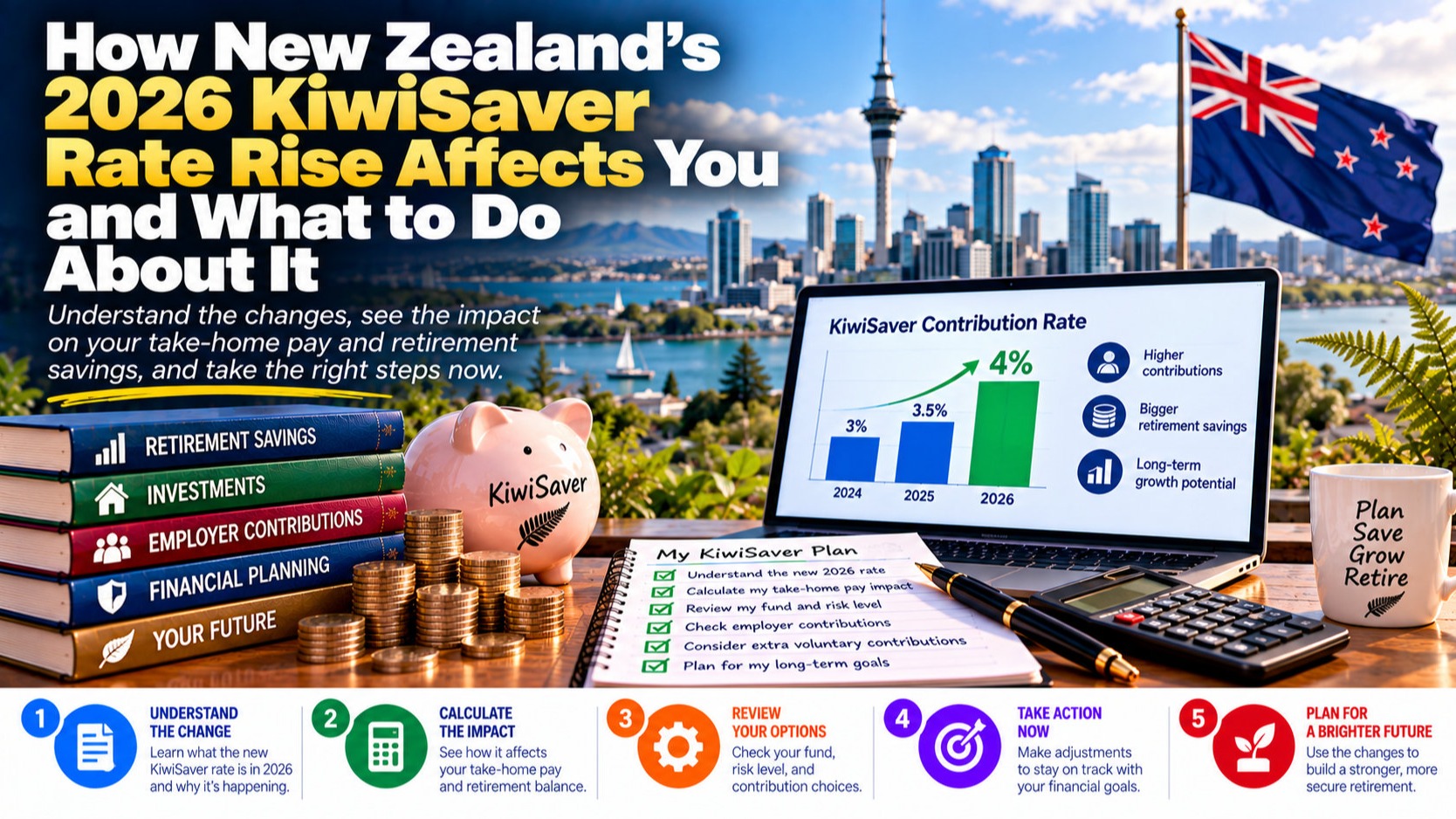
From April 1, 2026, the default KiwiSaver contribution rate in New Zealand climbs from 3% to 3.5% for both employees and employers, under changes confirmed in the government's Budget 2025 factsheet and now being rolled into payroll systems nationwide. Workers aged 16 and 17, who previously missed out, will also start receiving compulsory employer contributions at that new 3.5% minimum. It's not an isolated tweak: the rate rises again to 4% on April 1, 2028, and it follows a separate change on July 1, 2025 that halved the government's own top-up contribution and capped it by income.
If you save into KiwiSaver, your take-home pay is about to shrink slightly as more of it gets redirected into your retirement account, and your employer's payroll costs are rising too. If you're reading this from the UK, Australia, Canada, or the US, the New Zealand change is still worth your attention, because it's a useful mirror: every one of these countries runs a different default savings rate, funded differently, with different rules about who pays and how much. Knowing where you sit in that global picture helps you judge whether your own retirement contributions are actually enough. Below is exactly what's changing, what to check on your own payslip, and how to use this moment to tighten up your retirement plan no matter which country you're saving in.
Key Numbers to Know
Here's what's actually changing in New Zealand, and when, based on Inland Revenue and the Budget 2025 factsheet.
| Change | Old Rule | New Rule | Effective Date |
|---|---|---|---|
| Default employee/employer contribution rate | 3% / 3% | 3.5% / 3.5% | April 1, 2026 |
| Next scheduled increase | 3.5% / 3.5% | 4% / 4% | April 1, 2028 |
| 16-17 year old workers | No compulsory employer contribution | Compulsory 3.5% minimum | April 1, 2026 |
| Government contribution rate | 50 cents per $1 contributed (max $521.43/yr) | 25 cents per $1 contributed (max $260.72/yr) | Since July 1, 2025 |
| Government contribution income cap | No income limit | None paid above $180,000 income | Since July 1, 2025 |
To put real numbers on it: someone earning NZ$70,000 contributing at the default rate currently sets aside $2,100 a year (3%). From April, that rises to $2,450 (3.5%) - an extra $350 a year, or roughly $13 per fortnightly pay. Their employer's matching contribution rises by the same amount. It sounds small per pay cycle, but compounded over a 20 or 30-year working life, that extra half a percent each from both sides adds up to a meaningfully larger balance at retirement.
Note: These changes apply automatically through payroll. You don't need to do anything for the rate itself to go up - but you do need to check whether you're one of the people for whom the old settings, like the government contribution income cap, now work differently.
How Your Contributions Compare If You're Not in New Zealand
New Zealand's 3.5% default is genuinely modest by international standards, and seeing where it sits next to other Tier 1 countries' retirement systems is a useful gut check on your own savings rate, wherever you live.
| Country | System | Total Minimum Rate (2026) | Who Pays |
|---|---|---|---|
| New Zealand | KiwiSaver | 7% (3.5% + 3.5%) | Split: employee and employer |
| Australia | Superannuation Guarantee | 12% | Employer only, on top of wages |
| United Kingdom | Workplace pension auto-enrolment | 8% of qualifying earnings (£6,240-£50,270 band) | Split: employer min. 3%, employee min. 5% |
| Canada | CPP (public pension, not a workplace savings account) | 5.95% + 5.95% up to $74,600, plus 4% + 4% up to $85,000 (CPP2) | Split 50/50, employee and employer |
| United States | 401(k) / workplace retirement plans | No federal minimum - fully voluntary | Employee elects; employer match varies by plan |
Two things stand out. First, Australia's system puts the entire 12% burden on employers, so Australian employees don't see their own pay reduced to fund it the way New Zealand, UK, or Canadian workers do. Second, the United States is the outlier with no mandatory contribution at all - which is exactly why the 2026 IRS limits matter so much there: the $24,500 employee deferral cap (up from $23,500) and the $8,000 standard catch-up for savers 50 and over are the only real ceiling on how much Americans can choose to put away, because there's no floor forcing a minimum in the first place. If you're American and your plan isn't at least capturing your full employer match, you're already behind savers in every other country on this list who have no choice in the matter.
Step-by-Step: How to Check and Adjust Your Own Contributions
Whether you're in New Zealand or elsewhere, this is the moment to actually look at your numbers rather than assume the default is working for you.
- Pull up your last payslip. Confirm what percentage is actually being deducted and matched - don't assume it's the scheme default, since many people have already opted up to 4%, 6%, 8%, or 10% in KiwiSaver, or increased their 401(k) deferral above the match minimum.
- Check your income against any threshold that affects you. In New Zealand, if your taxable income is above $180,000, you no longer receive the government KiwiSaver contribution - factor that lost $260.72 a year into your own planning rather than assuming it's still coming.
- Work out the dollar impact of the rate change on your specific pay. Multiply your annual salary by 0.5% to see the extra amount you and your employer will each contribute from April 2026, and adjust your household budget for the slightly smaller take-home pay.
- Decide if the default rate is actually enough for your retirement goals. A 3.5% or 7% combined contribution rate is a floor, not a target - compare it to how much you'd need using a retirement calculator for your expected retirement age and lifestyle.
- If you're self-employed or a contractor, remember none of these employer-side rules apply to you automatically. You're responsible for your own contributions at whatever rate you choose, so use this update as a prompt to set up or increase a voluntary contribution schedule.
Should You Apply for a Temporary Contribution Rate Reduction?
New Zealand employees who are genuinely stretched by the increase to 3.5% have an option most people don't know exists: applying to Inland Revenue for a temporary reduction back down to 3%. It's worth understanding before you assume you're stuck with the higher rate.
The case for applying
If you're dealing with a genuine, temporary cashflow issue - a reduced-hours period, a short-term financial hardship, or a specific savings goal like a house deposit that needs every available dollar right now - a temporary reduction can free up cash without you having to opt out of KiwiSaver altogether and lose the employer match and government contribution entirely.
The case against applying
The application has to come from you, not your employer, and it only pauses the increase - it doesn't eliminate your base contribution. You'll also be contributing less at exactly the point your employer's matching contribution would otherwise be growing too, since most employers match at the same rate you choose. Unless the extra $350-or-so a year genuinely isn't available, staying at the new default is usually the better long-term move, given how much compounding time a reduction forfeits.
What Employers Need to Prepare
If you run payroll for a New Zealand business, the rate change isn't something you need to manually trigger - but a few related things do need attention before April 1, 2026.
- Confirm your payroll software vendor has already built in the automatic shift from 3% to 3.5% for all employees currently on the default rate.
- Budget for the higher employer-side cost now, rather than being surprised by it in your first April 2026 pay run - a workforce of 50 people on an average $65,000 salary represents roughly an extra $16,250 a year in employer contributions alone.
- If you also run a separate complying superannuation fund for staff, check whether your existing employer contributions already offset the new KiwiSaver minimum, since the rules differ for dual-contributing employers.
- Make sure your systems correctly add 16 and 17 year old employees to the compulsory employer contribution from April 2026, since many payroll setups still have this age group flagged as exempt from older rules.
- If any employees apply for a temporary rate reduction, remember Inland Revenue notifies you when it starts and ends - you don't action the reduction, but you may need to manually adjust your own employer rate to match if that's your policy.
Common Mistakes to Avoid
- Assuming "default" means "adequate." A 3.5% or 7% combined contribution rate was set as a sustainable minimum for the scheme, not a benchmark for a comfortable retirement - treat it as a floor you build on, not a target.
- Forgetting to check the government contribution income cap. Higher earners who've crossed $180,000 and don't adjust their expectations will be short by hundreds of dollars a year versus what older guides or past statements promised.
- Opting out entirely instead of requesting a temporary reduction. A full opt-out forfeits the employer match and government contribution completely - a far bigger loss than the extra 0.5% you were trying to avoid.
- Ignoring the comparison to other countries' systems if you're an expat or dual-resident. Someone who has worked in Australia and New Zealand, for example, may have very different balances accruing in each system and needs to track both rather than assuming they're equivalent.
- Not updating household budgets before the pay cut hits. A $13-per-fortnight reduction in take-home pay is easy to absorb if you plan for it and easy to notice as an unexplained shortfall if you don't.
Practical Tips to Make the Most of the Increase
- Use the rate change as a natural trigger to review your KiwiSaver fund choice (conservative, balanced, growth, or aggressive) rather than just the contribution percentage - the fund type usually has a bigger impact on your eventual balance than a 0.5% rate change.
- If your pay is about to rise anyway (a raise, bonus, or promotion), time any further voluntary contribution increase to coincide with it so you never actually feel a drop in spendable income.
- Check whether your employer offers to match above the compulsory minimum - some do, especially for longer-tenured staff, and it's a frequently under-asked question at review time.
- If you're outside New Zealand, run the same exercise locally: work out your own country's minimum contribution rate, confirm you're at least capturing any employer match available to you, and calculate what a 0.5 percentage point increase would mean for your own pay and your own retirement balance.
Related Articles
- How to Adjust Your Retirement Plan for the 2026 Pension Increases (Age Pension, Social Security, State Pension, CPP)
- How the UK's New Pension Salary Sacrifice Cap Affects You and What to Do About It
- How to Maximize Your 401(k) in 2026 | New IRS Limits & SECURE 2.0
- 401(k) Strategy for Building Retirement Wealth: 2026 Limits & Expert Tips