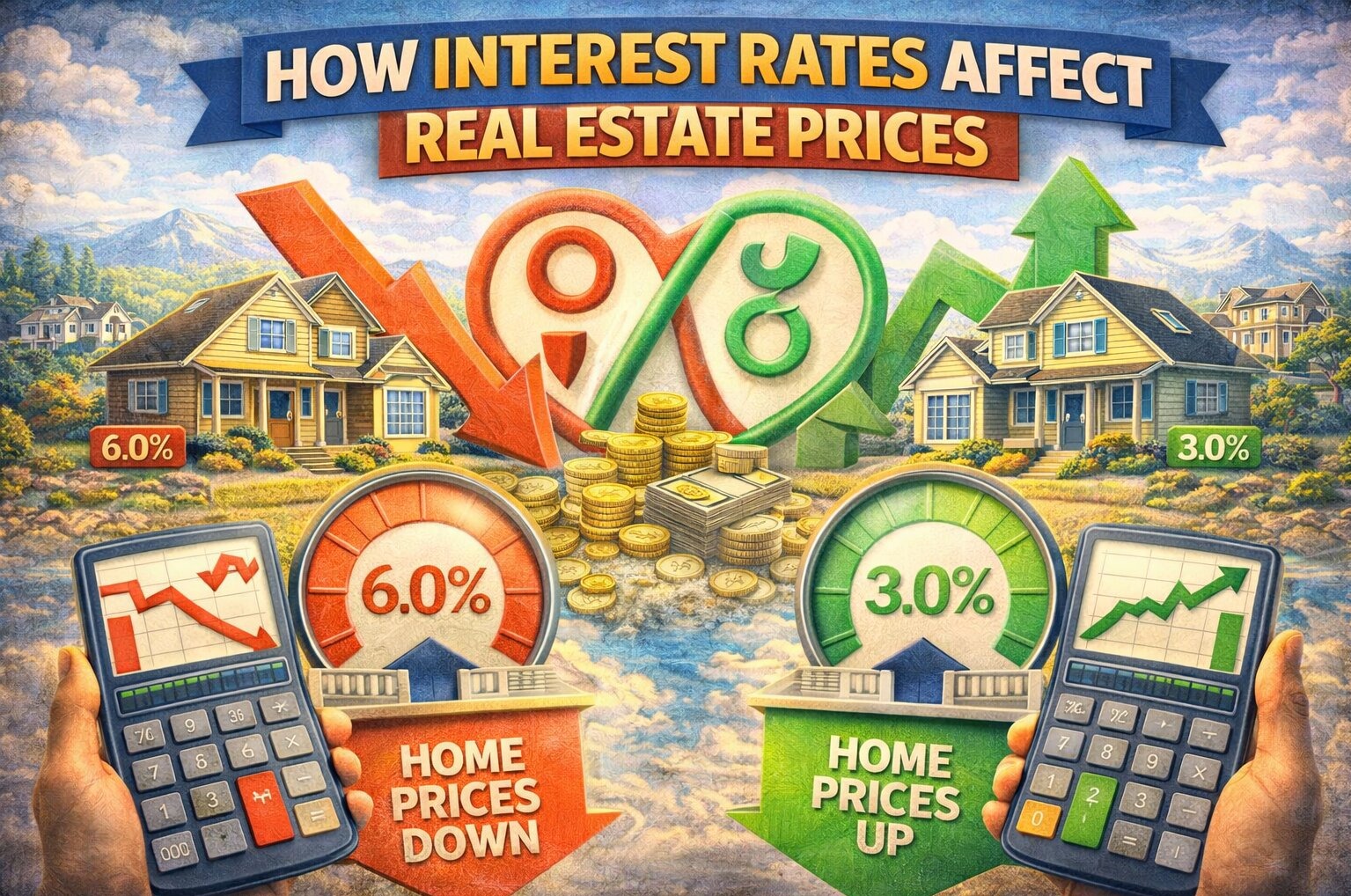
Interest rates are one of the most powerful forces shaping the U.S. real estate market. They influence everything—from how much buyers can afford to pay, to how quickly properties sell, to how investors calculate returns.
If you understand how interest rates work, you gain a major advantage as a real estate investor. You’ll be able to anticipate market shifts, identify better opportunities, and avoid costly mistakes.
This guide explains how interest rates affect real estate prices in the U.S., with clear examples, practical insights, and actionable takeaways.
What Are Interest Rates in Real Estate?
In real estate, interest rates refer to the cost of borrowing money to purchase property—typically through a mortgage.
When you take a loan:
- The interest rate determines your monthly payment
- It directly impacts affordability
Simple Idea:
- Lower interest rates → cheaper loans → higher demand
- Higher interest rates → expensive loans → lower demand
If you're new to real estate investing, start here:
How Real Estate Investing Works — https://statush.com/real-estate/how-real-estate-investing-works
How Interest Rates Impact Affordability
The biggest effect of interest rates is on affordability.
Example:
Loan Amount: $300,000
| Interest Rate | Monthly Payment |
|---|---|
| 3% | ~$1,265 |
| 6% | ~$1,799 |
That’s over $500 more per month—for the same property.
Result:
- Buyers can afford less at higher rates
- Demand decreases
- Price growth slows
Interest Rates and Home Prices
Interest rates don’t directly set home prices—but they strongly influence them through demand.
| Interest Rate Trend | Market Impact |
|---|---|
| Falling Rates | Increased demand → Rising prices |
| Rising Rates | Reduced demand → Slower price growth |
| Stable Rates | Balanced market |
Real-World Insight:
During periods of low rates (like 2020–2021), home prices surged due to high demand. When rates increased later, price growth slowed significantly.
Impact on Buyers
Interest rates affect buyer behavior in several ways.
When Rates Are Low:
- More buyers enter the market
- Competition increases
- Bidding wars are common
When Rates Are High:
- Fewer buyers qualify for loans
- Buyers become more cautious
- Negotiation power increases
This shift changes the entire market dynamic.
Impact on Sellers
Interest rates also influence seller decisions.
Low Rates:
- High demand → easier to sell
- Higher sale prices
High Rates:
- Fewer buyers → longer time on market
- More price reductions
Additionally, many homeowners hesitate to sell when they already have low mortgage rates—this reduces supply.
Impact on Real Estate Investors
Investors are heavily affected by interest rates.
1. Financing Costs Increase
Higher rates mean:
- Higher monthly payments
- Lower cash flow
2. Lower Property Values (Indirectly)
Reduced demand can slow price growth or cause slight declines.
3. Better Buying Opportunities
Higher rates often reduce competition, creating opportunities for investors.
To understand deal analysis:
Real Estate Investment Metrics Explained — https://statush.com/real-estate/real-estate-investment-metrics-explained
Interest Rates and Rental Markets
Interest rates also impact rental demand.
When Rates Rise:
- Fewer people can afford to buy homes
- More people rent instead
- Rental demand increases
Result:
- Higher occupancy rates
- Potential rent growth
This is why rental investors often benefit during high-rate periods.
For rental strategy insights:
Long-Term Rental Investing Strategy — https://statush.com/real-estate/long-term-rental-investing-strategy
The “Lock-In Effect”
A unique phenomenon in the U.S. market is the lock-in effect.
What It Means:
- Homeowners with low interest rates (e.g., 3%) don’t want to sell
- They would have to buy at higher rates (e.g., 6%)
Impact:
- Reduced housing supply
- Fewer listings
- Market imbalance
This has been a major factor in recent years.
Interest Rates and Market Cycles
Interest rates are closely tied to real estate cycles.
| Phase | Interest Rate Impact |
|---|---|
| Expansion | Low rates fuel growth |
| Peak | Rates rise to control inflation |
| Contraction | Demand slows |
| Recovery | Rates stabilize or fall |
To understand cycles:
Real Estate Market Cycles Explained — https://statush.com/real-estate/real-estate-market-cycles-explained
Practical Strategies for Investors
Understanding interest rates is one thing—using that knowledge is another.
1. Focus on Cash Flow
In high-rate environments, strong cash flow becomes essential.
2. Negotiate Better Deals
Higher rates reduce competition—use this to your advantage.
3. Consider Fixed-Rate Loans
Locking in rates protects against future increases.
4. Monitor Market Trends
Stay updated on interest rate movements and forecasts.
For broader market insights:
Real Estate Market Trends in the USA — https://statush.com/real-estate/real-estate-market-trends-in-the-usa
Common Mistakes to Avoid
Ignoring Interest Rate Impact
Rates significantly affect affordability and returns.
Overleveraging
High debt becomes riskier when rates rise.
Assuming Prices Always Rise
Higher rates can slow or stabilize price growth.
Not Stress-Testing Deals
Always evaluate deals under different rate scenarios.
For more pitfalls:
Real Estate Investing Mistakes to Avoid in USA — https://statush.com/real-estate/real-estate-investing-mistakes-to-avoid-in-usa
When Interest Rates Matter Most
Interest rates are especially important when:
- Buying or refinancing property
- Evaluating investment returns
- Timing market entry
- Scaling your portfolio
Even small rate changes can significantly impact long-term outcomes.
Final Thoughts
Interest rates are one of the most influential factors in real estate—but they don’t operate in isolation. They interact with:
- Supply and demand
- Economic conditions
- Market cycles
Understanding this relationship allows you to make smarter, more informed decisions.
Instead of fearing interest rate changes, successful investors learn to adapt:
- Buy strategically
- Focus on fundamentals
- Think long-term
In many cases, the best opportunities appear when interest rates are high—because that’s when competition is lowest.
To see how interest rates fit into your overall strategy:
Best Real Estate Investment Strategies — https://statush.com/real-estate/best-real-estate-investment-strategies