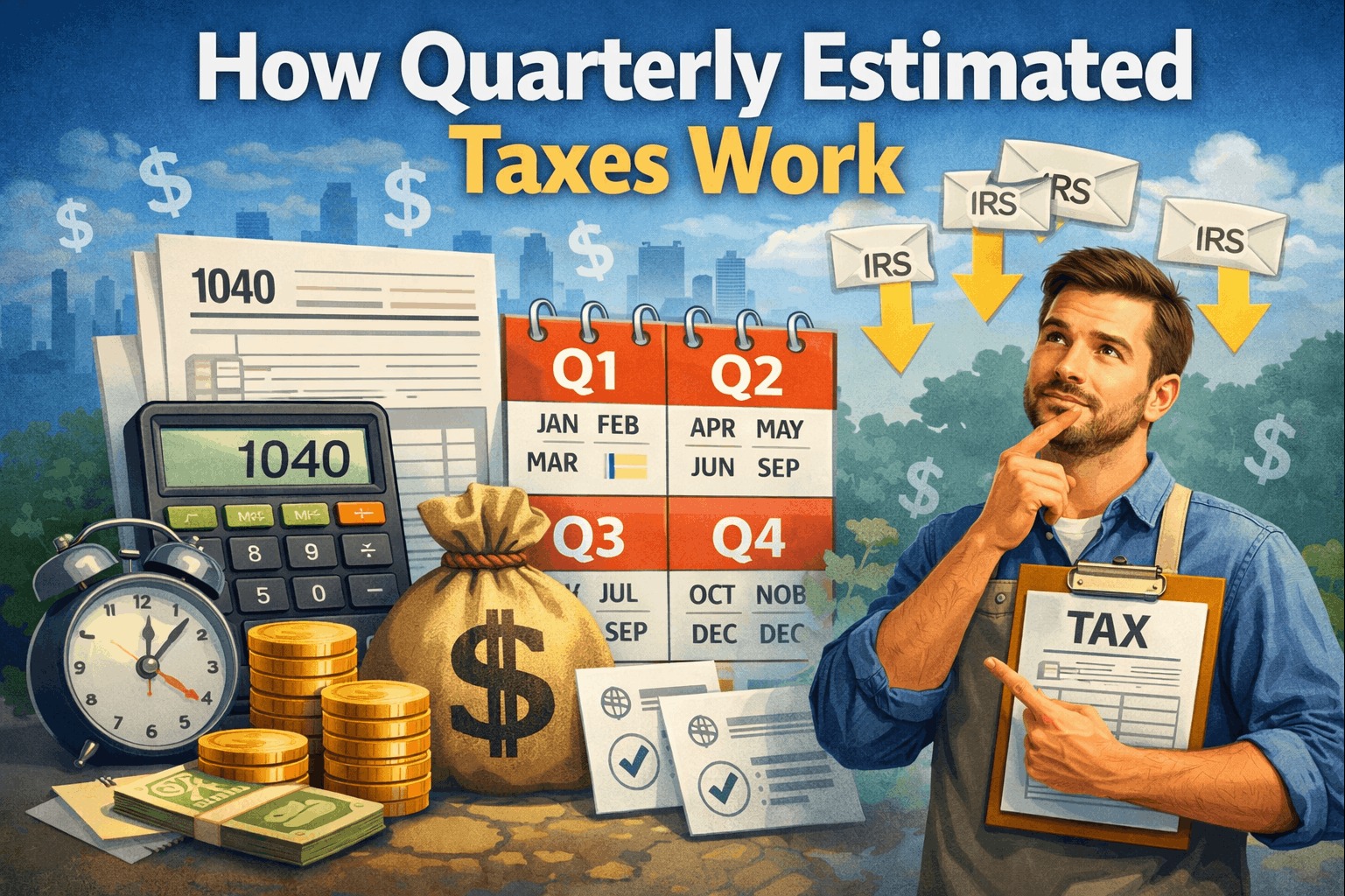
If you’re self-employed, freelancing, or earning income without tax withholding in the United States, you’ve probably heard about quarterly estimated taxes. For many people, this is one of the most confusing parts of the tax system—and also one of the easiest places to make costly mistakes.
Unlike traditional employees who have taxes automatically deducted from their paychecks, self-employed individuals are responsible for paying taxes throughout the year. That’s where quarterly estimated taxes come in.
Once you understand how they work, they become much more manageable—and even predictable.
What Are Quarterly Estimated Taxes?
Quarterly estimated taxes are payments you make to the IRS four times a year to cover your expected tax liability.
These payments typically include:
- Federal income tax
- Self-employment tax (Social Security and Medicare)
Instead of paying everything at the end of the year, the IRS requires you to pay as you earn income. This system ensures that taxes are collected steadily rather than in one large lump sum.
If you’re unfamiliar with self-employment taxes, it’s helpful to review:
Self-Employment Taxes Explained
https://statush.com/finance-statistics/self-employment-taxes-explained
Who Needs to Pay Quarterly Taxes?
Not everyone has to worry about quarterly payments. They generally apply if:
- You’re self-employed or a freelancer
- You earn income without tax withholding (side hustles, investments, etc.)
- You expect to owe at least $1,000 in taxes for the year
Real-world example:
If you’re a freelance developer earning $5,000 per month with no taxes withheld, the IRS expects you to pay taxes throughout the year—not just in April.
If you skip these payments, you may face penalties, even if you pay everything later.
When Are Quarterly Taxes Due?
Quarterly payments are spread across four deadlines during the year.
| Quarter | Income Period | Due Date |
|---|---|---|
| Q1 | Jan 1 – Mar 31 | April 15 |
| Q2 | Apr 1 – May 31 | June 15 |
| Q3 | Jun 1 – Aug 31 | September 15 |
| Q4 | Sep 1 – Dec 31 | January 15 (next year) |
These dates don’t align perfectly with calendar quarters, which can feel a bit unusual at first. But once you get used to the schedule, it becomes routine.
How to Calculate Quarterly Estimated Taxes
At a basic level, you’re estimating your total yearly tax and dividing it into four payments.
Step-by-step idea:
- Estimate your annual income
- Subtract expected deductions
- Calculate total tax (income tax + self-employment tax)
- Divide by four
Example:
- Expected yearly income: $100,000
- Estimated total tax: $25,000
Quarterly payment:
- $25,000 ÷ 4 = $6,250 per quarter
This doesn’t have to be perfect—the IRS understands it’s an estimate. The goal is to stay reasonably accurate.
A Practical Scenario
Let’s say you run a small online business and expect to earn $80,000 this year.
After expenses, your taxable income is around $60,000. Your combined tax (income + self-employment tax) might be roughly $15,000.
Instead of paying $15,000 at once, you would pay:
- $3,750 every quarter
This spreads the burden across the year and helps you avoid a large bill at tax time.
Safe Harbor Rule (Avoiding Penalties)
One of the most useful things to understand is the safe harbor rule.
The IRS won’t penalize you if you pay:
- At least 90% of your current year’s tax, or
- 100% of your previous year’s tax (110% for higher incomes)
Why this matters:
Even if your estimates aren’t perfect, following this rule can help you avoid penalties.
Example:
If you paid $12,000 in taxes last year:
- Paying $12,000 this year (spread quarterly) keeps you safe
This is especially helpful if your income fluctuates.
Comparing Employees vs Self-Employed Tax Payments
Here’s a simple comparison to clarify the difference:
| Category | Employee | Self-Employed |
|---|---|---|
| Tax payments | Automatically withheld | Paid manually |
| Payment timing | Every paycheck | Quarterly |
| Risk of penalties | Low | Higher if missed |
| Control over timing | Limited | High |
This highlights why planning is more important when you’re self-employed.
How to Make Quarterly Payments
The IRS provides several ways to pay estimated taxes:
- Online through IRS Direct Pay
- Using EFTPS (Electronic Federal Tax Payment System)
- Through tax software or an accountant
Most people prefer online payments because they’re fast and easy to track.
Tips to Make Quarterly Taxes Easier
Quarterly taxes can feel overwhelming at first, but a few simple habits can make them much easier to manage.
One of the most effective approaches is setting aside a percentage of your income every time you get paid. Many freelancers choose to save 25%–30% of their earnings for taxes.
It’s also helpful to review your income regularly and adjust your estimates if your earnings change significantly during the year.
If you want to reduce your tax burden overall, consider strategies like deductions and retirement contributions:
How to Reduce Your Taxable Income
https://statush.com/finance-statistics/how-to-reduce-your-taxable-income
Common Mistakes to Avoid
A lot of issues with quarterly taxes come down to simple misunderstandings.
Some people assume they can wait until the end of the year to pay everything, which often leads to penalties. Others underestimate their tax liability and end up with a large bill anyway.
Another common mistake is not adjusting payments when income changes. If your earnings increase, your estimated taxes should increase as well.
The Bigger Picture: Why Quarterly Taxes Exist
Quarterly estimated taxes might seem inconvenient, but they serve a purpose. They ensure that the tax system functions smoothly by collecting revenue throughout the year.
From a practical perspective, they also help you avoid a massive one-time payment, making your finances more manageable.
Final Thoughts
Quarterly estimated taxes are simply the IRS’s way of saying: “Pay as you earn.” Once you understand that concept, everything else becomes easier.
The key is to stay consistent, estimate your taxes reasonably, and make payments on time. With a little planning, quarterly taxes become just another routine part of managing your income.
Continue Learning
- Self-Employment Taxes Explained
https://statush.com/finance-statistics/self-employment-taxes-explained - Tax Benefits for Small Business Owners
https://statush.com/finance-statistics/tax-benefits-for-small-business-owners - Tax Optimization Strategies
https://statush.com/finance-statistics/tax-optimization-strategies