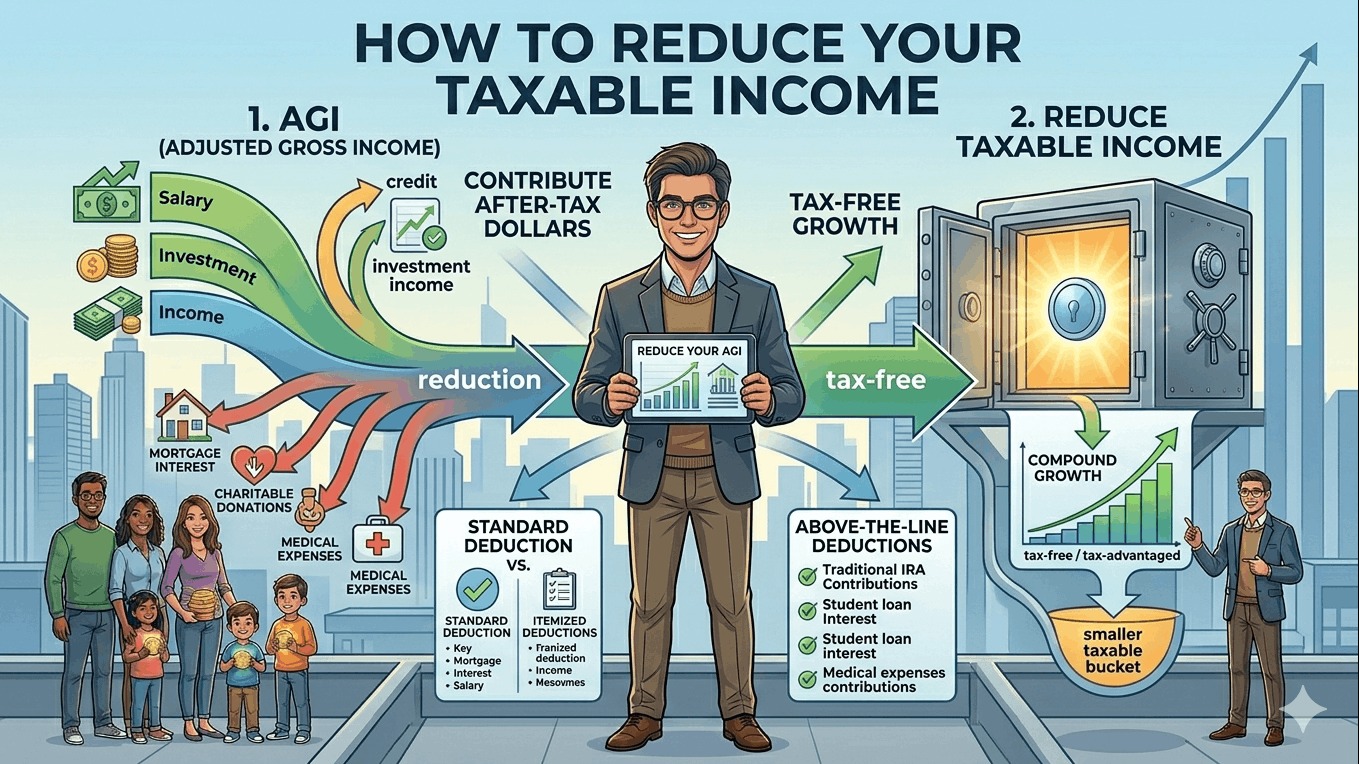
If you want to pay less in taxes, the key is simple: reduce your taxable income.
Many people assume taxes are fixed, but in reality, there are several legal strategies that can significantly lower how much of your income is taxed. Whether you’re a salaried employee, business owner, or investor, small adjustments can lead to meaningful savings.
In this guide, we’ll break down practical ways to reduce your taxable income in the United States—with real examples and easy-to-understand explanations.
What Is Taxable Income? (Simple Explanation)
Taxable income is the portion of your earnings that the government actually taxes after deductions and adjustments.
Basic formula:
- Total income
- Minus deductions
- Minus adjustments
= Taxable income
Example:
- Salary: $100,000
- Deductions: $20,000
- Taxable income: $80,000
Learn more:
What Is Taxable Income
https://statush.com/finance-statistics/what-is-taxable-income
1. Contribute to Retirement Accounts
One of the easiest and most effective ways to reduce taxable income is through retirement contributions.
How it works:
- Contributions to traditional 401(k) or IRA are tax-deductible
- Your taxable income decreases immediately
Real-world example:
- Income: $90,000
- 401(k) contribution: $15,000
- New taxable income: $75,000
Related:
Tax Advantages of a 401(k)
https://statush.com/finance-statistics/tax-advantages-of-a-401k
Practical tip:
Always contribute at least enough to get employer matching—it’s both tax savings and free money.
2. Use Health Savings Accounts (HSA)
An HSA is one of the most tax-efficient tools available.
Benefits:
- Contributions are tax-deductible
- Growth is tax-free
- Withdrawals for medical expenses are tax-free
Example:
If you contribute $3,500 to an HSA:
- Your taxable income drops by $3,500
My take:
HSAs are often overlooked, but they offer one of the best tax advantages available.
3. Take Advantage of Tax Deductions
Deductions directly reduce your taxable income.
Common deductions:
- Mortgage interest
- Student loan interest
- Medical expenses (above limits)
- State and local taxes (SALT)
Learn more:
Standard Deduction vs Itemized Deduction
https://statush.com/finance-statistics/standard-deduction-vs-itemized-deduction
Practical tip:
If your deductions exceed the standard deduction, itemizing can save more money.
4. Claim Tax Credits (Indirect Impact)
While credits don’t reduce taxable income directly, they reduce your total tax bill—which is just as valuable.
Examples:
- Child Tax Credit
- Education credits
- Earned Income Tax Credit
Related:
Tax Credits vs Tax Deductions
https://statush.com/finance-statistics/tax-credits-vs-tax-deductions
5. Deduct Business Expenses
If you have a side hustle or business, you can deduct legitimate expenses.
Examples:
- Home office
- Equipment
- Software
- Travel expenses
Real-world example:
- Side income: $20,000
- Expenses: $5,000
- Taxable income: $15,000
Learn more:
Tax Write-Offs for Side Hustles
https://statush.com/finance-statistics/tax-write-offs-for-side-hustles
6. Use Flexible Spending Accounts (FSA)
An FSA allows you to use pre-tax money for medical or dependent care expenses.
Benefit:
- Contributions reduce taxable income
- Covers everyday healthcare costs
Example:
If you contribute $2,000 to an FSA:
- Your taxable income drops by $2,000
7. Invest in Tax-Efficient Accounts
Where you invest matters just as much as what you invest in.
Tax-efficient options:
- 401(k)
- IRA
- Roth accounts (for future tax savings)
Related:
Tax Benefits of Retirement Accounts
https://statush.com/finance-statistics/tax-benefits-of-retirement-accounts
8. Harvest Investment Losses
Tax-loss harvesting helps offset gains and reduce taxable income.
Example:
- Capital gain: $10,000
- Capital loss: $4,000
- Taxable gain: $6,000
Learn more:
Tax Strategies for Investors
https://statush.com/finance-statistics/tax-strategies-for-investors
Practical tip:
Review your portfolio before year-end to take advantage of this strategy.
9. Time Your Income and Expenses
Timing can play a big role in reducing taxes.
Strategies:
- Delay income to next year
- Accelerate deductions into current year
Example:
If you expect higher income next year, deferring income can reduce your current taxable income.
10. Contribute to Charitable Donations
Charitable giving can lower taxable income if you itemize deductions.
Example:
- Donate $5,000
- Taxable income reduces by $5,000
Practical tip:
“Bunch” donations into one year to maximize deductions.
11. Use Education-Related Tax Benefits
Education expenses can provide deductions or credits.
Examples:
- Tuition deductions
- Education tax credits
Learn more:
Education Tax Credits Explained
https://statush.com/finance-statistics/education-tax-credits-explained
12. Optimize Filing Status
Your filing status affects your tax brackets and deductions.
Options:
- Single
- Married filing jointly
- Married filing separately
- Head of household
Choosing the right status can lower taxable income and taxes owed.
Common Mistakes to Avoid
Even smart taxpayers miss opportunities:
- Not contributing to retirement accounts
- Ignoring HSAs or FSAs
- Taking standard deduction when itemizing is better
- Missing eligible credits
Avoiding these can make a noticeable difference.
Final Thoughts
Reducing your taxable income is one of the most effective ways to keep more of your money. The best part is that most strategies are simple and completely legal—you just need to use them consistently.
In my opinion, the most powerful strategies are:
- Retirement contributions
- Tax-advantaged accounts (HSA, 401(k))
- Smart use of deductions
Simple plan to follow:
- Maximize tax-advantaged contributions
- Track deductions and expenses
- Plan ahead instead of waiting until tax season
Continue Learning
- Tax Planning Strategies for High Earners
https://statush.com/finance-statistics/tax-planning-strategies-for-high-earners - Tax Optimization Strategies
https://statush.com/finance-statistics/tax-optimization-strategies - Long-Term Tax Planning Guide
https://statush.com/finance-statistics/long-term-tax-planning-guide