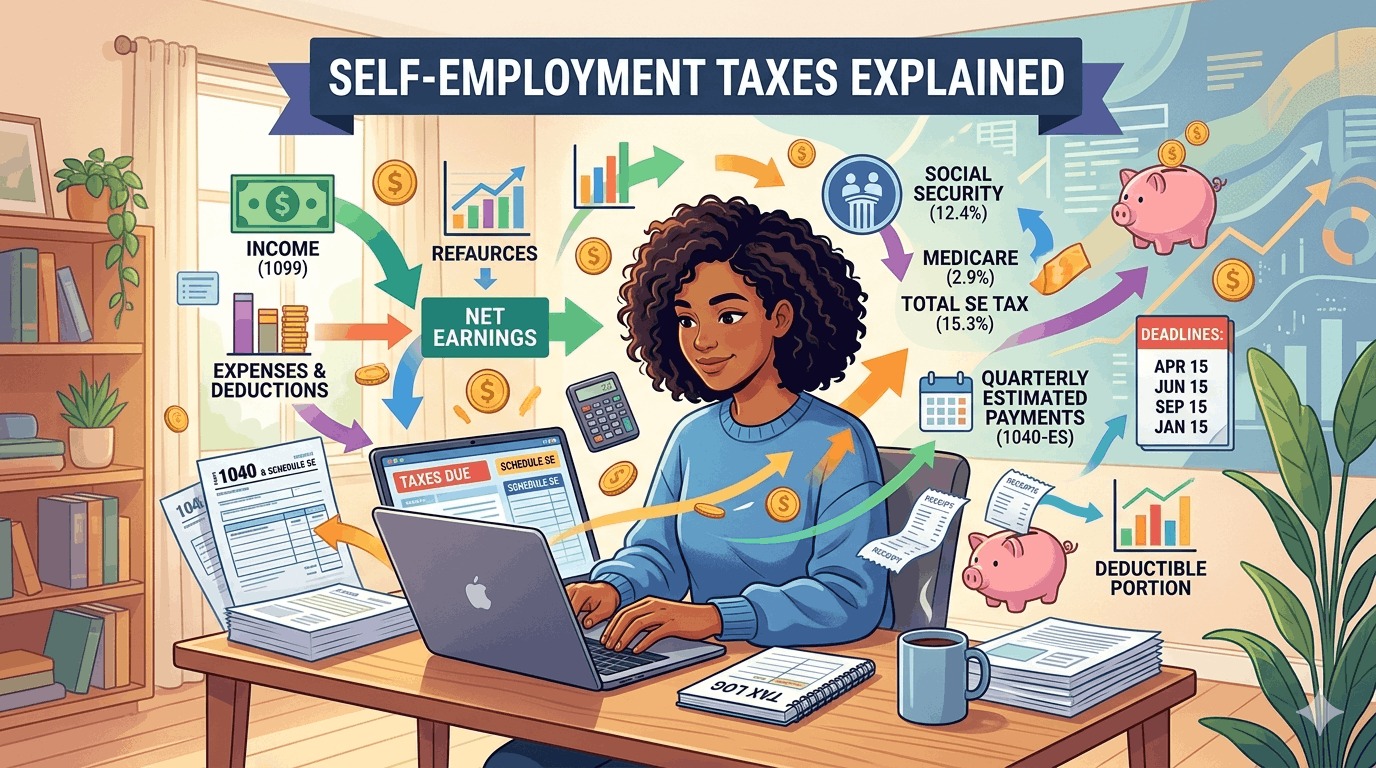
If you work for yourself in the United States—whether as a freelancer, consultant, or small business owner—your tax situation is very different from that of a traditional employee. One of the biggest differences is something called self-employment tax.
Many people are surprised the first time they see how much they owe, not because the system is unfair, but because it works differently than a regular paycheck setup. Once you understand how self-employment taxes actually function, it becomes much easier to plan, save, and avoid unexpected tax bills.
What Are Self-Employment Taxes?
Self-employment tax is essentially the combination of Social Security and Medicare taxes that self-employed individuals must pay on their income.
When you’re an employee, these taxes are split:
- You pay half
- Your employer pays the other half
But when you’re self-employed, you are both the employee and the employer. That means you’re responsible for both portions.
In simple terms, self-employment tax ensures that you still contribute to Social Security and Medicare, even without an employer.
How Much Is the Self-Employment Tax?
The current self-employment tax rate is 15.3%, which is made up of:
- 12.4% for Social Security
- 2.9% for Medicare
This applies to your net earnings, not your total revenue.
Real-Life Example
Let’s say you run a freelance business and earn $80,000 in revenue. After deducting $20,000 in business expenses, your net income is $60,000.
Your self-employment tax would be approximately:
- $60,000 × 15.3% = $9,180
That’s separate from your regular income tax, which is why the total tax bill can feel higher than expected.
Self-Employment Tax vs Income Tax (Quick Comparison)
To make this clearer, here’s how the two types of taxes differ:
| Type of Tax | What It Covers | Applies To | Who Pays |
|---|---|---|---|
| Income Tax | General federal tax | Total taxable income | Everyone |
| Self-Employment Tax | Social Security + Medicare | Net business income | Self-employed only |
This distinction is important because many new freelancers only plan for income tax and forget about self-employment tax.
The Hidden Benefit: Deducting Half of SE Tax
While paying both portions may seem like a disadvantage, there is a built-in tax benefit.
You can deduct half of your self-employment tax when calculating your adjusted gross income.
Example:
- Self-employment tax: $9,180
- Deductible portion: $4,590
This deduction reduces your taxable income, helping offset the total tax burden.
What Counts as Self-Employment Income?
Self-employment tax applies to income earned from:
- Freelancing or consulting
- Running a small business
- Gig work (rideshare, delivery, etc.)
- Independent contracting
However, it applies only to net earnings, meaning your income after business expenses are deducted.
This is why tracking expenses is so important—it directly reduces the amount of income subject to both income tax and self-employment tax.
To understand this better:
Tax Benefits for Small Business Owners
https://statush.com/finance-statistics/tax-benefits-for-small-business-owners
Why Quarterly Taxes Are Important
Unlike employees, self-employed individuals don’t have taxes automatically withheld from their income.
Instead, you’re expected to make quarterly estimated tax payments throughout the year.
If you don’t, you may face penalties—even if you pay the full amount at the end of the year.
Example:
If you expect to owe $12,000 in taxes:
- You may need to pay about $3,000 every quarter
This system helps the IRS collect taxes regularly instead of waiting until year-end.
How to Reduce Self-Employment Taxes
While you can’t avoid self-employment tax entirely, you can reduce its impact through smart planning.
One of the most effective ways is by deducting legitimate business expenses, which lowers your net income.
For example, if you reduce your net income from $60,000 to $50,000 through deductions, your self-employment tax drops accordingly.
You can also use retirement contributions, such as a Solo 401(k), to reduce your taxable income further.
If you want a broader strategy:
How to Reduce Your Taxable Income
https://statush.com/finance-statistics/how-to-reduce-your-taxable-income
Common Mistakes to Avoid
Many self-employed individuals run into problems simply because they don’t fully understand how the system works.
A common mistake is underestimating taxes by only planning for income tax and ignoring self-employment tax. Another issue is failing to make quarterly payments, which can lead to penalties.
Poor record-keeping is also a frequent problem. Without tracking expenses properly, you may end up paying more tax than necessary.
The Bigger Picture: Why This Tax Exists
It’s easy to view self-employment tax as an extra burden, but it serves an important purpose. These contributions fund Social Security and Medicare, which provide benefits later in life.
In other words, you’re not just paying taxes—you’re contributing to your future retirement and healthcare support.
Understanding this perspective can make the system feel more logical and less frustrating.
Final Thoughts
Self-employment taxes are one of the most important concepts to understand if you work for yourself in the United States. They can significantly impact your total tax bill, but they’re also manageable with the right approach.
The key is to plan ahead, track your income and expenses carefully, and make quarterly payments to avoid surprises.
From a practical standpoint, once you understand how self-employment tax works, it becomes less of a shock and more of a predictable part of running a business.
Continue Learning
- Tax Benefits for Small Business Owners
https://statush.com/finance-statistics/tax-benefits-for-small-business-owners - How Quarterly Estimated Taxes Work
https://statush.com/finance-statistics/how-quarterly-estimated-taxes-work - Tax Optimization Strategies
https://statush.com/finance-statistics/tax-optimization-strategies