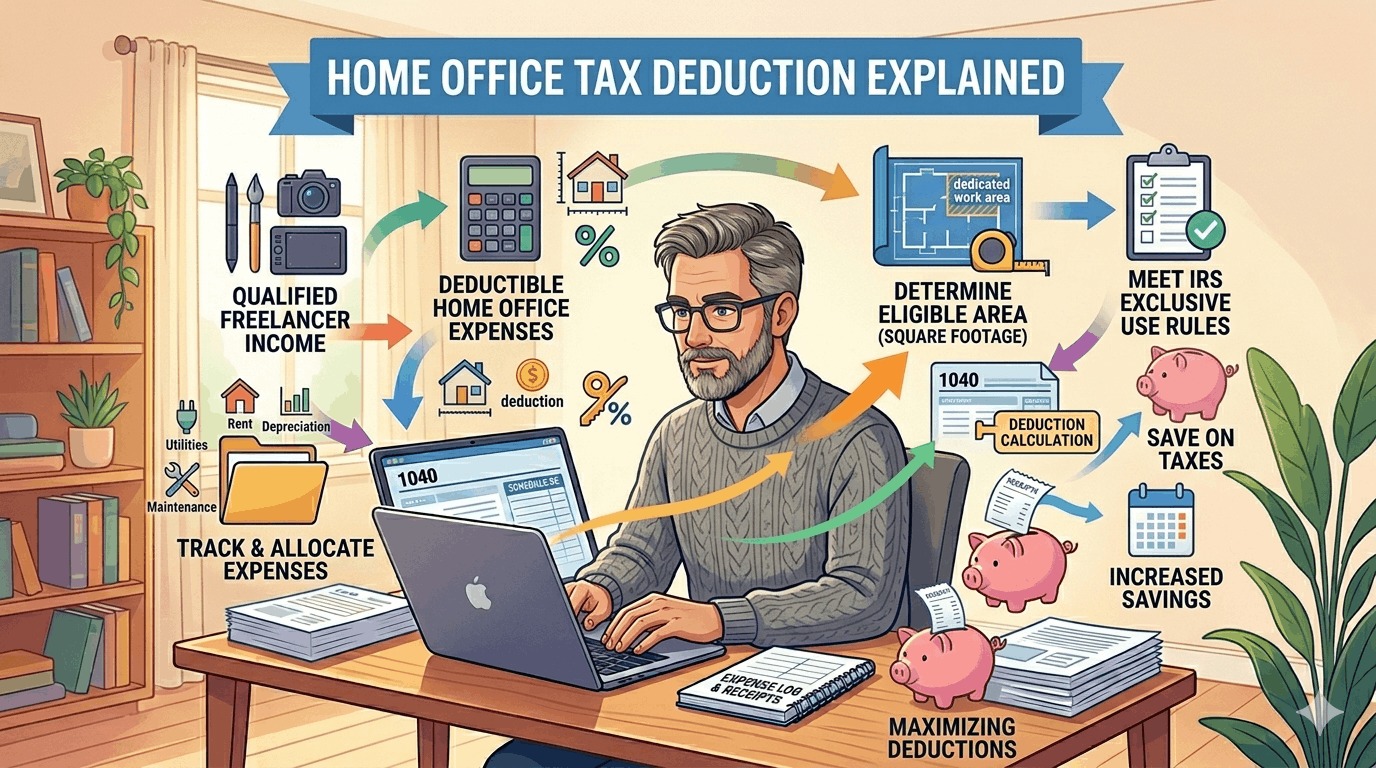
Working from home has become increasingly common in the United States, especially for freelancers, remote workers, and small business owners. But beyond convenience, your home workspace can also provide a valuable tax benefit—if you understand how to use it correctly.
The home office tax deduction allows eligible individuals to deduct a portion of their housing expenses, reducing their taxable income. However, this deduction is often misunderstood, and many people either miss it entirely or claim it incorrectly.
Once you understand the rules and apply them properly, it becomes a straightforward and useful way to lower your tax bill.
What Is the Home Office Tax Deduction?
The home office deduction allows you to deduct expenses related to the part of your home used for business.
In simple terms, if you use a portion of your home exclusively and regularly for work, you may be able to write off a percentage of your housing costs.
This includes expenses like rent, utilities, internet, and maintenance.
If you’re unfamiliar with how deductions reduce taxes, you can review:
How to Reduce Your Taxable Income
https://statush.com/finance-statistics/how-to-reduce-your-taxable-income
Who Qualifies for the Home Office Deduction?
This is where many people get confused.
The deduction is generally available to:
- Self-employed individuals
- Freelancers
- Independent contractors
- Small business owners
However, most employees working from home do not qualify, even if they work remotely full-time. This changed under recent tax laws.
The key requirement is that your home office must be used:
- Regularly (not occasionally)
- Exclusively for business
For example, a dedicated room used only for work qualifies. A kitchen table used for both work and meals does not.
A Real-Life Example
Let’s say you run a freelance business from home.
- Total home size: 1,000 sq. ft.
- Home office: 100 sq. ft.
- Business use: 10%
Annual expenses:
- Rent: $24,000
- Utilities: $3,000
- Internet: $1,200
Total eligible expenses: $28,200
Since your office is 10% of your home:
- Deduction = $2,820
If you’re in the 22% tax bracket, that’s about $620 in tax savings.
Two Methods to Calculate the Deduction
The IRS provides two ways to calculate the home office deduction.
Comparison Table
| Method | How It Works | Best For |
|---|---|---|
| Simplified Method | $5 per sq. ft. (up to 300 sq. ft.) | Smaller offices, easy calculation |
| Actual Expense Method | Based on percentage of real expenses | Larger homes, higher expenses |
Simplified Method Explained
The simplified method is exactly what it sounds like—easy and quick.
You multiply your office size by $5 per square foot, up to a maximum of 300 square feet.
Example:
- Office size: 150 sq. ft.
- Deduction: 150 × $5 = $750
This method requires minimal record-keeping and is ideal for those who want a straightforward approach.
Actual Expense Method Explained
The actual expense method is more detailed but often more beneficial.
You calculate:
- The percentage of your home used for business
- Apply that percentage to your total home expenses
Example:
- Business use: 10%
- Total expenses: $28,200
- Deduction: $2,820
This method usually results in a larger deduction, especially if your housing costs are high.
What Expenses Can You Deduct?
When using the actual expense method, you can include:
- Rent or mortgage interest
- Utilities (electricity, water, gas)
- Internet
- Home insurance
- Repairs and maintenance
Some expenses apply only to the office area, while others are shared across the home.
Comparing Both Methods (Example)
| Scenario | Simplified Method | Actual Method |
|---|---|---|
| Office size | 150 sq. ft. | 150 sq. ft. |
| Deduction | $750 | $2,820 |
| Record-keeping | Minimal | Detailed |
| Best choice | Simplicity | Higher savings |
This shows why it’s often worth calculating both methods before choosing.
Common Mistakes to Avoid
The home office deduction is valuable, but it comes with strict rules.
One of the most common mistakes is not meeting the “exclusive use” requirement. Even occasional personal use can disqualify the space.
Another issue is poor record-keeping. Without proper documentation, it’s difficult to support your deduction if questioned.
Some people also assume all remote workers qualify, which is not the case for most employees.
How This Fits Into Your Overall Tax Strategy
The home office deduction works best when combined with other business deductions.
For example, when you also deduct:
- Equipment and software
- Marketing expenses
- Travel costs
Your total taxable income decreases significantly.
To see how this fits into a bigger picture:
Tax Write-Offs for Side Hustles
https://statush.com/finance-statistics/tax-write-offs-for-side-hustles
When Should You Use This Deduction?
You should consider claiming the home office deduction if:
- You’re self-employed or freelancing
- You have a dedicated workspace
- You incur regular home-related expenses
Even a small home office can lead to meaningful tax savings over time.
Final Thoughts
The home office tax deduction is one of the most practical benefits available to self-employed individuals, but it requires careful attention to detail.
When used correctly, it allows you to turn everyday living expenses into legitimate business deductions. Over time, this can lead to consistent tax savings and improved financial efficiency.
From a practical standpoint, the best approach is to choose the method that fits your situation, maintain proper records, and treat your workspace as a true part of your business.
Continue Learning
- Tax Write-Offs for Side Hustles
https://statush.com/finance-statistics/tax-write-offs-for-side-hustles - Self-Employment Taxes Explained
https://statush.com/finance-statistics/self-employment-taxes-explained - Tax Benefits for Small Business Owners
https://statush.com/finance-statistics/tax-benefits-for-small-business-owners