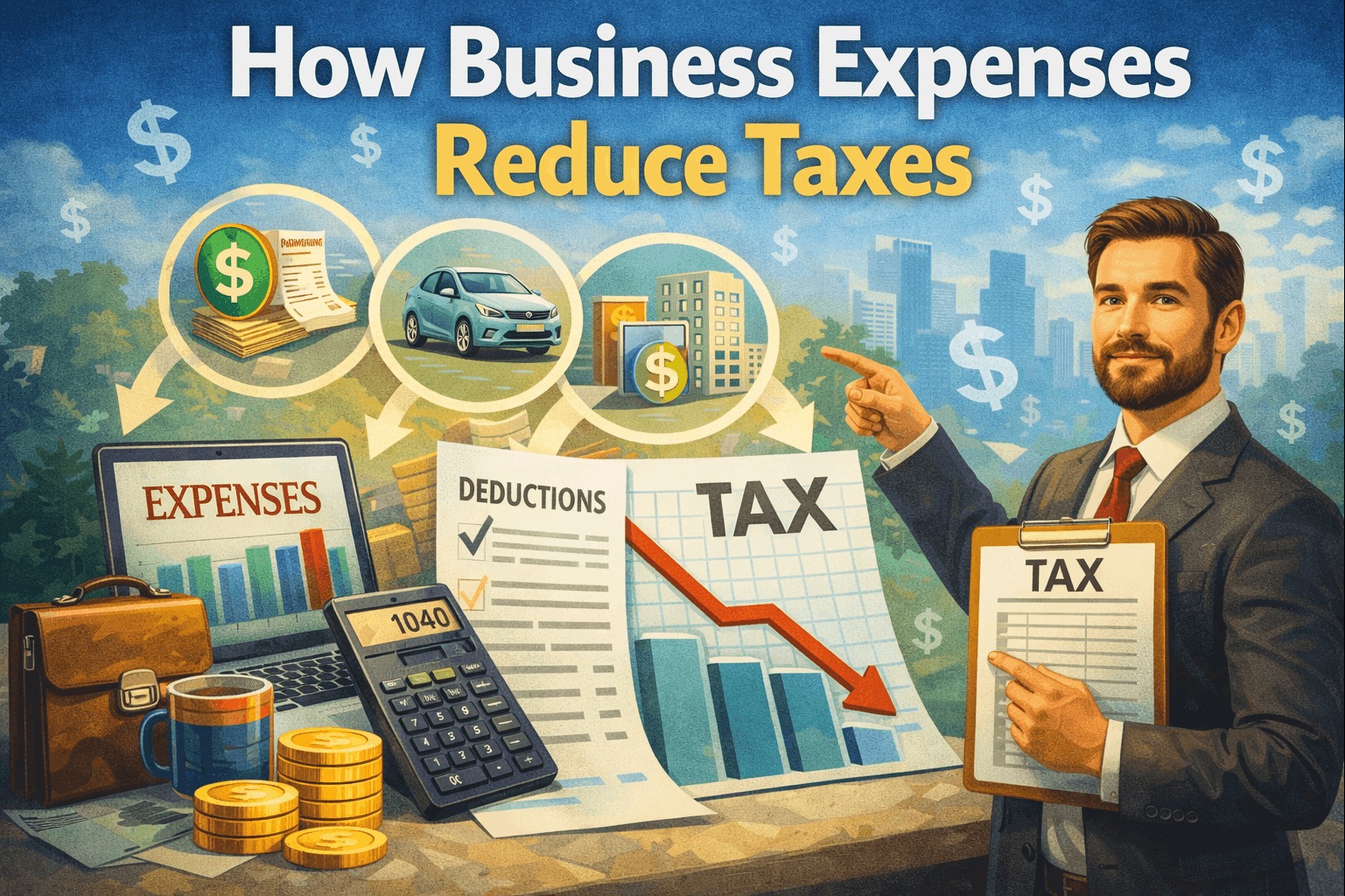
If you run a business, freelance, or even manage a side hustle in the United States, one of the most important concepts to understand is how business expenses reduce taxes.
At first glance, it might seem like expenses are just costs that reduce your profit. But from a tax perspective, they also play a powerful role in lowering how much of your income gets taxed.
The reality is simple: you are taxed on your profit—not your total revenue. Once you understand this, tax planning becomes much more strategic and far less stressful.
What Are Business Expenses? (Simple Explanation)
Business expenses are costs you incur to operate and grow your business.
The IRS defines them as expenses that are both:
- Ordinary (common in your industry)
- Necessary (helpful for running your business)
This can include everything from software subscriptions to office supplies to marketing costs.
If you’re new to how deductions work, it helps to understand:
How to Reduce Your Taxable Income
https://statush.com/finance-statistics/how-to-reduce-your-taxable-income
How Business Expenses Reduce Your Taxes
The way business expenses reduce taxes is actually very straightforward.
You start with your total income, subtract your expenses, and what remains is your taxable profit.
Formula:
Revenue – Expenses = Taxable Income
That final number is what gets taxed—not the full amount you earned.
A Real-Life Example
Let’s say you run an online business.
- Total revenue: $100,000
- Business expenses: $30,000
- Taxable income: $70,000
If you’re in the 24% tax bracket:
- Without deductions: tax on $100,000 → $24,000
- With deductions: tax on $70,000 → $16,800
Tax savings:
You save about $7,200 just by deducting legitimate expenses.
This is why expense tracking is one of the most important habits for any business owner.
Common Types of Business Expenses
Business expenses vary depending on your industry, but most fall into a few broad categories.
Examples include:
- Equipment (laptops, tools, machinery)
- Software and subscriptions
- Marketing and advertising
- Office supplies
- Internet and phone bills
- Travel and transportation
Each of these reduces your taxable income when properly documented.
To explore more examples:
Tax Write-Offs for Side Hustles
https://statush.com/finance-statistics/tax-write-offs-for-side-hustles
Comparing Income With vs Without Expenses
To see the impact more clearly, here’s a simple comparison:
| Scenario | No Expenses | With Expenses |
|---|---|---|
| Revenue | $100,000 | $100,000 |
| Expenses | $0 | $30,000 |
| Taxable income | $100,000 | $70,000 |
| Tax (24%) | $24,000 | $16,800 |
| Tax savings | — | $7,200 |
This table highlights how powerful deductions can be in reducing your overall tax burden.
Business Expenses and Self-Employment Tax
Business expenses don’t just reduce income tax—they also reduce self-employment tax.
Since self-employment tax is based on your net income, lowering your profit also lowers the amount you pay for Social Security and Medicare.
Example:
- Net income without expenses: $60,000
- Net income with expenses: $50,000
That $10,000 reduction lowers both:
- Income tax
- Self-employment tax
To understand this better:
Self-Employment Taxes Explained
https://statush.com/finance-statistics/self-employment-taxes-explained
Timing Expenses Strategically
Another advantage business owners have is control over timing.
For example, you might choose to:
- Buy equipment before year-end
- Pay for subscriptions in advance
- Invest in marketing campaigns
This can increase your expenses in the current year and reduce your taxable income.
Practical insight:
If you expect higher income this year, increasing deductible expenses can help lower your tax bill.
The Importance of Record-Keeping
The IRS requires that all deductions be properly documented.
This means:
- Keeping receipts
- Tracking expenses regularly
- Maintaining clear financial records
Without proper documentation, you risk losing deductions if audited.
Good record-keeping isn’t just about compliance—it also helps you understand your business performance more clearly.
Common Mistakes to Avoid
Many business owners miss out on tax savings due to simple mistakes.
One common issue is not tracking expenses throughout the year, which leads to missed deductions. Another is mixing personal and business expenses, making it harder to identify what qualifies.
Some people also hesitate to claim legitimate deductions out of caution, but as long as expenses are valid and documented, they are allowed.
How This Fits Into a Bigger Tax Strategy
Business expenses are just one part of a larger tax strategy.
When combined with:
- Retirement contributions
- Home office deductions
- Tax credits
They can significantly reduce your overall tax liability.
To explore broader strategies:
Tax Optimization Strategies
https://statush.com/finance-statistics/tax-optimization-strategies
Final Thoughts
Understanding how business expenses reduce taxes is one of the most valuable skills for any entrepreneur, freelancer, or side hustler.
The concept itself is simple, but the impact can be substantial. By tracking your expenses carefully and using deductions effectively, you can lower your taxable income and keep more of what you earn.
From a practical standpoint, the most successful business owners treat expense tracking as an ongoing habit—not something they deal with once a year.
Continue Learning
- Tax Benefits for Small Business Owners
https://statush.com/finance-statistics/tax-benefits-for-small-business-owners - How to File Taxes as a Freelancer
https://statush.com/finance-statistics/how-to-file-taxes-as-a-freelancer - Long-Term Tax Planning Guide
https://statush.com/finance-statistics/long-term-tax-planning-guide