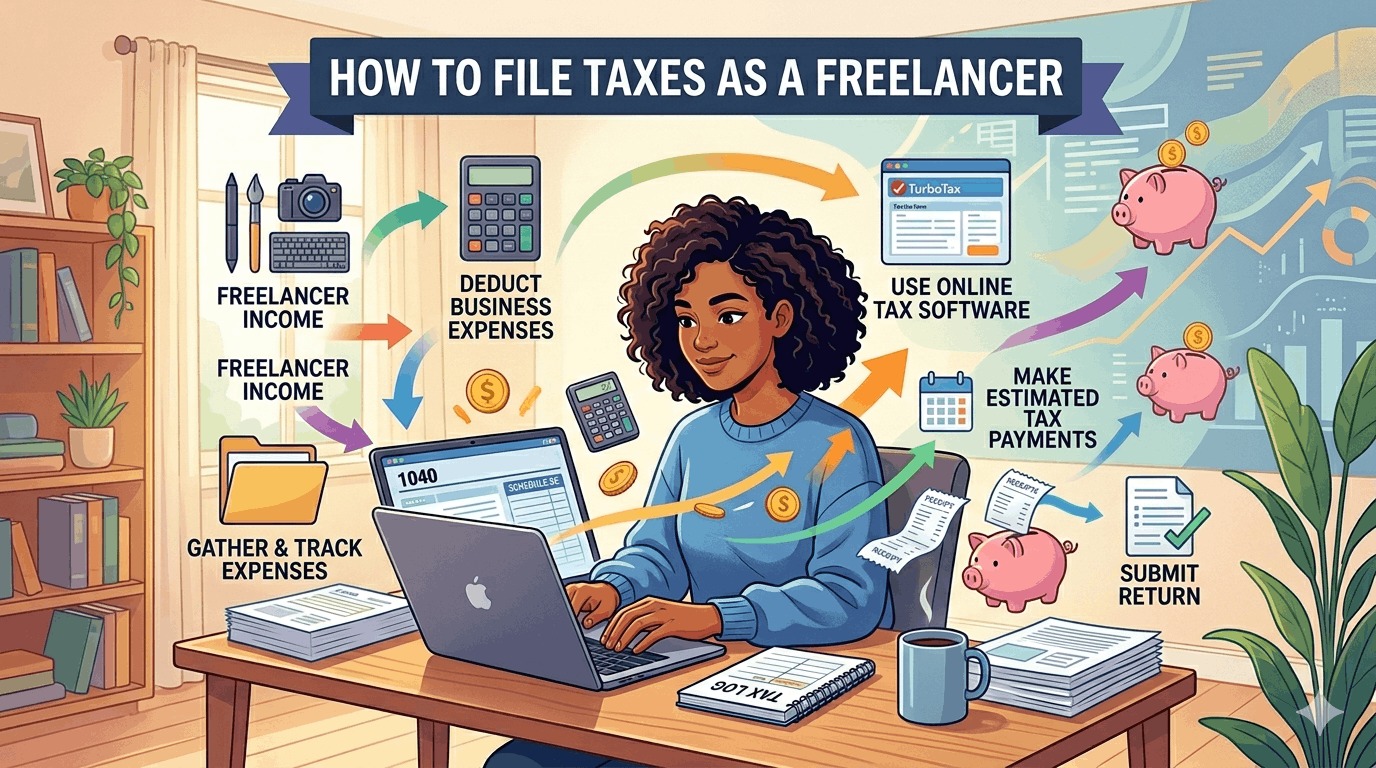
Freelancing offers flexibility, independence, and control over your income—but it also comes with one major responsibility: handling your own taxes.
If you’re used to a traditional job where taxes are automatically deducted, freelancing can feel confusing at first. There’s no employer withholding taxes, no simple W-2 form, and no one reminding you what to do. But once you understand the process, filing taxes as a freelancer becomes much more manageable.
This guide walks you through everything step by step, in a practical and easy-to-understand way.
How Freelance Taxes Are Different
The biggest difference between freelancers and employees is how taxes are handled.
As a freelancer, you are considered self-employed, which means:
- You report your own income
- You track your own expenses
- You pay your own taxes
Instead of receiving a W-2, you’ll usually receive Form 1099-NEC from clients who paid you $600 or more during the year.
Even if you don’t receive a form, you are still required to report all income.
To understand the tax side better, you can review:
Self-Employment Taxes Explained
https://statush.com/finance-statistics/self-employment-taxes-explained
A Real-Life Example
Let’s say you’re a freelance writer earning income from multiple clients.
- Total income: $70,000
- Business expenses: $10,000
- Net income: $60,000
You’ll pay taxes on the $60,000, not the full $70,000. This is why tracking expenses is so important—it directly reduces your taxable income.
Step 1: Gather All Your Income Records
The first step in filing taxes is collecting all sources of income.
This includes:
- 1099-NEC forms
- Payments from platforms (Upwork, Fiverr, etc.)
- Direct client payments (even without forms)
Freelancers often have multiple income streams, so it’s important to keep accurate records throughout the year rather than trying to reconstruct everything at tax time.
Step 2: Track and Deduct Business Expenses
One of the biggest advantages of freelancing is the ability to deduct business expenses.
These are costs that are ordinary and necessary for your work.
Common examples include:
- Laptop and equipment
- Software subscriptions
- Internet and phone bills
- Home office expenses
- Marketing and advertising
Real-world impact:
If you earn $70,000 and deduct $10,000 in expenses:
- You’re taxed on $60,000 instead
This can lead to significant tax savings.
To explore this further:
Tax Benefits for Small Business Owners
https://statush.com/finance-statistics/tax-benefits-for-small-business-owners
Step 3: Calculate Your Net Income
After subtracting expenses from your total income, you arrive at your net profit, which is the amount you’ll be taxed on.
This number is reported on Schedule C (Profit or Loss from Business).
This step is critical because both your income tax and self-employment tax are based on this figure.
Step 4: Understand Self-Employment Tax
In addition to regular income tax, freelancers must pay self-employment tax, which covers Social Security and Medicare.
This is currently 15.3% of your net income.
Example:
- Net income: $60,000
- Self-employment tax: ~$9,180
This is why freelancers often feel like they’re paying more in taxes—it’s because they’re covering both the employee and employer portions.
Step 5: Fill Out the Required Tax Forms
Freelancers typically need to file several forms along with their main tax return.
Here’s a simple overview:
| Form | Purpose |
|---|---|
| Form 1040 | Main tax return |
| Schedule C | Reports business income and expenses |
| Schedule SE | Calculates self-employment tax |
| 1099-NEC | Reports income from clients |
Most tax software handles these automatically, but it’s still helpful to understand what each form does.
Step 6: Pay Quarterly Estimated Taxes
Freelancers are expected to pay taxes throughout the year, not just in April.
This is done through quarterly estimated tax payments.
If you don’t make these payments, you may face penalties—even if you pay the full amount later.
To understand how this works:
How Quarterly Estimated Taxes Work
https://statush.com/finance-statistics/how-quarterly-estimated-taxes-work
Step 7: File Your Tax Return
Once everything is calculated, you’ll file your tax return using:
- Tax software (like TurboTax or similar tools)
- A professional accountant
Most freelancers prefer software because it simplifies the process and helps identify deductions automatically.
Comparing Freelancer vs Employee Taxes
To make the difference clearer, here’s a simple comparison:
| Category | Employee | Freelancer |
|---|---|---|
| Tax withholding | Automatic | Manual |
| Forms received | W-2 | 1099-NEC |
| Expense deductions | Limited | Extensive |
| Tax payments | Once per year | Quarterly |
| Self-employment tax | No | Yes |
This highlights why freelancers need a more proactive approach.
Common Mistakes to Avoid
Filing taxes as a freelancer becomes much easier when you avoid a few common mistakes.
Many freelancers forget to report income that doesn’t come with a 1099 form. Others fail to track expenses, which leads to paying more tax than necessary.
Another common issue is not setting aside money for taxes, which can result in a large and stressful bill at the end of the year.
Planning ahead solves most of these problems.
Practical Tips for Freelancers
A simple habit like setting aside 25%–30% of your income for taxes can make a big difference. It ensures you’re prepared when payments are due.
Keeping separate bank accounts for business and personal finances also helps with organization and accuracy.
Over time, these small systems make tax filing much smoother.
Final Thoughts
Filing taxes as a freelancer may seem complicated at first, but it becomes much easier once you understand the structure.
At its core, the process comes down to:
- Tracking income
- Deducting expenses
- Calculating net profit
- Paying taxes consistently
From a practical standpoint, the most successful freelancers treat taxes as part of their business—not something to deal with once a year.
Continue Learning
- Self-Employment Taxes Explained
https://statush.com/finance-statistics/self-employment-taxes-explained - Tax Benefits for Small Business Owners
https://statush.com/finance-statistics/tax-benefits-for-small-business-owners - How Quarterly Estimated Taxes Work
https://statush.com/finance-statistics/how-quarterly-estimated-taxes-work