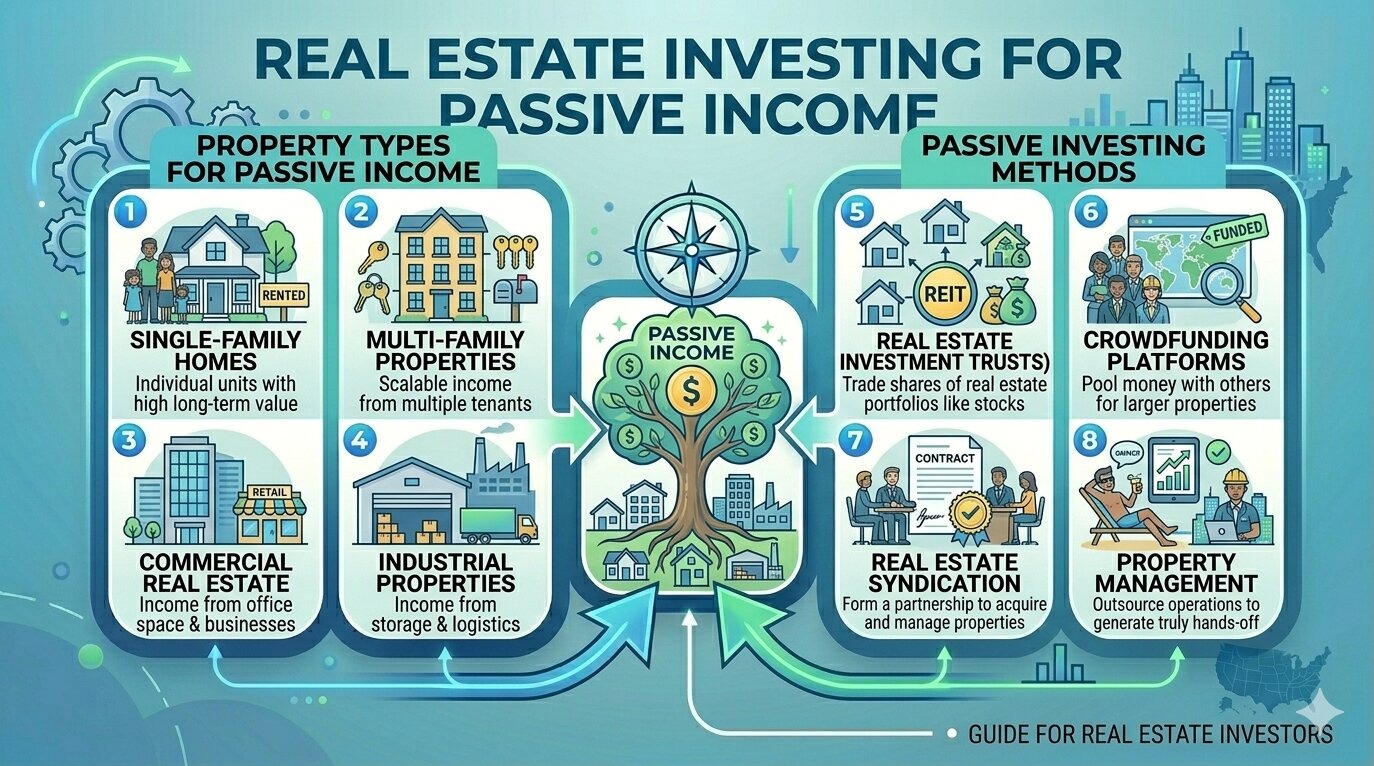
Real estate investing is widely considered one of the most effective ways to generate passive income in the United States. The idea is simple: acquire income-producing properties that generate consistent cash flow with minimal day-to-day involvement.
But here’s the truth—real estate is not truly passive at the beginning. It requires effort to set up, manage, and optimize. The real “passive income” comes later, once systems are in place and your portfolio is running smoothly.
This guide explains how to build passive income through real estate, with real-world examples, practical strategies, and a clear roadmap to get started.
What Is Passive Income in Real Estate?
Passive income is money earned with limited ongoing effort. In real estate, this typically comes from:
- Rental income
- Real estate funds (REITs, syndications)
- Short-term or long-term rental properties
The goal is to create income streams that continue to generate money even when you're not actively working.
If you're new to real estate investing, start here:
How Real Estate Investing Works — https://statush.com/real-estate/how-real-estate-investing-works
How Real Estate Generates Passive Income
Real estate income comes from multiple sources.
| Income Type | Description | Stability |
|---|---|---|
| Rental Income | Monthly tenant payments | High |
| Appreciation | Property value growth | Long-term |
| Tax Benefits | Reduced taxable income | Indirect |
| Equity Growth | Loan paydown over time | Long-term |
The combination of these factors makes real estate a powerful wealth-building tool.
Real-World Example: Passive Income Property
Let’s look at a rental property in Indianapolis:
- Purchase Price: $250,000
- Monthly Rent: $2,000
Monthly Expenses:
- Mortgage: $1,200
- Taxes & Insurance: $300
- Maintenance: $200
Total Expenses: $1,700
Cash Flow: $300/month
Over time:
- Rent increases
- Mortgage decreases
- Property value rises
This is how passive income grows.
Best Strategies for Passive Income
There are several ways to generate passive income through real estate.
1. Long-Term Rental Properties
This is the most common strategy.
Benefits:
- Stable monthly income
- Lower management effort
- Predictable returns
Long-Term Rental Investing Strategy — https://statush.com/real-estate/long-term-rental-investing-strategy
2. REITs (Real Estate Investment Trusts)
REITs allow you to invest in real estate without owning property.
Advantages:
- Fully passive
- Low capital requirement
- Liquidity (can buy/sell easily)
Learn more:
How to Invest in REITs for Passive Income — https://statush.com/real-estate/how-to-invest-in-reits-for-passive-income
3. Real Estate Syndication
Syndications allow you to invest in large properties with other investors.
Benefits:
- Passive ownership
- Professional management
- Access to larger deals
Real Estate Syndication Explained — https://statush.com/real-estate/real-estate-syndication-explained
4. Short-Term Rentals (Airbnb)
Higher income potential, but less passive unless managed properly.
Key Consideration:
- Requires active management or a property manager
Airbnb Investment Strategy — https://statush.com/real-estate/airbnb-investment-strategy
Building a Passive Income Portfolio
Passive income doesn’t happen overnight—it’s built over time.
| Stage | What You Do | Goal |
|---|---|---|
| Start | Buy first property | Learn fundamentals |
| Stabilize | Generate steady income | Build confidence |
| Scale | Acquire more properties | Increase cash flow |
| Optimize | Improve efficiency | Reduce effort |
| Automate | Delegate management | Achieve passivity |
Consistency is more important than speed.
Key Metrics to Focus On
To build reliable passive income, track these metrics:
| Metric | Meaning | Importance |
|---|---|---|
| Cash Flow | Monthly profit | Core income |
| Cap Rate | Return on property value | Deal comparison |
| Occupancy Rate | Rental stability | Income consistency |
| ROI | Overall return | Performance tracking |
For deeper insights:
Real Estate Investment Metrics Explained — https://statush.com/real-estate/real-estate-investment-metrics-explained
Making Real Estate Truly Passive
Real estate becomes passive when you reduce your involvement.
Ways to Do This:
1. Hire Property Management
- Handles tenants, maintenance, and operations
- Costs ~8–12% of rent
Property Management Basics — https://statush.com/real-estate/property-management-basics
2. Automate Systems
- Online rent collection
- Maintenance tracking
- Financial reporting
3. Build a Reliable Team
- Property managers
- Contractors
- Accountants
The right team reduces your workload significantly.
Common Mistakes to Avoid
Expecting Immediate Passivity
Real estate requires effort upfront.
Ignoring Expenses
Maintenance and vacancies reduce income.
Overleveraging
Too much debt increases risk.
Poor Tenant Selection
Bad tenants can disrupt income.
Learn more:
Real Estate Investing Mistakes to Avoid in USA — https://statush.com/real-estate/real-estate-investing-mistakes-to-avoid-in-usa
Passive Income vs Active Income
| Feature | Passive Income | Active Income |
|---|---|---|
| Effort | Low (after setup) | High |
| Scalability | High | Limited |
| Stability | Moderate to high | Depends on work |
| Time Freedom | High | Low |
Real estate bridges the gap between income and freedom.
When Passive Income Strategy Works Best
This approach works best when:
- You have a long-term investment horizon
- You focus on stable markets
- You prioritize cash flow over quick gains
It becomes challenging when:
- Cash flow is negative
- Management is poor
- Markets are highly volatile
Final Thoughts
Real estate investing for passive income is not about quick wins—it’s about building systems that generate income over time.
The most successful investors focus on:
- Consistent cash flow
- Smart property selection
- Efficient management
Over time, these efforts compound into:
- Reliable monthly income
- Financial independence
- Long-term wealth
If you approach real estate with patience and strategy, it can become one of the most powerful passive income sources available.
To explore more strategies:
Best Real Estate Investment Strategies — https://statush.com/real-estate/best-real-estate-investment-strategies