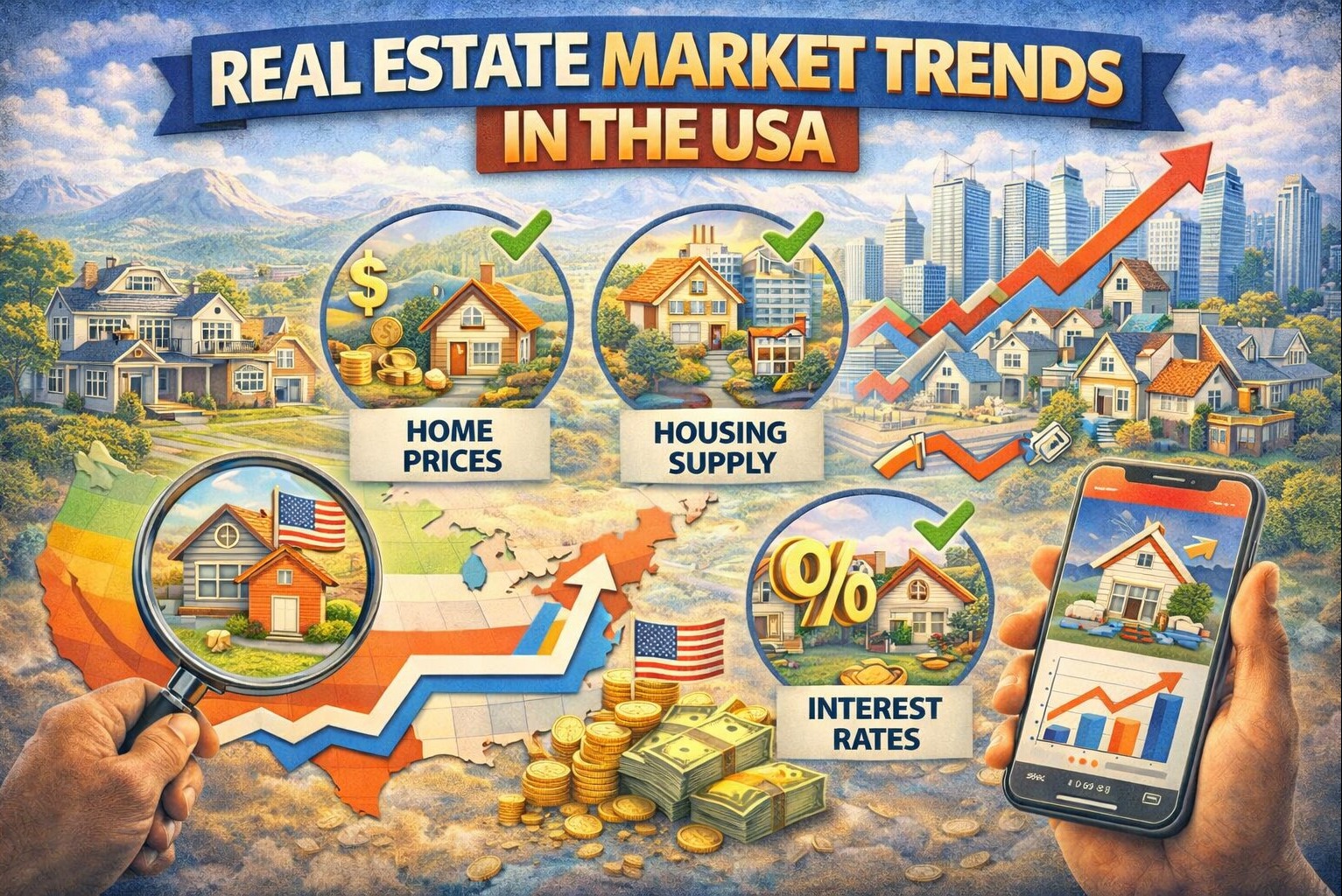
The U.S. real estate market is constantly evolving—and in recent years, it has shifted from rapid growth to a more balanced, data-driven environment. After the intense price surges of 2020–2022 and the correction phase that followed, the market in 2025–2026 is entering what many experts call a “stabilization phase.”
For investors, this is actually a critical period. Markets that are no longer overheated often provide better opportunities—if you understand the trends.
This guide breaks down the most important real estate market trends in the U.S., supported by recent data, real-world insights, and practical implications for investors.
1. Home Prices Are Stabilizing (Not Crashing)
One of the biggest shifts in the U.S. housing market is the slowdown in price growth.
- Home prices increased only about 0.9%–1.8% year-over-year recently
- Forecasts suggest ~1%–3% growth in 2026
- Some models even expect near-flat growth in certain markets
In simple terms:
- Prices are no longer skyrocketing
- But they are also not collapsing
This is a healthier market condition—especially for buyers and long-term investors.
What It Means:
- Less competition compared to peak years
- More predictable investment outcomes
- Better entry opportunities
2. Mortgage Rates Are Still a Major Factor
Mortgage rates continue to shape the market.
- Rates have hovered around ~6%–6.3% in 2026
- Even small changes significantly affect affordability
Lower rates earlier in 2026 briefly improved affordability, encouraging some buyers back into the market.
Impact on Investors:
- Higher rates → lower affordability → reduced demand
- Lower rates → increased activity → rising competition
This push-pull dynamic is one of the biggest drivers of current market behavior.
3. Inventory Is Increasing (Slowly)
After years of extremely low housing supply, inventory is finally improving.
- New listings have started to grow year-over-year
- Unsold homes are increasingly entering the rental market
However:
- Inventory is still below long-term averages
- Supply constraints continue in many regions
What This Means:
- Buyers have more options than before
- Sellers need more realistic pricing strategies
Recent market behavior shows fewer price cuts and more accurate initial pricing by sellers.
4. Rent Growth Is Slowing (But Still Strong Long-Term)
Rental markets are also shifting.
- Single-family rents increased only ~1.3% year-over-year
- Some segments (like apartments) have seen declines in asking rents
However:
- Rents are still significantly higher than pre-pandemic levels
- Demand remains strong in many regions
Key Insight:
The rental market is becoming more tenant-friendly, but not weak.
For Investors:
- Cash flow remains viable
- But aggressive rent increases are harder
5. Market Is Becoming More “Buyer-Friendly”
After years of seller dominance, the market is shifting.
Recent trends show:
- Homes staying longer on the market
- More negotiation opportunities
- Slight price adjustments in some regions
For example:
- Median listing prices have dipped slightly
- Time on market has increased in many areas
What This Means:
- Buyers have more leverage
- Investors can negotiate better deals
This is a major shift from the ultra-competitive pandemic-era market.
6. Regional Differences Are Increasing
The U.S. real estate market is no longer moving uniformly.
Stronger Markets:
- Midwest and some Northeast regions (steady growth)
- Affordable cities with job growth
Cooling Markets:
- Some Sun Belt regions (price corrections)
- Previously overheated markets
Key Takeaway:
Local market analysis matters more than ever.
National trends are helpful—but real opportunities are local.
7. Affordability Is Still a Major Challenge
Housing affordability remains one of the biggest issues in the U.S.
- High prices + elevated mortgage rates = affordability pressure
- First-time homeownership is at historically low levels in recent years
New models like fractional ownership are emerging to address this issue
Impact:
- More people renting longer
- Increased demand for affordable housing
- Growth in alternative ownership models
8. Shift Toward Rentals and “Accidental Landlords”
An interesting trend is the rise of “accidental landlords.”
- Some homeowners are renting instead of selling
- This increases rental supply
Why This Happens:
- Owners don’t want to sell in a slower market
- Renting becomes a better short-term option
Investor Impact:
- More competition in rental markets
- But also more opportunities to acquire properties
9. Commercial Real Estate Is Recovering
While residential markets stabilized, commercial real estate is seeing renewed activity.
- Investment volume expected to rise significantly in 2026
- Returns increasingly driven by income rather than appreciation
Key Insight:
- Investors are focusing more on cash flow than speculation
10. Market Sentiment: Cautiously Optimistic
Overall, the outlook for 2026 is:
- Stable
- Gradually improving
- Less volatile
Industry surveys show improving confidence compared to previous years.
In Simple Terms:
- Not a boom
- Not a crash
- A transition phase
Summary of Key Trends
| Trend | Current Direction | Impact |
|---|---|---|
| Home Prices | Slow growth | Stable market |
| Mortgage Rates | Moderate (~6%) | Affects demand |
| Inventory | Increasing | More buyer options |
| Rent Growth | Slowing | Balanced rental market |
| Affordability | Challenging | More renters |
| Market Power | Shifting to buyers | Better deals |
What These Trends Mean for Investors
Opportunities:
- Better negotiation power
- More inventory
- Stabilizing prices
Risks:
- Slower appreciation
- Rent growth moderation
- Regional market variation
Strategy Shift:
Successful investors in this market focus on:
- Cash flow over speculation
- Strong fundamentals
- Long-term holding
Final Thoughts
The U.S. real estate market is no longer in a rapid growth phase—it’s entering a more balanced and sustainable cycle.
For investors, this is actually a positive shift.
Instead of chasing fast appreciation, the focus now is on:
- Smart buying decisions
- Strong cash flow
- Long-term strategy
Markets like this reward discipline, patience, and good analysis—not speculation.
If you understand these trends and adapt your strategy accordingly, this phase of the market can offer some of the best opportunities in years.
To explore how to apply these trends in your strategy:
Best Real Estate Investment Strategies — https://statush.com/real-estate/best-real-estate-investment-strategies