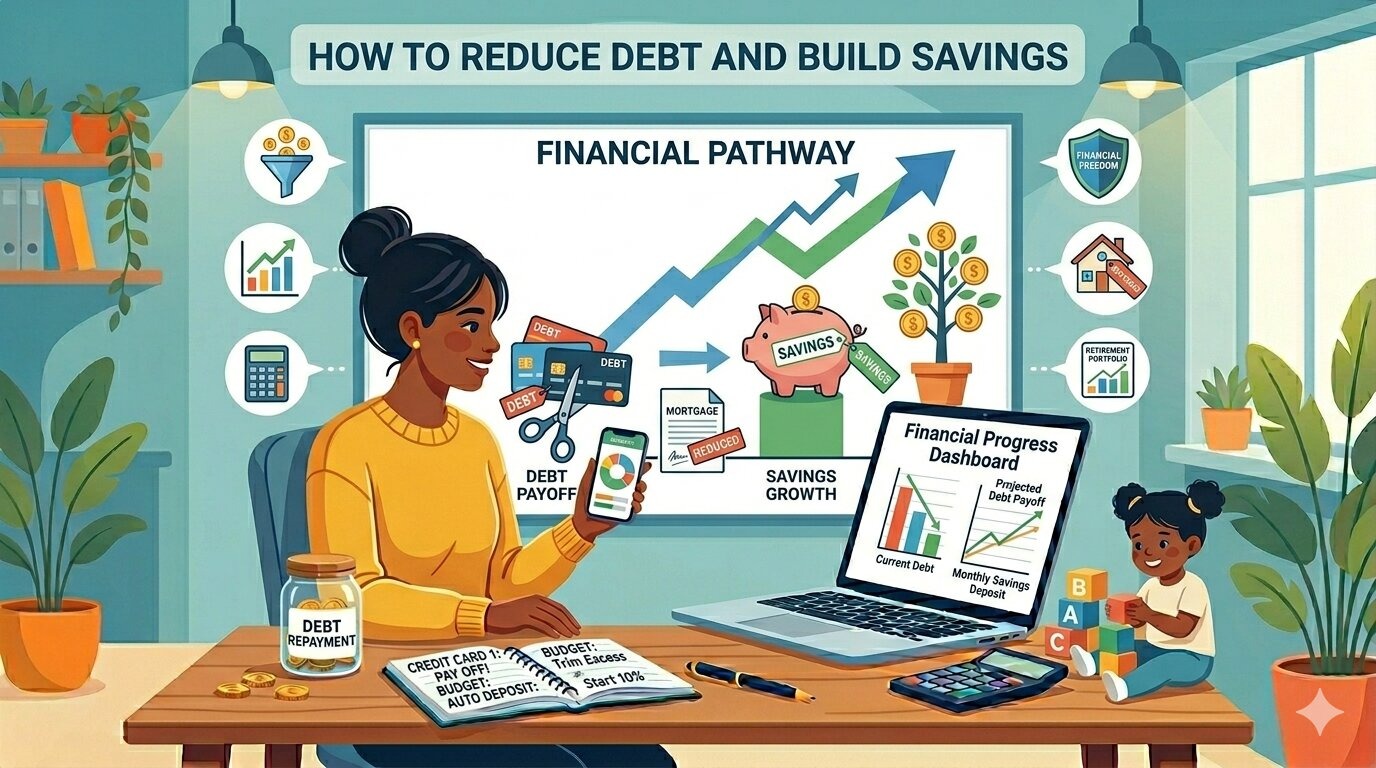
Debt and savings often feel like opposites.
When you’re in debt, saving money seems difficult. And when you focus on saving, debt feels like a constant burden in the background.
But the truth is—you don’t have to choose one over the other. With the right strategy, you can reduce debt and build savings at the same time.
Let’s break down how to do it in a practical and sustainable way.
Why Debt Feels Hard to Escape
Debt isn’t just a financial issue—it’s also psychological.
Common challenges include:
- High interest rates
- Minimum payments that barely reduce principal
- Constant financial stress
- Lack of a clear plan
For example:
If you only pay minimum dues on a credit card, most of your payment goes toward interest—not the actual debt.
That’s why a structured approach is essential.
If you’re struggling with overall money management, start with
Financial Planning for Beginners
https://statush.com/money/financial-planning-for-beginners
Step 1: Understand Your Total Debt
You can’t fix what you don’t fully understand.
List all your debts:
| Debt Type | Amount | Interest Rate | Minimum Payment |
|---|---|---|---|
| Credit Card | ₹50,000 | 36% | ₹3,000 |
| Personal Loan | ₹1,00,000 | 14% | ₹5,000 |
This gives you clarity on:
- Total debt
- High-interest obligations
- Monthly burden
Once everything is visible, it becomes easier to plan.
Step 2: Choose a Debt Repayment Strategy
There are two popular methods:
| Method | How It Works | Best For |
|---|---|---|
| Snowball Method | Pay smallest debt first | Motivation and quick wins |
| Avalanche Method | Pay highest interest first | Saving money on interest |
Example:
If your credit card has 36% interest, it should be prioritized in the avalanche method.
Choose the method that fits your mindset.
Step 3: Continue Saving (Even While Paying Debt)
One common mistake is stopping savings completely while paying off debt.
This creates risk.
If an emergency happens, you may fall back into debt.
Instead:
- Save a small fixed amount
- Build a basic emergency fund
If you’re starting from zero, read
How to Build an Emergency Fund from Zero
https://statush.com/money/how-to-build-an-emergency-fund-from-zero
Even ₹1,000–₹2,000/month can create a safety buffer.
Step 4: Cut Unnecessary Expenses
Reducing expenses frees up money for both debt repayment and savings.
Focus on:
- Dining out
- Subscriptions
- Impulse purchases
For example:
Cutting ₹3,000/month in unnecessary expenses can accelerate debt repayment significantly.
For more strategies, read
How to Reduce Monthly Expenses Quickly
https://statush.com/money/how-to-reduce-monthly-expenses-quickly
Step 5: Increase Your Payments Strategically
Paying only the minimum amount will keep you in debt for years.
Instead:
- Add extra payments whenever possible
- Use bonuses or extra income to reduce debt
Example:
- Minimum payment: ₹3,000
- Actual payment: ₹5,000
This reduces both interest and repayment time.
Step 6: Avoid Taking New Debt
This may sound obvious—but it’s one of the biggest challenges.
Avoid:
- Unnecessary loans
- Buy-now-pay-later schemes
- Impulse purchases on credit
Discipline is key here.
To strengthen this, read
How to Build Financial Discipline
https://statush.com/money/how-to-build-financial-discipline
Step 7: Track Your Progress Regularly
Tracking keeps you motivated.
Monitor:
- Debt reduced
- Savings increased
- Monthly progress
For example:
- Debt reduced by ₹10,000
- Savings increased by ₹5,000
Seeing progress encourages consistency.
To improve tracking, read
How to Track Your Spending Effectively
https://statush.com/money/how-to-track-your-spending-effectively
Step 8: Build a Long-Term Savings Plan
Once your debt reduces, shift focus toward savings and investments.
Start with:
- Emergency fund
- Short-term savings
- Long-term investments
If you want a broader strategy, read
How to Build a Financial Safety Net
https://statush.com/money/how-to-build-a-financial-safety-net
Real-Life Example: Balancing Debt and Savings
Karan has:
- ₹80,000 credit card debt
- ₹20,000 savings
His approach:
- Paid ₹6,000/month toward debt
- Saved ₹2,000/month
After 12 months:
- Cleared most of his debt
- Built ₹24,000 savings
He avoided falling back into debt because he maintained a savings buffer.
Common Mistakes to Avoid
While managing debt and savings, avoid these mistakes:
- Paying only minimum dues
- Ignoring savings completely
- Taking new debt
- Not tracking progress
Small mistakes can delay progress significantly.
Final Thoughts
Reducing debt and building savings isn’t about choosing one—it’s about balancing both.
When done right:
- You reduce financial stress
- You gain control over your money
- You build long-term stability
Start small. Stay consistent. Avoid shortcuts.
Because financial freedom isn’t built overnight—it’s built through steady, disciplined action.