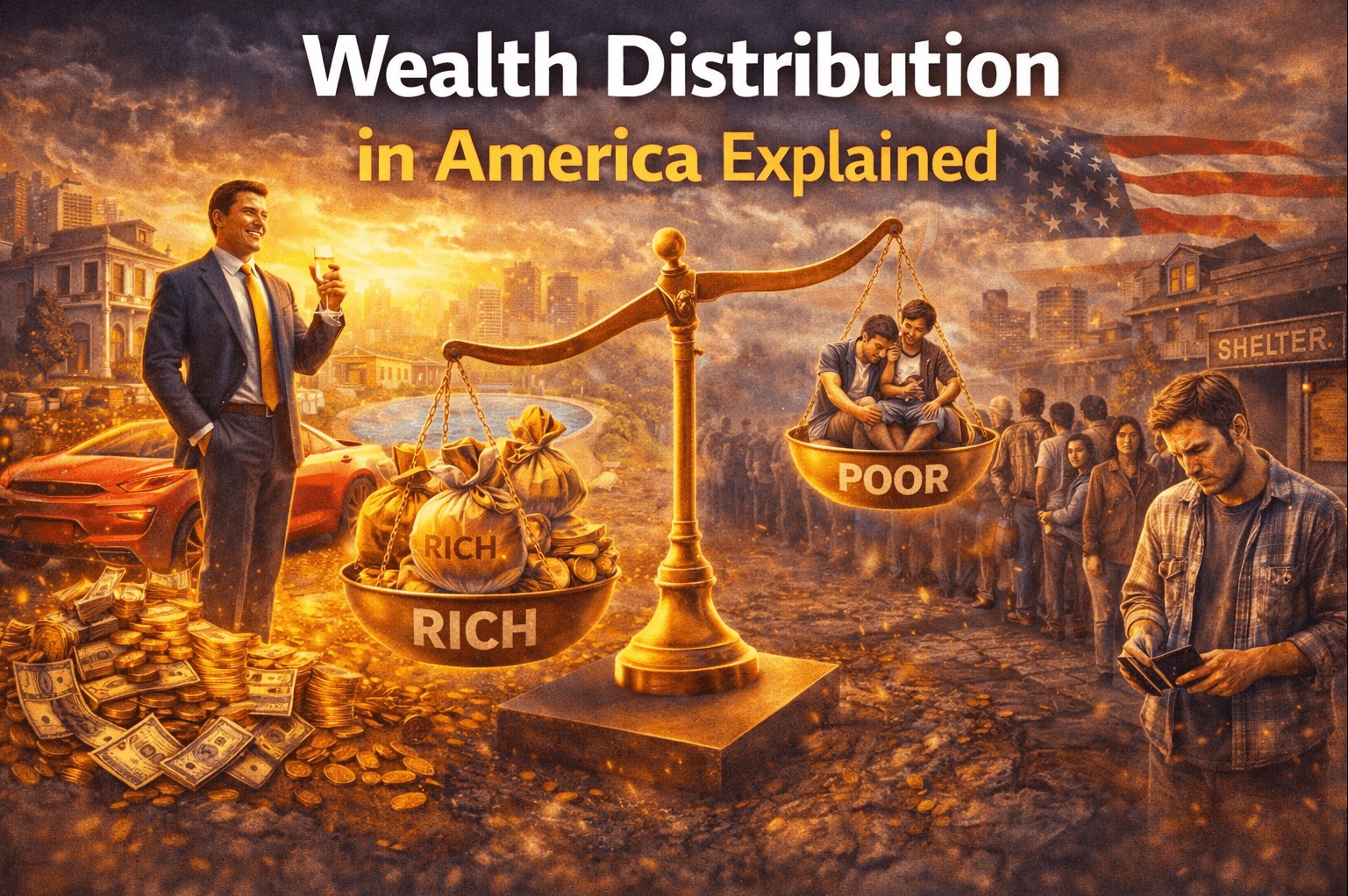
Wealth distribution is one of the most important—and often misunderstood—parts of the U.S. economy. While income tells you how much people earn, wealth shows what they actually own over time. And in America, wealth is not evenly spread.
Understanding how wealth is distributed helps explain differences in financial stability, opportunities, and long-term security across households. It also gives you a clearer perspective on where you stand and how wealth is built over time.
What Is Wealth Distribution?
Wealth distribution refers to how total assets are spread across individuals or households in a country.
Wealth includes:
- Cash and savings
- Investments (stocks, bonds)
- Real estate
- Retirement accounts
It does not just measure income—it reflects accumulated financial resources over time.
To understand how wealth is calculated:
Median Net Worth by Age in America – https://statush.com/finance-statistics/median-net-worth-by-age-in-america
Wealth vs Income: A Key Difference
Many people confuse wealth with income, but they are very different.
| Category | What It Represents | Why It Matters |
|---|---|---|
| Income | Money earned over time | Supports daily expenses |
| Wealth | Total assets minus liabilities | Determines long-term financial security |
A person can have a high income but low wealth if they spend most of what they earn. On the other hand, someone with moderate income but strong saving and investing habits can build significant wealth.
How Wealth Is Distributed in the USA
Wealth in the United States is unevenly distributed, with a large portion concentrated among higher-income households.
In general:
- A small percentage of households hold a large share of total wealth
- The majority of households hold a smaller share
- Wealth gaps have widened over time
This doesn’t mean wealth is fixed—but it does show that building wealth requires long-term strategy and consistency.
Wealth Distribution by Percentile
One of the most common ways to understand wealth distribution is by looking at percentiles.
| Group | Wealth Share Pattern | Explanation |
|---|---|---|
| Top 10% | Largest share of wealth | High-income earners, strong investments, asset ownership |
| Next 40% | Moderate share | Middle-class households with homes and retirement savings |
| Bottom 50% | Small share | Limited assets, higher debt levels |
This structure highlights how wealth becomes more concentrated at higher levels.
Real-World Example
Let’s compare two households:
Household A (Top 10%)
- Owns a home worth $600,000
- Has $300,000 in investments
- Minimal debt
Household B (Bottom 50%)
- Rents a home
- Has $5,000 in savings
- Carries credit card debt
Even if both households earn similar incomes, their wealth positions are very different due to asset ownership and long-term financial decisions.
Factors That Influence Wealth Distribution
Wealth distribution is shaped by multiple interconnected factors.
Income Levels
Higher income makes it easier to save and invest, but it doesn’t guarantee wealth without proper financial habits.
Asset Ownership
Owning assets like real estate and stocks is one of the biggest drivers of wealth.
Assets can:
- Increase in value over time
- Generate passive income
Debt Levels
High levels of debt reduce net worth and slow down wealth accumulation.
For example, credit card debt can significantly impact financial progress:
Credit Card Debt Statistics in the USA – https://statush.com/finance-statistics/credit-card-debt-statistics-in-the-usa
Access to Opportunities
Education, job opportunities, and financial literacy all play a role in shaping wealth outcomes.
Wealth Distribution by Age
Wealth tends to increase with age as people earn, save, and invest over time.
| Age Group | Wealth Trend | Explanation |
|---|---|---|
| Under 35 | Low or negative | Early career, student debt |
| 35–54 | Growing steadily | Increasing income and investments |
| 55–64 | Peak wealth | Maximum accumulation before retirement |
| 65+ | Stabilizes or declines | Retirement withdrawals |
This shows that wealth building is a long-term process.
The Role of Homeownership
Homeownership is one of the most important factors in wealth distribution.
Owning a home allows:
- Equity accumulation
- Property value appreciation
However, rising housing costs can make it harder for some households to enter the market.
To understand housing trends:
Housing Price Trends in the USA – https://statush.com/finance-statistics/housing-price-trends-in-the-usa
Wealth and Taxes
Taxes play a significant role in shaping wealth over time.
They affect:
- Income available for saving
- Investment returns
- Long-term financial growth
Understanding tax impact is essential for building wealth efficiently.
Learn more:
How Taxes Impact Wealth Building – https://statush.com/finance-statistics/how-taxes-impact-wealth-building
Why Wealth Inequality Exists
Wealth inequality exists due to a combination of factors:
- Differences in income and opportunities
- Unequal access to education and investments
- Long-term compounding advantages
- Generational wealth transfer
These factors create gaps that can persist over time.
Can Wealth Distribution Change?
Yes, wealth distribution is not fixed.
Individuals can improve their financial position through:
- Consistent saving and investing
- Reducing high-interest debt
- Building assets over time
While structural factors exist, personal financial decisions still play a major role.
Tools to Track and Build Wealth
Understanding your financial position is the first step toward improvement.
- Net Worth Calculator – https://statush.com/net-worth-calculator
- Savings Goal Calculator – https://statush.com/savings-goal-calculator
- Retirement Calculator – https://statush.com/retirement-calculator
These tools help you measure progress and plan for the future.
A Practical Perspective
Instead of focusing only on national statistics, it’s more useful to think about your own financial path.
Ask yourself:
- Am I building assets over time?
- Am I reducing debt?
- Am I improving my financial position year by year?
Wealth is built gradually, not instantly.
Final Thoughts
Wealth distribution in America highlights a key reality: financial outcomes vary widely, but they are influenced by both external factors and personal decisions.
The key takeaway is simple:
- Wealth is built over time, not earned overnight
- Asset ownership plays a major role
- Consistent financial habits matter more than starting point
When you understand how wealth distribution works, you gain a clearer perspective—not just on the economy, but on your own path toward financial growth.