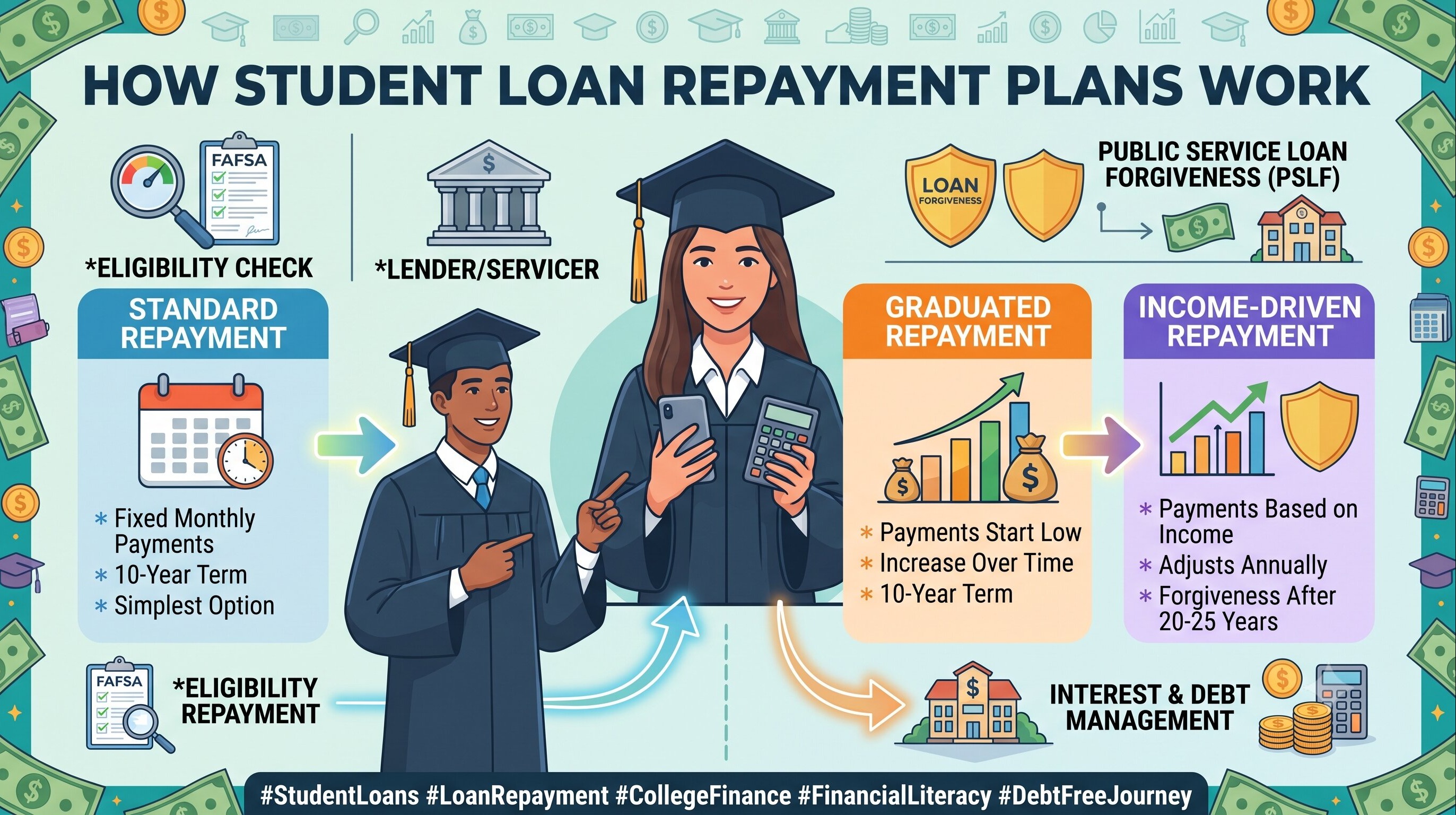
Graduating from college is an exciting milestone, but it also marks the beginning of another important responsibility for many students—repaying student loans. While borrowing money for education can open doors to better career opportunities, understanding your repayment options is essential for managing debt without putting unnecessary strain on your finances.
Fortunately, student loan repayment isn't one-size-fits-all. Federal student loans offer several repayment plans designed to fit different income levels and financial situations, while private lenders may provide their own repayment options.
This guide explains how student loan repayment plans work, the most common repayment options, and practical strategies to help you stay on track.
What Is a Student Loan Repayment Plan?
A student loan repayment plan determines:
- How much you'll pay each month
- How long it will take to repay your loan
- The total amount of interest you'll pay over time
Choosing the right repayment plan can make monthly payments more manageable while helping you achieve your long-term financial goals.
If you're new to student borrowing, start with How Student Loans Work in the USA:
https://statush.com/credit-score-debt/how-student-loans-work-in-the-usa
Student Loan Repayment Plans at a Glance
| Repayment Plan | Best For | Typical Repayment Period |
|---|---|---|
| Standard Repayment | Borrowers wanting to pay off loans quickly | 10 years |
| Graduated Repayment | Borrowers expecting income growth | Up to 10 years |
| Extended Repayment | Borrowers needing lower monthly payments | Up to 25 years |
| Income-Driven Repayment | Borrowers with lower income | 20–25 years |
| Private Loan Repayment | Depends on lender | Varies |
Each plan offers different advantages depending on your financial circumstances.
When Does Repayment Begin?
Most federal student loans include a grace period after you graduate, leave school, or drop below half-time enrollment.
This grace period gives borrowers time to:
- Find employment
- Organize finances
- Prepare for monthly payments
Private lenders may have different rules, so it's important to review your loan agreement carefully.
Standard Repayment Plan
The Standard Repayment Plan is the default option for many federal borrowers.
Features include:
- Fixed monthly payments
- Predictable repayment schedule
- Loan paid off in approximately 10 years
Because the repayment period is shorter, borrowers generally pay less total interest than with longer repayment plans.
Real-World Example
Sophia graduates with $30,000 in federal student loans and starts a full-time job shortly after college.
She chooses the Standard Repayment Plan because her salary allows her to comfortably make fixed monthly payments. By staying on schedule, she pays off the loan in about 10 years while minimizing interest costs.
Graduated Repayment Plan
Under this plan, monthly payments begin lower and gradually increase over time.
This option may work well for borrowers who expect their income to grow as their careers progress.
Advantages include:
- Lower payments early in repayment
- Gradually increasing payments
- Predictable payment schedule
However, because payments start lower, borrowers often pay more interest over the life of the loan.
Extended Repayment Plan
Borrowers with larger loan balances may qualify for an Extended Repayment Plan.
Features include:
- Longer repayment period
- Lower monthly payments
- More flexibility in monthly budgeting
The trade-off is that extending repayment usually increases the total amount of interest paid.
Income-Driven Repayment Plans
Income-driven repayment (IDR) plans adjust monthly payments based on factors such as:
- Income
- Family size
- Eligible loan balance
These plans are designed to help borrowers whose standard monthly payments would be difficult to afford.
Benefits include:
- Affordable monthly payments
- Flexibility during lower-income periods
- Potential eligibility for loan forgiveness after meeting program requirements
Learn more in Student Loan Forgiveness Programs Explained:
https://statush.com/credit-score-debt/student-loan-forgiveness-programs-explained
Private Student Loan Repayment
Private lenders set their own repayment terms.
Depending on the lender, you may have options such as:
- Fixed monthly payments
- Interest-only payments while in school
- Deferred repayment
- Various repayment terms
Unlike federal loans, repayment flexibility varies significantly between lenders.
Before borrowing, compare several lenders to understand their repayment policies.
Read Federal vs Private Student Loans:
https://statush.com/credit-score-debt/federal-vs-private-student-loans
How Interest Affects Repayment
Every repayment plan has one thing in common—interest.
The longer it takes to repay your loan, the more interest you'll usually pay overall.
For example:
- A shorter repayment period generally means higher monthly payments but lower total interest.
- A longer repayment period reduces monthly payments but increases the total borrowing cost.
Understanding this trade-off helps borrowers choose a repayment plan that balances affordability and long-term savings.
For more information, read How Interest Works on Loans:
https://statush.com/credit-score-debt/how-interest-works-on-loans
Can You Change Repayment Plans?
In many cases, federal borrowers can switch repayment plans if their financial situation changes.
For example:
- A borrower who loses a job may move to an income-driven repayment plan.
- Someone receiving a significant salary increase may switch to the Standard Plan to pay off debt faster.
Private loan flexibility depends on the lender, so available options may be more limited.
Practical Tips for Successful Repayment
Managing student loans becomes much easier with a solid plan.
Here are a few practical tips:
- Set up automatic payments to avoid missed due dates.
- Pay more than the minimum whenever possible.
- Keep track of your remaining loan balance.
- Review your repayment plan annually.
- Build an emergency fund to avoid missing payments during unexpected situations.
- Contact your loan servicer if you're experiencing financial hardship.
Even small extra payments can reduce both your repayment period and total interest costs.
Common Mistakes to Avoid
Many borrowers make repayment mistakes that increase their debt unnecessarily.
Avoid these common errors:
- Missing payment deadlines
- Ignoring communication from your loan servicer
- Choosing a repayment plan without comparing alternatives
- Borrowing more than needed during school
- Paying only the minimum when you can afford extra payments
- Forgetting to update your repayment plan after major income changes
Staying informed can save both money and stress over the life of your loan.
Should You Pay Off Student Loans Early?
If your budget allows, paying extra toward your student loans can reduce total interest and help you become debt-free sooner.
However, before making additional payments, consider:
- Your emergency savings
- High-interest debt, such as credit cards
- Retirement contributions
- Other financial goals
The right strategy depends on your overall financial picture.
Final Thoughts
Student loan repayment plans are designed to provide flexibility for borrowers with different financial situations. Whether you choose a Standard, Graduated, Extended, or Income-Driven Repayment Plan, understanding how each option works can help you make smarter financial decisions.
The best repayment plan is one that fits comfortably within your budget while helping you minimize interest over time. Review your options regularly, make payments consistently, and don't hesitate to explore alternative repayment plans if your financial circumstances change.
Learning about repayment strategies today can make managing student debt much easier for years to come.
Related Articles
- How Student Loans Work in the USA
https://statush.com/credit-score-debt/how-student-loans-work-in-the-usa - Federal vs Private Student Loans
https://statush.com/credit-score-debt/federal-vs-private-student-loans - Student Loan Forgiveness Programs Explained
https://statush.com/credit-score-debt/student-loan-forgiveness-programs-explained - How to Consolidate Student Loans
https://statush.com/credit-score-debt/how-to-consolidate-student-loans - Loan Repayment Strategies
https://statush.com/credit-score-debt/loan-repayment-strategies