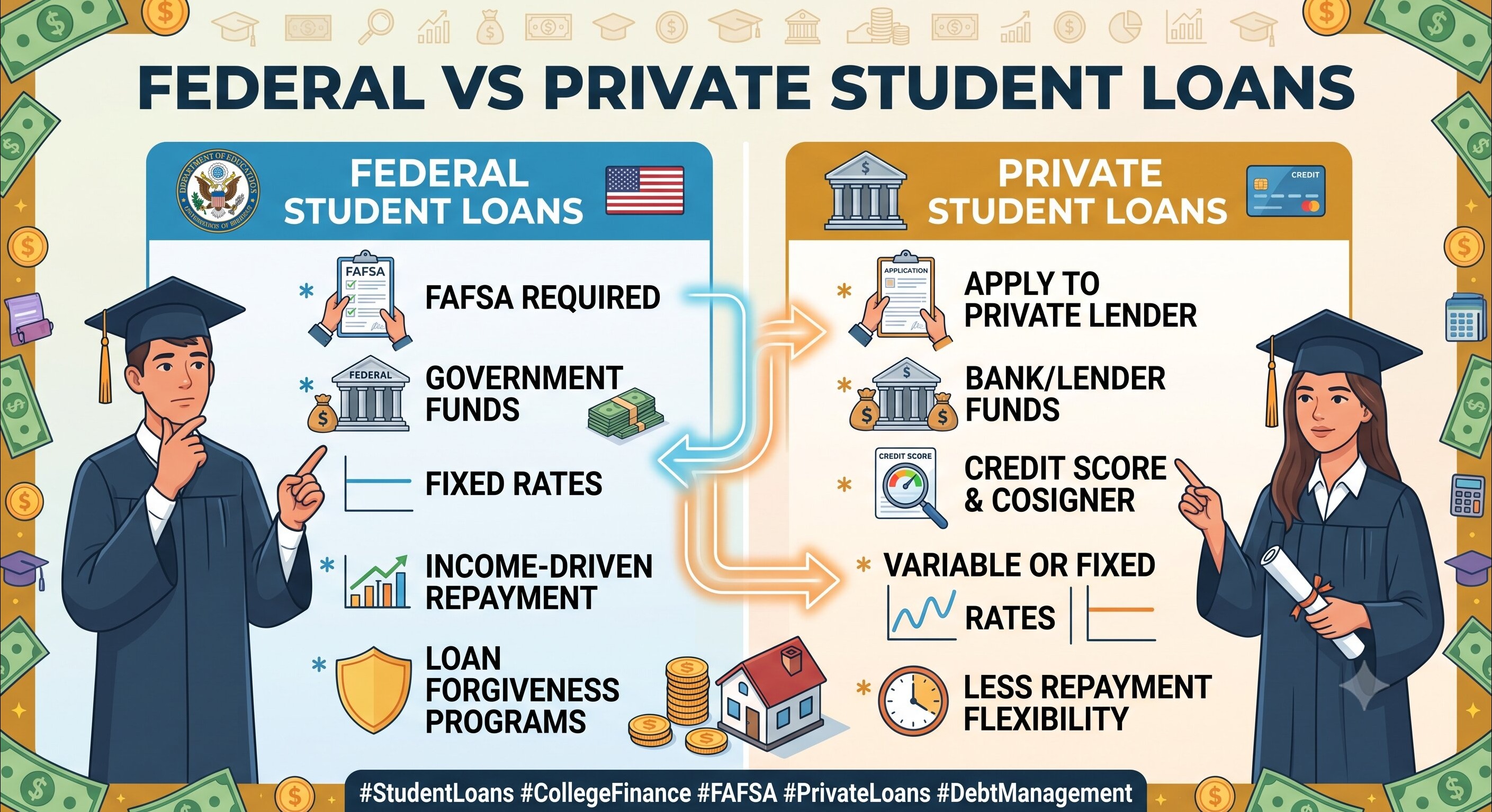
Paying for college is a significant financial commitment, and for many students, loans make higher education possible. Once you've decided to borrow money for school, one of the first choices you'll face is whether to use federal student loans or private student loans.
While both types of loans help cover education expenses, they differ in eligibility requirements, interest rates, repayment flexibility, borrower protections, and forgiveness opportunities. Understanding these differences can help you make smarter borrowing decisions and potentially save thousands of dollars over the life of your loan.
In this guide, we'll compare federal and private student loans in simple terms, explain when each option makes sense, and share practical tips to help you borrow responsibly.
What Are Federal Student Loans?
Federal student loans are funded by the U.S. government and are generally considered the first borrowing option for most students.
These loans are designed to make higher education more affordable and typically include borrower-friendly benefits that private lenders don't offer.
Common advantages include:
- Fixed interest rates
- Flexible repayment plans
- Income-driven repayment options
- Deferment and forbearance programs
- Potential loan forgiveness opportunities
Most students begin by applying for federal financial aid before considering private loans.
For a complete introduction, read How Student Loans Work in the USA:
https://statush.com/credit-score-debt/how-student-loans-work-in-the-usa
What Are Private Student Loans?
Private student loans are offered by financial institutions such as:
- Banks
- Credit unions
- Online lenders
Unlike federal loans, private lenders determine approval based on factors like:
- Credit history
- Income
- Employment
- Cosigner qualifications
Private loans can help fill funding gaps after scholarships, grants, and federal loans have been exhausted.
Federal vs Private Student Loans at a Glance
| Feature | Federal Student Loans | Private Student Loans |
|---|---|---|
| Loan Provider | U.S. Government | Banks, credit unions, online lenders |
| Credit Check | Often not required | Usually required |
| Interest Rate | Fixed | Fixed or variable |
| Repayment Options | Flexible | Depends on lender |
| Loan Forgiveness | Available for some programs | Rarely available |
| Income-Driven Plans | Yes | Usually not available |
This comparison shows why financial experts often recommend federal loans first whenever possible.
Real-World Example
Imagine two students, Olivia and Ethan, each need to borrow $20,000 for college.
Olivia qualifies for federal student loans. She receives a fixed interest rate, several repayment plan options, and the possibility of income-driven repayment after graduation if needed.
Ethan chooses a private student loan because he needs additional funding beyond federal limits. His approval depends on his family's credit profile, and a relative agrees to cosign the loan. While he secures the funds he needs, his repayment flexibility is more limited.
Both students achieve their educational goals, but the long-term repayment experience is quite different.
Advantages of Federal Student Loans
Federal loans offer several important benefits.
Easier Qualification
Many undergraduate federal loans don't require a credit check, making them accessible to first-time borrowers.
Fixed Interest Rates
Federal student loans generally have fixed interest rates, providing predictable monthly payments throughout repayment.
Flexible Repayment Plans
Borrowers may qualify for repayment plans based on their income, helping make monthly payments more manageable during financial hardship.
Learn more in How Student Loan Repayment Plans Work:
https://statush.com/credit-score-debt/how-student-loan-repayment-plans-work
Loan Forgiveness Opportunities
Some federal borrowers may qualify for forgiveness programs after meeting specific employment or repayment requirements.
Read more in Student Loan Forgiveness Programs Explained:
https://statush.com/credit-score-debt/student-loan-forgiveness-programs-explained
Advantages of Private Student Loans
Private loans also have benefits in certain situations.
Higher Borrowing Limits
Students with education costs beyond federal loan limits may use private loans to bridge the gap.
Competitive Rates for Excellent Credit
Borrowers with strong credit—or qualified cosigners—may receive attractive interest rates from some lenders.
Flexible Loan Options
Many private lenders offer different repayment terms, allowing borrowers to select a payment schedule that fits their budget.
Disadvantages of Federal Student Loans
Although federal loans are often the preferred choice, they have some limitations.
- Annual borrowing limits
- Lifetime borrowing caps
- Application deadlines
- Not every student qualifies for every federal program
Students attending expensive schools may still need additional funding.
Disadvantages of Private Student Loans
Private student loans typically involve more risk.
Common drawbacks include:
- Credit-based approval
- Possible need for a cosigner
- Fewer repayment protections
- Limited hardship assistance
- Usually no loan forgiveness programs
- Variable interest rates from some lenders
These differences make it important to compare offers carefully before borrowing.
How to Decide Which Loan Is Right for You
For most students, a smart borrowing strategy looks like this:
- Apply for scholarships and grants.
- Accept federal student loans first.
- Borrow private loans only if additional funding is necessary.
- Compare several private lenders before making a decision.
This approach usually helps reduce borrowing costs while preserving valuable repayment protections.
Practical Tips Before Borrowing
Whether you choose federal or private loans, follow these best practices.
- Borrow only what you truly need.
- Estimate your future monthly payments.
- Compare total repayment costs, not just interest rates.
- Understand whether your loan has a fixed or variable rate.
- Keep track of your total student debt each year.
- Read every loan agreement carefully before signing.
Responsible borrowing during college can make repayment much easier after graduation.
Common Mistakes to Avoid
Many students unintentionally increase their debt by making avoidable mistakes.
Try to avoid:
- Borrowing the maximum amount available every year
- Choosing private loans before exploring federal aid
- Ignoring interest rates
- Not understanding repayment options
- Forgetting to compare multiple lenders
- Assuming every lender offers the same terms
Making informed borrowing decisions today can reduce financial stress for years to come.
What Happens After Graduation?
Once you graduate or leave school, repayment begins according to your loan agreement.
Federal borrowers may have access to:
- Standard repayment plans
- Graduated repayment
- Extended repayment
- Income-driven repayment
Private loan repayment depends entirely on the lender's terms and conditions.
Understanding your repayment options early helps you prepare your post-graduation budget.
Final Thoughts
Federal and private student loans both play an important role in helping students finance higher education, but they serve different purposes. Federal student loans generally provide stronger borrower protections, flexible repayment options, and potential forgiveness programs, making them the preferred choice for most students.
Private student loans can still be valuable when additional funding is needed, especially for borrowers with strong credit or qualified cosigners. However, they should usually be considered only after maximizing scholarships, grants, and federal financial aid.
Before signing any loan agreement, compare your options carefully, estimate your future payments, and borrow only what you truly need. Making thoughtful decisions now can make repaying your education much easier in the future.
Related Articles
- How Student Loans Work in the USA
https://statush.com/credit-score-debt/how-student-loans-work-in-the-usa - How Student Loan Repayment Plans Work
https://statush.com/credit-score-debt/how-student-loan-repayment-plans-work - Student Loan Forgiveness Programs Explained
https://statush.com/credit-score-debt/student-loan-forgiveness-programs-explained - How to Consolidate Student Loans
https://statush.com/credit-score-debt/how-to-consolidate-student-loans - How Interest Works on Loans
https://statush.com/credit-score-debt/how-interest-works-on-loans