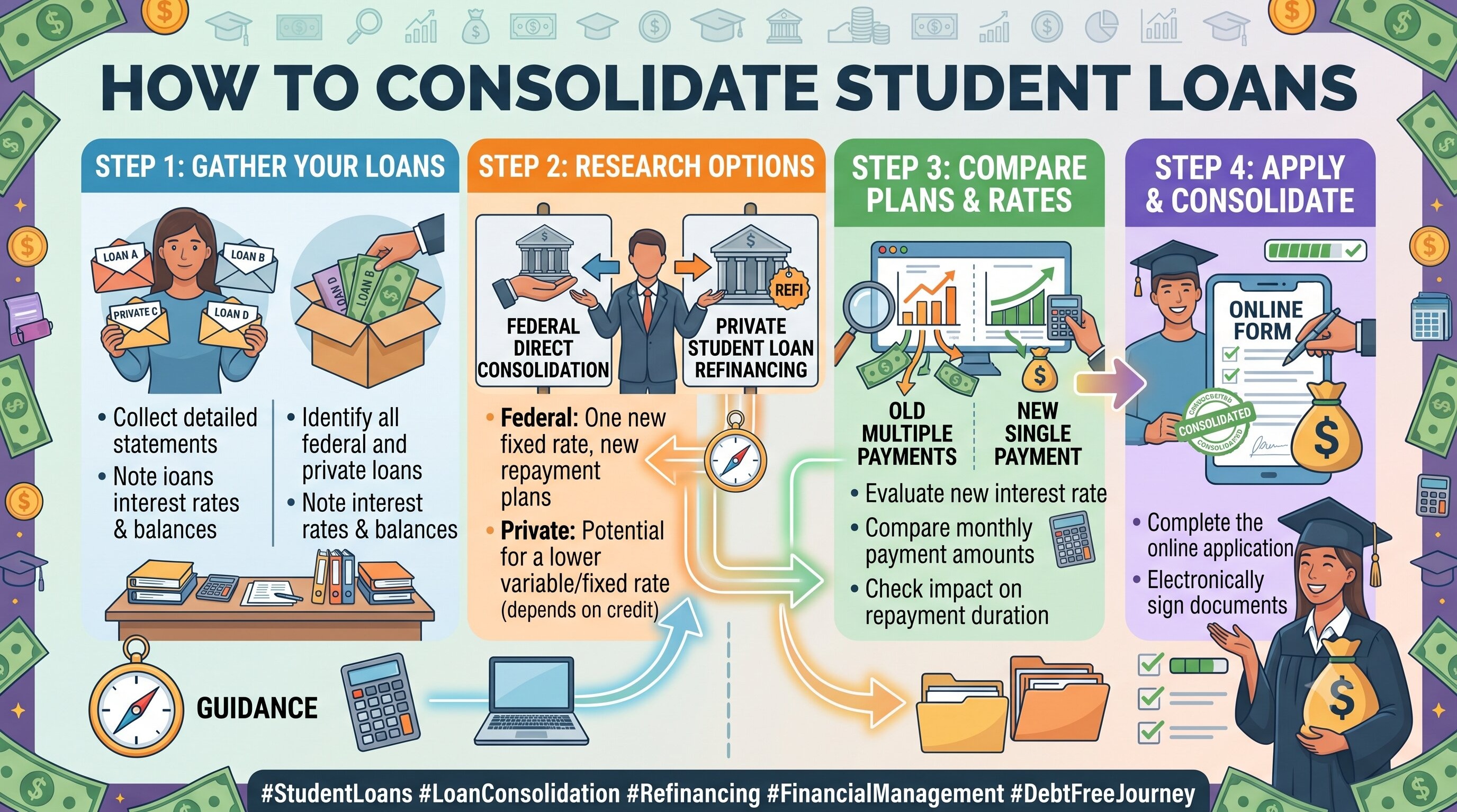
Managing multiple student loans can become overwhelming, especially if they have different lenders, interest rates, monthly payment amounts, and due dates. Keeping track of several payments each month increases the risk of missing a payment, which can hurt your credit score and add unnecessary stress.
That's why many borrowers consider student loan consolidation. Consolidating your loans can simplify repayment by combining multiple loans into one new loan with a single monthly payment. However, consolidation isn't always the best choice for everyone.
In this guide, you'll learn how student loan consolidation works, its benefits and drawbacks, when it makes sense, and practical tips to help you decide whether it's the right option for your financial situation.
What Is Student Loan Consolidation?
Student loan consolidation is the process of combining multiple student loans into a single new loan.
Instead of making payments to several lenders or loan servicers, you'll make one monthly payment on the consolidated loan.
Depending on your situation, consolidation may:
- Simplify repayment
- Extend your repayment period
- Lower your monthly payment
- Change your interest rate calculation
- Make certain federal repayment programs available
It's important to understand that consolidation simplifies repayment—it doesn't automatically reduce the total amount you owe.
Student Loan Consolidation at a Glance
| Feature | Simple Explanation |
|---|---|
| Purpose | Combine multiple student loans into one loan |
| Monthly Payments | One payment instead of several |
| Interest Rate | Based on existing loan rates (federal consolidation) or lender offer (private refinancing) |
| Best For | Borrowers managing multiple loans |
| Potential Benefit | Easier budgeting and repayment |
| Possible Drawback | Longer repayment may increase total interest |
Understanding these basics helps borrowers determine whether consolidation aligns with their financial goals.
Federal Loan Consolidation vs Private Loan Refinancing
Many people use the terms consolidation and refinancing interchangeably, but they are different.
Federal Student Loan Consolidation
Federal Direct Consolidation allows eligible federal student loans to be combined into one federal loan.
Benefits include:
- One monthly payment
- Access to certain federal repayment plans
- Continued eligibility for some federal borrower protections
- Simplified loan management
The interest rate is generally calculated as a weighted average of your existing federal loan rates and rounded up slightly.
Private Student Loan Refinancing
Private refinancing replaces one or more student loans with a new private loan.
Borrowers may refinance:
- Federal loans
- Private loans
- Both together (depending on the lender)
The new interest rate depends on factors such as:
- Credit score
- Income
- Employment history
- Debt-to-income ratio
Refinancing may lower your interest rate, but refinancing federal loans into a private loan usually means giving up valuable federal protections.
For a complete comparison, read Federal vs Private Student Loans:
https://statush.com/credit-score-debt/federal-vs-private-student-loans
Real-World Example
James graduated with six separate federal student loans from different semesters.
Each month, he had to remember multiple due dates and track several loan balances.
After consolidating his federal loans, James now makes one monthly payment through a single loan servicer. His finances are easier to manage, and he no longer worries about keeping track of multiple payment schedules.
Although his repayment became simpler, he also understood that consolidation didn't reduce the amount he originally borrowed.
Benefits of Student Loan Consolidation
Consolidation offers several advantages.
Simplifies Repayment
One payment is much easier to manage than several payments with different due dates.
Easier Budgeting
Knowing exactly how much you'll pay each month helps with long-term financial planning.
Access to Federal Repayment Options
Some borrowers become eligible for additional federal repayment plans after consolidating qualifying federal loans.
Learn more in How Student Loan Repayment Plans Work:
https://statush.com/credit-score-debt/how-student-loan-repayment-plans-work
Reduced Risk of Missed Payments
Fewer payments mean fewer opportunities to accidentally miss a due date.
Potential Drawbacks
Consolidation isn't always the best financial move.
Some disadvantages include:
- Longer repayment periods
- Higher total interest over time
- Loss of certain borrower benefits attached to original loans
- Private refinancing may eliminate federal loan protections
Before consolidating, compare both your monthly savings and your total repayment cost.
Who Should Consider Consolidation?
Consolidation may make sense if you:
- Have multiple student loans
- Want one monthly payment
- Struggle to manage several due dates
- Need access to certain federal repayment options
- Prefer simpler financial organization
It may be less beneficial if your existing loans already have very low interest rates and manageable repayment terms.
When Refinancing Might Be Better
Private refinancing may be worth considering if you:
- Have excellent credit
- Have a stable income
- Qualify for significantly lower interest rates
- Don't need federal borrower protections
A lower interest rate can reduce both monthly payments and the total interest paid over the life of the loan.
However, carefully compare all benefits before replacing federal loans with private loans.
Practical Tips Before Consolidating
Before making a decision, consider these practical tips.
- Review every existing loan balance.
- Compare repayment plans carefully.
- Calculate total interest over the life of the loan.
- Understand whether you're consolidating or refinancing.
- Consider future eligibility for federal forgiveness programs.
- Read every loan agreement before signing.
Taking time to compare your options can prevent costly mistakes.
Common Mistakes to Avoid
Many borrowers misunderstand how consolidation works.
Avoid these common mistakes:
- Assuming consolidation lowers your loan balance
- Focusing only on monthly payments
- Ignoring total interest costs
- Refinancing federal loans without understanding the consequences
- Not comparing multiple refinancing offers
- Consolidating without reviewing current repayment benefits
Making an informed decision helps you avoid unexpected surprises later.
Can Consolidation Help With Loan Forgiveness?
For some federal borrowers, consolidation may help them qualify for certain repayment plans or forgiveness programs.
However, eligibility depends on the specific program and the types of loans involved.
Before consolidating, review how it could affect your eligibility.
Read Student Loan Forgiveness Programs Explained:
https://statush.com/credit-score-debt/student-loan-forgiveness-programs-explained
Is Consolidation Right for You?
Student loan consolidation is primarily about simplifying repayment—not eliminating debt.
If you're juggling several loans and want a more organized repayment schedule, consolidation can make managing your finances much easier.
On the other hand, if your goal is simply lowering interest costs, refinancing or making extra payments may be more effective, depending on your financial situation.
Evaluate your current loans, future goals, and repayment strategy before making a final decision.
Final Thoughts
Student loan consolidation can make repayment simpler by combining multiple loans into one manageable monthly payment. For many borrowers, this added convenience reduces financial stress and makes budgeting easier.
However, consolidation isn't a one-size-fits-all solution. Before moving forward, compare repayment plans, understand how your interest rate will be calculated, and carefully consider any borrower protections you may gain or lose. A thoughtful decision today can help you manage your student debt more effectively for years to come.
Related Articles
- How Student Loans Work in the USA
https://statush.com/credit-score-debt/how-student-loans-work-in-the-usa - Federal vs Private Student Loans
https://statush.com/credit-score-debt/federal-vs-private-student-loans - How Student Loan Repayment Plans Work
https://statush.com/credit-score-debt/how-student-loan-repayment-plans-work - Student Loan Forgiveness Programs Explained
https://statush.com/credit-score-debt/student-loan-forgiveness-programs-explained - Loan Repayment Strategies
https://statush.com/credit-score-debt/loan-repayment-strategies - Best Strategies to Manage Multiple Loans
https://statush.com/credit-score-debt/best-strategies-to-manage-multiple-loans