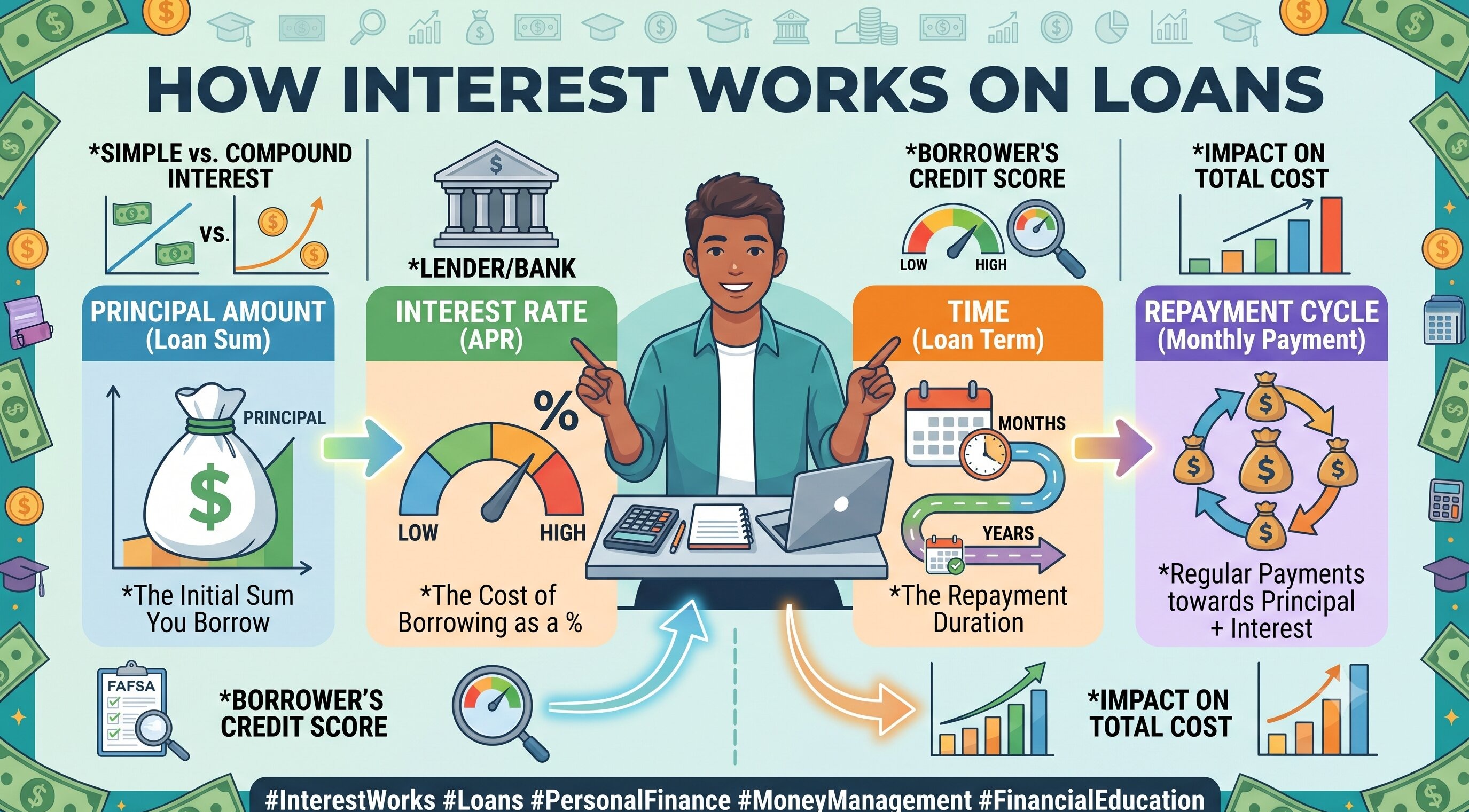
When you borrow money, you don't just repay the amount you borrowed—you also pay interest. Interest is the price of borrowing money, and it's one of the most important factors that determines how much a loan will actually cost.
Many borrowers focus only on the monthly payment, but understanding how interest works can help you compare loan offers, reduce borrowing costs, and pay off debt more efficiently. Even a small difference in interest rates can save—or cost—you thousands of dollars over the life of a loan.
In this guide, you'll learn how loan interest works, how it's calculated, the different types of interest rates, and practical ways to reduce the amount you pay.
What Is Loan Interest?
Loan interest is the fee a lender charges for allowing you to borrow money.
When you take out a loan, the lender expects two things back:
- The principal (the amount you borrowed)
- The interest (the cost of borrowing)
The interest you pay depends on several factors, including the loan amount, interest rate, and repayment period.
Loan Interest at a Glance
| Term | Simple Explanation |
|---|---|
| Principal | The amount you borrow |
| Interest | The cost of borrowing money |
| Interest Rate | The percentage charged on the loan |
| Monthly Payment | Amount paid each month toward principal and interest |
| Loan Term | How long you have to repay the loan |
| Total Cost | Principal plus all interest and fees |
Understanding these terms makes it much easier to compare different loan offers.
How Does Loan Interest Work?
Most loans charge interest based on your remaining loan balance.
Each monthly payment usually includes two parts:
- A payment toward the principal
- A payment toward interest
At the beginning of many loans, a larger portion of your payment goes toward interest. As your balance decreases, more of each payment goes toward reducing the principal.
This process is called amortization.
Learn more in Loan Amortization Explained:
https://statush.com/credit-score-debt/loan-amortization-explained
Real-World Example
Imagine you borrow $15,000 to finance a home improvement project.
The lender charges a fixed interest rate, and you agree to repay the loan over five years.
Each month:
- Part of your payment reduces the loan balance.
- Part covers the interest charged by the lender.
As the balance becomes smaller, the amount of interest charged each month also decreases.
By the final payment, most of your monthly payment goes toward paying off the remaining principal.
What Determines Your Interest Rate?
Lenders consider several factors before setting your interest rate.
These often include:
- Credit score
- Credit history
- Income
- Employment stability
- Debt-to-income ratio
- Loan amount
- Loan term
- Type of loan
- Whether the loan is secured or unsecured
Borrowers with stronger financial profiles generally qualify for lower interest rates.
Read:
How Credit History Impacts Loan Approval
https://statush.com/credit-score-debt/how-credit-history-impacts-loan-approval
Fixed vs Variable Interest
There are two main types of interest rates.
Fixed Interest Rate
A fixed rate remains the same throughout the loan.
Benefits include:
- Predictable monthly payments
- Easier budgeting
- Protection if market interest rates increase
Variable Interest Rate
A variable rate can change over time based on market conditions.
Advantages may include:
- Lower starting rates
- Possible savings if rates fall
However, monthly payments can increase if interest rates rise.
Learn more in Fixed vs Variable Interest Rates:
https://statush.com/credit-score-debt/fixed-vs-variable-interest-rates
Why Loan Term Matters
Many borrowers assume the lowest monthly payment is always the best option.
In reality, a longer repayment period usually means paying more interest overall.
For example:
- A 3-year loan often has higher monthly payments but lower total interest.
- A 7-year loan reduces monthly payments but increases the total borrowing cost.
Choosing the right balance between affordability and total cost is important.
Simple Interest vs Compound Interest
Most installment loans use simple interest, meaning interest is calculated on the remaining loan balance.
Compound interest works differently because interest is charged on both the principal and previously accumulated interest.
While compound interest is more common with savings accounts and some credit products, understanding the difference helps borrowers compare financial products more effectively.
How Interest Affects Different Loans
Interest works differently depending on the type of loan.
Personal Loans
Usually have fixed interest rates and predictable monthly payments.
Learn more in:
How Personal Loans Work
https://statush.com/credit-score-debt/how-personal-loans-work
Student Loans
Federal and private student loans may have different interest structures depending on the loan program.
Read:
How Student Loans Work in the USA
https://statush.com/credit-score-debt/how-student-loans-work-in-the-usa
Auto Loans
Interest depends on factors such as credit score, loan term, and vehicle value.
Read:
How Car Loans Work
https://statush.com/credit-score-debt/how-car-loans-work
Mortgages
Mortgage interest significantly affects the total cost of buying a home because repayment often lasts 15 to 30 years.
Even a small rate difference can change the total amount paid over decades.
Practical Tips to Pay Less Interest
Reducing interest costs doesn't always require a lower interest rate.
Here are several practical strategies:
- Improve your credit score before applying.
- Compare offers from multiple lenders.
- Choose the shortest affordable repayment term.
- Make extra payments whenever possible.
- Refinance if significantly lower rates become available.
- Avoid missing payment deadlines.
Small improvements today can lead to substantial savings over the life of your loan.
Common Mistakes to Avoid
Many borrowers unintentionally increase their borrowing costs.
Avoid these common mistakes:
- Looking only at the monthly payment.
- Ignoring the Annual Percentage Rate (APR).
- Choosing the longest repayment term without comparing total costs.
- Missing payments and paying late fees.
- Borrowing more than necessary.
- Accepting the first loan offer without shopping around.
Understanding interest helps you make smarter financial decisions.
Can You Reduce Interest After Getting a Loan?
Yes, in many cases.
Depending on your situation, you may be able to:
- Make extra principal payments.
- Refinance at a lower interest rate.
- Pay off the loan early if there are no prepayment penalties.
- Improve your credit before refinancing.
Learn more in:
- How to Refinance a Loan
https://statush.com/credit-score-debt/how-to-refinance-a-loan - What Is Loan Prepayment?
https://statush.com/credit-score-debt/what-is-loan-prepayment - Best Strategies to Reduce Loan Interest
https://statush.com/credit-score-debt/best-strategies-to-reduce-loan-interest
Final Thoughts
Interest is one of the biggest factors affecting the total cost of any loan. While it may seem like a small percentage, it can add thousands of dollars to the amount you repay over time.
Before borrowing, compare interest rates, understand the loan term, and calculate the total repayment cost—not just the monthly payment. Borrow only what you need, make payments on time, and look for opportunities to reduce interest through refinancing or extra payments.
The more you understand how interest works, the more confident you'll be when comparing loans and making financial decisions that support your long-term goals.
Related Articles
- Loan Amortization Explained
https://statush.com/credit-score-debt/loan-amortization-explained - Fixed vs Variable Interest Rates
https://statush.com/credit-score-debt/fixed-vs-variable-interest-rates - How to Calculate Loan Payments
https://statush.com/credit-score-debt/how-to-calculate-loan-payments - Best Strategies to Reduce Loan Interest
https://statush.com/credit-score-debt/best-strategies-to-reduce-loan-interest - How to Refinance a Loan
https://statush.com/credit-score-debt/how-to-refinance-a-loan - Loan Repayment Strategies
https://statush.com/credit-score-debt/loan-repayment-strategies