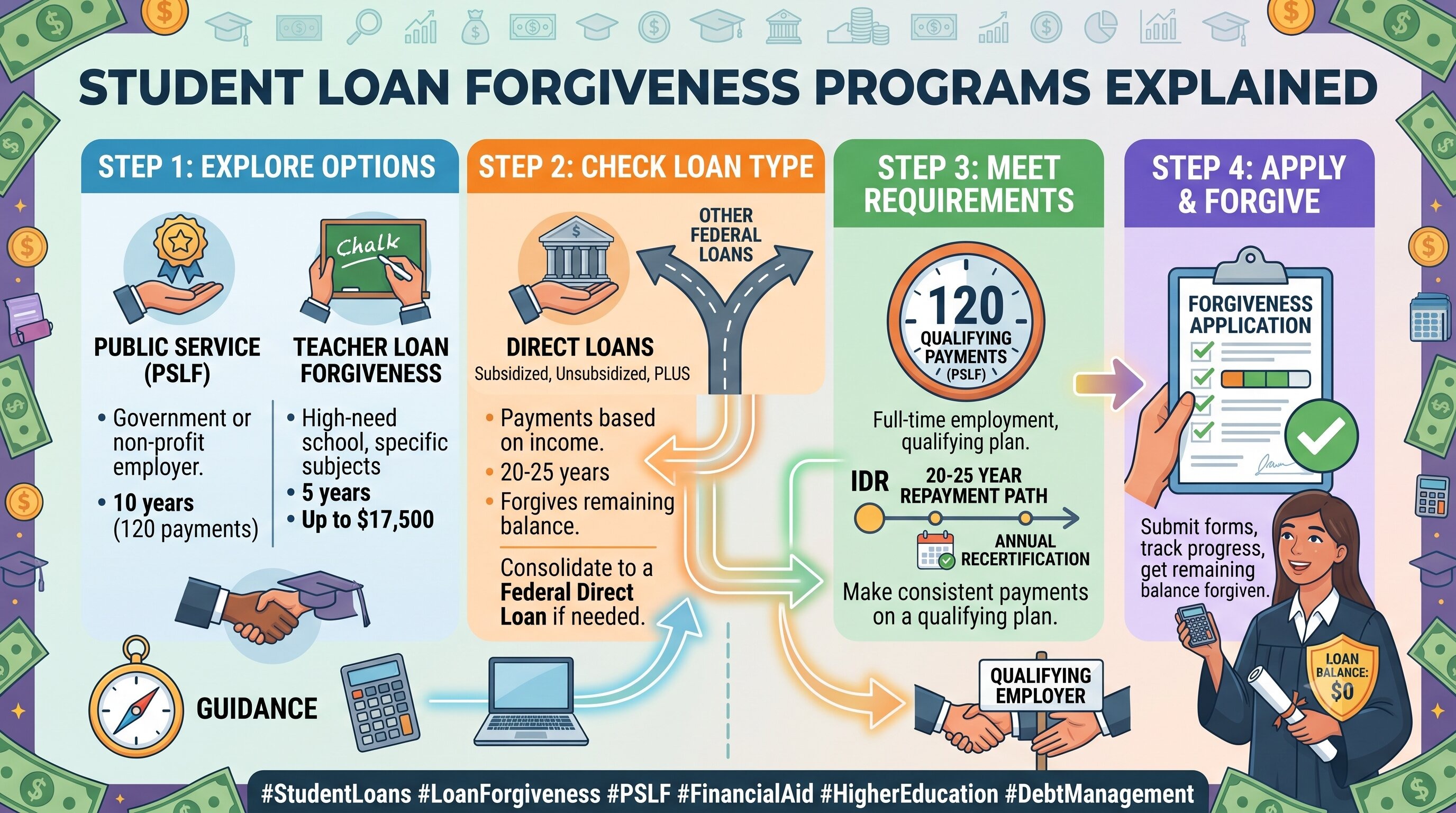
For many graduates, student loans are one of the largest financial commitments they'll ever make. While most borrowers are expected to repay their loans in full, some may qualify for student loan forgiveness programs that eliminate part—or sometimes all—of their remaining loan balance after meeting specific requirements.
Loan forgiveness can be a valuable benefit for eligible borrowers, especially those working in public service, education, healthcare, or nonprofit organizations. However, these programs have strict eligibility rules, and not every borrower or loan qualifies.
This guide explains how student loan forgiveness works, the most common forgiveness programs, who may qualify, and practical tips to help you stay on track.
What Is Student Loan Forgiveness?
Student loan forgiveness is a program that allows eligible borrowers to have some or all of their remaining student loan balance canceled after meeting certain conditions.
These conditions often include:
- Working in a qualifying profession
- Making a required number of payments
- Enrolling in an eligible repayment plan
- Holding qualifying federal student loans
It's important to understand that forgiveness is not automatic. Borrowers usually need to apply and meet specific program requirements.
Student Loan Forgiveness at a Glance
| Program Type | Who It May Benefit | Basic Requirement |
|---|---|---|
| Public Service Forgiveness | Government and nonprofit employees | Qualifying employment and payments |
| Teacher Forgiveness | Eligible teachers | Teaching in qualifying schools |
| Income-Driven Repayment Forgiveness | Federal loan borrowers | Long-term qualifying repayment |
| State Assistance Programs | Varies by state | State-specific eligibility |
| Employer Repayment Benefits | Employees of participating companies | Employer-sponsored program |
Understanding which program matches your situation is the first step toward determining eligibility.
Which Loans Qualify?
Most forgiveness programs apply only to federal student loans.
Private student loans generally do not qualify for federal forgiveness programs.
Before exploring forgiveness options, understand the difference between loan types by reading:
Federal vs Private Student Loans
https://statush.com/credit-score-debt/federal-vs-private-student-loans
Public Service Loan Forgiveness (PSLF)
One of the best-known federal programs is Public Service Loan Forgiveness (PSLF).
This program may benefit borrowers employed full-time by:
- Government agencies
- Public schools
- Military organizations
- Certain nonprofit organizations
Eligible borrowers must generally:
- Have qualifying federal student loans
- Work for a qualifying employer
- Make the required number of qualifying monthly payments under an eligible repayment plan
Once all requirements are met, the remaining eligible loan balance may be forgiven.
Teacher Loan Forgiveness
Teachers working in qualifying low-income schools may be eligible for loan forgiveness after meeting specific teaching service requirements.
Eligibility typically depends on factors such as:
- Length of teaching service
- School eligibility
- Loan type
- Subject area
Programs may differ depending on individual circumstances.
Income-Driven Repayment (IDR) Forgiveness
Federal borrowers enrolled in an Income-Driven Repayment (IDR) plan may qualify for loan forgiveness after making qualifying payments over many years.
Monthly payments are based largely on:
- Income
- Family size
- Eligible loan balance
This option can make repayment more affordable while offering a path toward eventual forgiveness.
Learn more in How Student Loan Repayment Plans Work:
https://statush.com/credit-score-debt/how-student-loan-repayment-plans-work
Real-World Example
Consider Maria, a nurse employed by a nonprofit hospital.
After graduating, she enrolls in an eligible federal repayment plan and continues working full-time for her qualifying employer. She carefully tracks her qualifying payments each year and submits any required employment documentation.
After meeting the program's requirements, Maria becomes eligible to have her remaining qualifying federal student loan balance forgiven.
This example highlights why understanding program rules from the beginning is so important.
Employer Student Loan Assistance
Some employers now offer student loan repayment assistance as part of their employee benefits package.
These programs may:
- Contribute toward monthly loan payments
- Provide annual repayment assistance
- Offer signing bonuses dedicated to student debt
If you're searching for a new job, it's worth asking whether student loan assistance is included in the benefits package.
State-Based Loan Forgiveness Programs
Some states operate their own loan assistance or forgiveness programs for professionals working in areas with workforce shortages.
These programs commonly support careers such as:
- Healthcare
- Nursing
- Teaching
- Public health
- Legal services
Eligibility varies by state, profession, and funding availability.
Benefits of Loan Forgiveness
Forgiveness programs can provide several advantages.
- Reduce long-term debt
- Lower financial stress
- Encourage careers in public service
- Support teachers and healthcare professionals
- Improve long-term financial stability
For eligible borrowers, forgiveness may significantly reduce the overall cost of higher education.
Potential Limitations
Loan forgiveness also has limitations.
- Strict eligibility requirements
- Detailed documentation
- Limited to qualifying loans
- Long repayment or employment periods
- Rules may change over time
Borrowers should review official program requirements regularly to remain eligible.
Practical Tips for Borrowers
If you're hoping to qualify for forgiveness, these habits can help.
- Keep copies of all loan documents.
- Save employment records.
- Make every payment on time.
- Stay enrolled in the correct repayment plan.
- Review your eligibility annually.
- Contact your loan servicer if you have questions.
- Update your personal information whenever it changes.
Good recordkeeping can prevent problems later in the process.
Common Mistakes to Avoid
Many borrowers accidentally delay or lose eligibility because of avoidable mistakes.
Some of the most common include:
- Assuming all student loans qualify
- Missing required payments
- Choosing the wrong repayment plan
- Changing employers without understanding the impact
- Ignoring annual paperwork
- Waiting until the end of repayment to verify eligibility
Taking a proactive approach can help ensure you're on the right path.
Should You Count on Forgiveness?
Loan forgiveness can be an excellent benefit, but it shouldn't be your only repayment strategy.
Instead:
- Borrow responsibly.
- Understand your repayment obligations.
- Build a realistic budget.
- Make payments consistently.
- Treat forgiveness as a potential benefit rather than a guaranteed outcome.
This approach leaves you financially prepared regardless of future program changes.
Final Thoughts
Student loan forgiveness programs can provide meaningful financial relief for eligible borrowers, particularly those working in public service, education, healthcare, and other qualifying professions. However, these programs require careful planning, consistent payments, and a clear understanding of eligibility rules.
Before relying on any forgiveness program, verify that your loans qualify, choose the appropriate repayment plan, and maintain accurate records throughout your repayment journey. Combining responsible borrowing with a solid repayment strategy will help you stay in control of your student debt while maximizing any benefits you may qualify for.
Related Articles
- How Student Loans Work in the USA
https://statush.com/credit-score-debt/how-student-loans-work-in-the-usa - Federal vs Private Student Loans
https://statush.com/credit-score-debt/federal-vs-private-student-loans - How Student Loan Repayment Plans Work
https://statush.com/credit-score-debt/how-student-loan-repayment-plans-work - How to Consolidate Student Loans
https://statush.com/credit-score-debt/how-to-consolidate-student-loans - Loan Repayment Strategies
https://statush.com/credit-score-debt/loan-repayment-strategies